

Introduction
Material choice says a great deal about how a shower seat will perform over time. In premium models, urea-formaldehyde is often selected instead of common plastics because it delivers a denser, more rigid, and more stable surface in demanding wet environments. That difference affects more than appearance: it influences comfort, perceived quality, resistance to staining and yellowing, and long-term durability under repeated use. This article explains the practical reasons behind that preference, comparing urea-formaldehyde with ordinary thermoplastics and showing how the material supports hygiene, structural reliability, and a more ceramic-like finish in high-end bathroom installations.
Why Premium Shower Seats Use Urea-Formaldehyde
In the commercial and high-end residential bathroom fixture markets, material specification dictates both the immediate user experience and the long-term viability of an installation. For premium shower seats, the industry has increasingly shifted away from standard thermoplastics in favor of thermosetting polymers, specifically urea-formaldehyde (UF). This transition is driven by the rigorous demands placed on fixtures in wet, high-humidity environments where hygiene, structural integrity, and aesthetic permanence are non-negotiable.
Urea-formaldehyde, also known as duroplast, offers a distinct set of chemical and physical properties that closely mimic those of ceramic. Unlike ordinary plastics that can degrade, yellow, or flex under continuous use, UF maintains a rigid, impenetrable profile. Understanding the transition from conventional polypropylene (PP) or acrylonitrile butadiene styrene (ABS) to urea-formaldehyde requires an examination of how tactile feedback, material density, and lifecycle longevity influence procurement decisions at the enterprise level.
How premium shower seats signal quality and durability
The tactile and visual cues of a bathroom fixture are immediate indicators of a facility’s overall quality standards. Premium shower seats manufactured from urea-formaldehyde possess a high specific density—typically ranging from 1.45 to 1.55 g/cm³—which is substantially heavier than standard thermoplastics. This density eliminates the hollow, resonant sound and flexible feel commonly associated with cheaper plastic fixtures.
When a user interacts with a UF shower seat, the material provides a cold, rigid, and substantial tactile response similar to high-grade ceramic or porcelain. This structural rigidity ensures that the seat does not bow or deflect under human weight, preserving the perception of safety and luxury. Furthermore, the inherent colorfastness of the UF compound means the seat retains its factory-grade optical white or custom tint without succumbing to the ultraviolet (UV) degradation that frequently plagues lesser plastics.
Why material choice matters for hospitality buyers
For hospitality procurement officers and healthcare specifiers, material choice directly impacts both guest satisfaction metrics and maintenance overhead. In high-traffic commercial environments, a standard polypropylene shower seat may require replacement every 2 to 3 years due to surface micro-abrasions, yellowing, or hinge fatigue. In contrast, a well-engineered urea-formaldehyde seat is designed to endure 10 to 15 years of continuous commercial use while maintaining its original finish.
Hospitality buyers also prioritize the acoustic properties of bathroom fixtures. The heavy, dense nature of urea-formaldehyde dampens the sound of the seat being lowered or manipulated, contributing to a quieter, more refined acoustic environment in luxury hotel suites. By eliminating the rapid degradation cycle associated with ordinary plastics, hospitality brands protect their capital investments and reduce the labor costs associated with frequent maintenance interventions.
Material Advantages Over Ordinary Plastics
The superiority of urea-formaldehyde in the premium shower seat sector is rooted in its fundamental polymer chemistry. As a thermosetting plastic, UF undergoes an irreversible chemical cross-linking process during molding. This creates a highly stable, three-dimensional molecular network that cannot be remelted or deformed by heat, setting it apart from thermoplastics like PP and ABS, which remain susceptible to thermal and chemical distortion.
Hardness, scratch resistance, and stain resistance
One of the most critical metrics for bathroom fixtures is surface hardness, which dictates the material’s resistance to scratching from abrasive cleaning pads and harsh detergents. Urea-formaldehyde registers a Barcol hardness of 40 to 50, placing it far above ordinary plastics and closer to the hardness of soft metals. This exceptional surface hardness prevents the formation of micro-scratches.
Micro-scratches in standard plastics act as reservoirs for moisture, soap scum, and bacterial growth, leading to irreversible staining. Because the UF surface remains uncompromised even after years of aggressive commercial cleaning, it exhibits superior stain resistance. Organic dyes, hair colorants, and iodine-based medical solutions—which would permanently discolor a polypropylene seat—can be easily wiped from a urea-formaldehyde surface without leaving a trace.
Surface feel, density, gloss, and cleanability
The aesthetic permanence of a premium shower seat relies heavily on its surface gloss and texture. Urea-formaldehyde can be polished in the mold to achieve a highly reflective surface, often exceeding 90 GU (Gloss Units) on a standard gloss meter. Because this gloss is an inherent property of the molded compound rather than an applied coating, it will not peel, flake, or wear away over time.
Cleanability is directly tied to surface porosity. UF is an ultra-low porosity material, rendering it inherently antimicrobial by denying pathogens a textured substrate on which to colonize. It is also highly resistant to the chemical degradation caused by standard janitorial supplies, including quaternary ammonium compounds and bleach solutions, ensuring the hygienic baseline of the shower environment remains intact.
Urea-formaldehyde vs polypropylene at a glance
To clearly illustrate the engineering delta between premium thermoset plastics and standard thermoplastics, the following matrix compares urea-formaldehyde against polypropylene and ABS across standard industry metrics.
Material Property | Urea-Formaldehyde (UF) | Polypropylene (PP) | ABS Plastic |
Specific Density | 1.45 – 1.55 g/cm³ | 0.89 – 0.92 g/cm³ | 1.03 – 1.06 g/cm³ |
Surface Hardness | Barcol 40–50 | Rockwell R 80–100 | Rockwell R 100–115 |
Heat Deflection | > 160°C (Thermoset) | ~ 90°C | ~ 100°C |
Scratch Resistance | Excellent (Ceramic-like) | Poor (Easily scuffed) | Moderate |
UV Color Stability | High (No yellowing) | Low (Prone to yellowing) | Moderate (Requires additives) |
Manufacturing, Compliance, and Lifecycle Cost
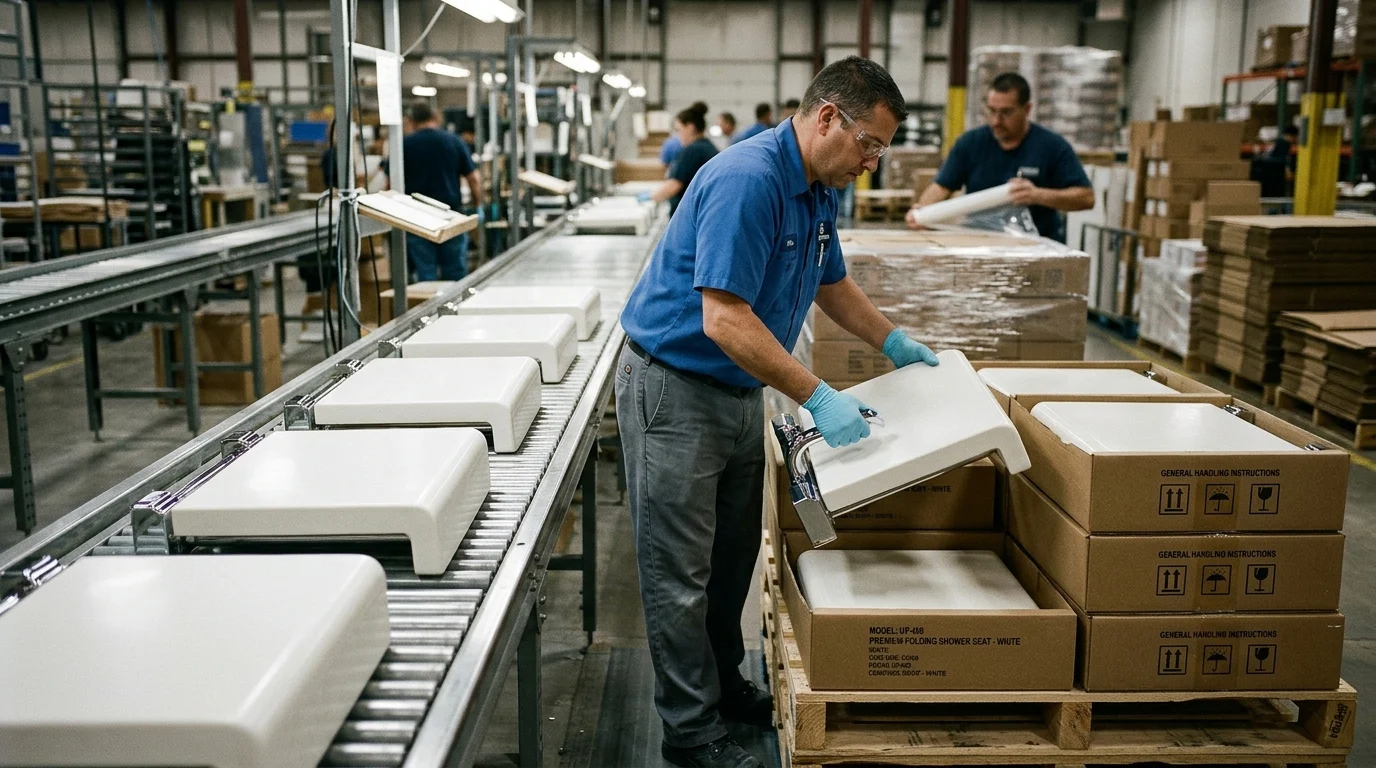
The transition from standard plastics to urea-formaldehyde introduces significant complexities into the manufacturing process. The production of thermoset fixtures demands specialized hydraulic compression molding equipment, rigorous thermal controls, and intensive post-processing. Consequently, the manufacturing ecosystem for UF shower seats is governed by strict quality assurance protocols and comprehensive compliance testing to ensure structural safety and environmental responsibility.
Molding precision, hardware integration, and quality control
Unlike injection-molded thermoplastics, which are rapidly formed in seconds, urea-formaldehyde requires compression molding. Raw UF powder is placed into heated steel molds operating at temperatures between 140°C and 160°C, under immense hydraulic pressure ranging from 150 to 300 tons. This high-pressure curing cycle ensures the material flows into complex geometries while achieving maximum density.
Precision is paramount during this phase, particularly regarding hardware integration. Premium shower seats require the embedding or attachment of heavy-duty 304 or 316 stainless steel hinges and mounting brackets. The dimensional stability of UF allows for exceptionally tight tolerances, ensuring hinges operate smoothly without the binding or loosening that occurs in softer plastics. Top-tier manufacturing facilities maintain defect rates strictly below 0.5%, utilizing automated optical inspection to verify surface flawlessness and hardware alignment.
Standards, emissions, and load performance
Because shower seats are load-bearing safety devices, structural compliance is heavily scrutinized. While standard ADA (Americans with Disabilities Act) guidelines mandate that a shower seat must support a static load of 250 lbs (113 kg), premium urea-formaldehyde seats are routinely engineered and tested to withstand static loads of 400 to 500 lbs (181 to 226 kg) without structural failure or permanent deflection.
In addition to mechanical strength, chemical emissions are strictly regulated. Modern urea-formaldehyde compounds must comply with stringent indoor air quality standards regarding volatile organic compounds (VOCs). Reputable manufacturers ensure their UF formulations meet or exceed E1 or CARB Phase 2 emission standards, guaranteeing that formaldehyde off-gassing remains safely below the 0.05 ppm threshold, ensuring they are safe for enclosed, unventilated bathroom spaces.
Why lifecycle cost can be lower over time
The initial procurement cost of a urea-formaldehyde shower seat is typically 2.5 to 3.5 times higher than that of an entry-level polypropylene equivalent. However, enterprise buyers evaluate fixtures based on Total Cost of Ownership (TCO). When factoring in the labor costs of replacement, the operational downtime of a hotel room or healthcare suite, and the depreciation of aesthetic value, the lifecycle cost narrative shifts dramatically.
Over a standard 10-year commercial renovation cycle, a single UF seat will outlast three consecutive PP seat installations. By eliminating these recurring hardware and labor expenses, the premium urea-formaldehyde fixture ultimately yields a 30% to 40% reduction in TCO, proving that higher upfront capital expenditure drives long-term operational efficiency.
How Buyers Should Source and Specify
Specifying premium shower seats requires a systematic approach to evaluating material data sheets, factory certifications, and hardware durability. Buyers must look beyond subjective aesthetic descriptions and demand empirical testing data to verify that the urea-formaldehyde fixture will perform reliably in highly corrosive, moisture-rich environments.
Key specifications to verify before purchase
Before finalizing a purchase order, specifiers must verify several critical technical thresholds. First, the metallic hardware accompanying the UF seat must be evaluated for corrosion resistance. Buyers should require Neutral Salt Spray (NSS) test documentation, ensuring the stainless steel hinges achieve a minimum of 96 to 120 hours of exposure without exhibiting red rust.
Additionally, ultraviolet resistance must be quantified. Specifiers should request colorfastness testing results, looking for a Grade 4 or Grade 5 rating on the standard grayscale under accelerated UV aging. Finally, load-bearing certifications from independent testing laboratories (such as SGS or TÜV Rheinland) compliant with EN 12520 or equivalent regional seating standards must be provided to mitigate liability risks.
How to assess suppliers and factory capabilities
Assessing the supply chain for urea-formaldehyde fixtures involves auditing factory capabilities. Because UF production is energy-intensive and requires specialized tooling, buyers should verify that the manufacturer holds active ISO 9001 (Quality Management) and ISO 14001 (Environmental Management) certifications. Direct factory audits should focus on the facility’s dust extraction systems and raw material storage, as UF powder is highly sensitive to ambient humidity before molding.
Buyers must also navigate logistical constraints, particularly Minimum Order Quantities (MOQs). Because color-matching thermoset compounds requires custom batch mixing of the raw powder, factories typically enforce MOQs ranging from 300 to 500 units for non-standard colors. Understanding these production realities is essential for aligning procurement schedules with construction timelines.
A decision matrix for selecting the right seat
To streamline the specification process, the following decision matrix outlines how different project parameters dictate the appropriate material selection for shower seating.
Project Environment | Recommended Material | Key Procurement Priority | Target Lifespan | Est. Budget Band (Unit) |
Luxury Hotel & Resort | Urea-Formaldehyde | Aesthetic permanence, high gloss | 10–15 Years | $80 – $150+ |
Healthcare / Bariatric | Reinforced UF or Phenolic | Load capacity, chemical resistance | 10+ Years | $120 – $250+ |
Mid-Scale Commercial | High-Grade ABS | Balance of cost and impact resistance | 5–7 Years | $40 – $75 |
Budget / High-Turnover | Polypropylene (PP) | Lowest initial capital expenditure | 2–4 Years | $15 – $35 |
When Urea-Formaldehyde Is the Better Choice
While urea-formaldehyde represents the apex of shower seat materials in terms of rigidity, hygiene, and aesthetic longevity, it is not a universally applicable solution for every architectural project. Understanding the limitations of thermoset plastics is just as critical as recognizing their advantages, ensuring that specifiers align the material’s physical profile with the practical realities of the installation environment.
When ordinary plastic is still suitable
Ordinary plastics like polypropylene and ABS remain highly relevant in specific use cases. Because urea-formaldehyde is exceptionally hard, it is also comparatively brittle under severe blunt force. In environments prone to extreme vandalism or heavy impact—such as public locker rooms or penitentiaries—the impact strength of UF (typically around 2 to 3 kJ/m²) may be insufficient, making the ductile, shock-absorbing nature of PP or ABS preferable.
Furthermore, standard plastics are the logical choice for ultra-low-budget renovations where immediate capital constraints override long-term lifecycle considerations. If a project requires unit costs to remain strictly under the $15 to $20 threshold, injection-molded polypropylene is the only viable manufacturing method capable of meeting those economic parameters.
What manufacturers and specifiers should consider
For manufacturers and architectural specifiers, the decision to utilize urea-formaldehyde requires balancing premium market positioning against logistical realities.
Key Takeaways
- The most important conclusions and rationale for Premium Shower Seats
- Specs, compliance, and risk checks worth validating before you commit
- Practical next steps and caveats readers can apply immediately
Frequently Asked Questions
Why do premium shower seats use urea-formaldehyde instead of ordinary plastic?
Because UF feels denser, stays rigid, resists yellowing, and holds a polished finish longer than common plastics like PP or ABS.
Does a urea-formaldehyde shower seat last longer in daily use?
Yes. In high-use bathrooms, UF seats can maintain appearance and performance far longer, reducing replacement cycles and upkeep.
Is urea-formaldehyde easier to keep clean?
Yes. Its hard, non-porous surface resists scratches, stains, and soap buildup, so routine wiping is usually enough for regular care.
How does a premium shower seat improve the bathroom look?
It delivers a ceramic-like feel, crisp gloss, and color stability, which suits Cassbern’s modern, elegant bathroom style.
Who benefits most from choosing a premium UF shower seat?
Luxury homes, hotels, and design-focused renovations benefit most because UF supports a refined look, quieter use, and long-term durability.


