

Introduction
High load capacity in premium shower seats is not simply a marketing claim; it reflects deliberate engineering choices that affect user safety, code compliance, and long-term facility liability. In healthcare, hospitality, and other accessible environments, these seats must support a wide range of users while resisting moisture, repeated stress, and mounting failure over time. This article explains how structural design, material selection, reinforcement methods, and testing standards work together to deliver reliable performance above minimum requirements, giving architects, facility managers, and buyers a clearer basis for evaluating which products can truly withstand demanding real-world use.
Why Premium Shower Seats Matter in High-Capacity Accessible Bathrooms
The specification of premium shower seats in high-capacity accessible bathrooms has evolved from a basic compliance checklist item to a critical engineering decision. In environments ranging from bariatric healthcare clinics to luxury hospitality venues, shower seating must accommodate diverse user demographics without compromising structural integrity. Standard accessibility guidelines typically mandate a baseline load capacity, but modern commercial facilities increasingly require fixtures that far exceed these minimums to ensure universal accessibility.
High-capacity shower seats serve as foundational safety infrastructure. When specifiers mandate premium models engineered for elevated weight thresholds—often exceeding 500 lbs (227 kg)—they address both immediate user needs and long-term facility risk management. Understanding the engineering principles behind these fixtures is essential for architects, facility managers, and procurement professionals tasked with outfitting modern accessible spaces.
Risk management and user safety
In commercial healthcare and hospitality environments, the liability associated with structural failure is immense. A single slip-and-fall or equipment collapse claim in a commercial facility can easily exceed $50,000 in direct legal and medical costs, dwarfing the initial procurement savings of utilizing substandard fixtures. Premium shower seats mitigate this risk through engineered redundancy.
By utilizing continuous hinges, reinforced mounting brackets, and load-distributing structural supports, premium seats prevent catastrophic shear failures. This risk management approach is particularly critical in bariatric care, where dynamic loads—the force exerted when a user sits down abruptly—can momentarily double the static weight applied to the fixture. Specifying seats with a minimum 500-lb dynamic load rating provides a necessary safety buffer that protects both vulnerable users and facility operators.

Commercial value of high load capacity
Beyond risk mitigation, high-capacity fixtures offer measurable commercial advantages through extended lifecycle durability. Standard shower seats utilizing basic powder-coated steel and blow-molded plastics often require replacement every 12 to 24 months in high-traffic, wet environments due to hinge fatigue or corrosion. Conversely, premium fixtures engineered with marine-grade materials are designed for a 10- to 15-year operational lifespan.
This extended lifecycle significantly reduces maintenance labor and facility downtime. When a hotel or hospital room must be taken offline to replace a failed shower seat, the lost revenue compounds the replacement cost. Investing in premium high-capacity seats effectively lowers the total cost of ownership while elevating the perceived quality of the facility, providing a tangible return on investment that justifies the higher initial specification costs.
What Defines High Load Capacity in Premium Shower Seats
High load capacity is not merely a function of thicker materials; it is the result of holistic mechanical engineering designed to manage and distribute complex forces. While standard ADA compliance requires a shower seat to withstand a static load of 250 lbs, premium models are engineered to support static loads ranging from 400 to over 900 lbs. Achieving these thresholds requires precision in structural geometry, material selection, and hinge mechanics.
Engineering factors behind load performance
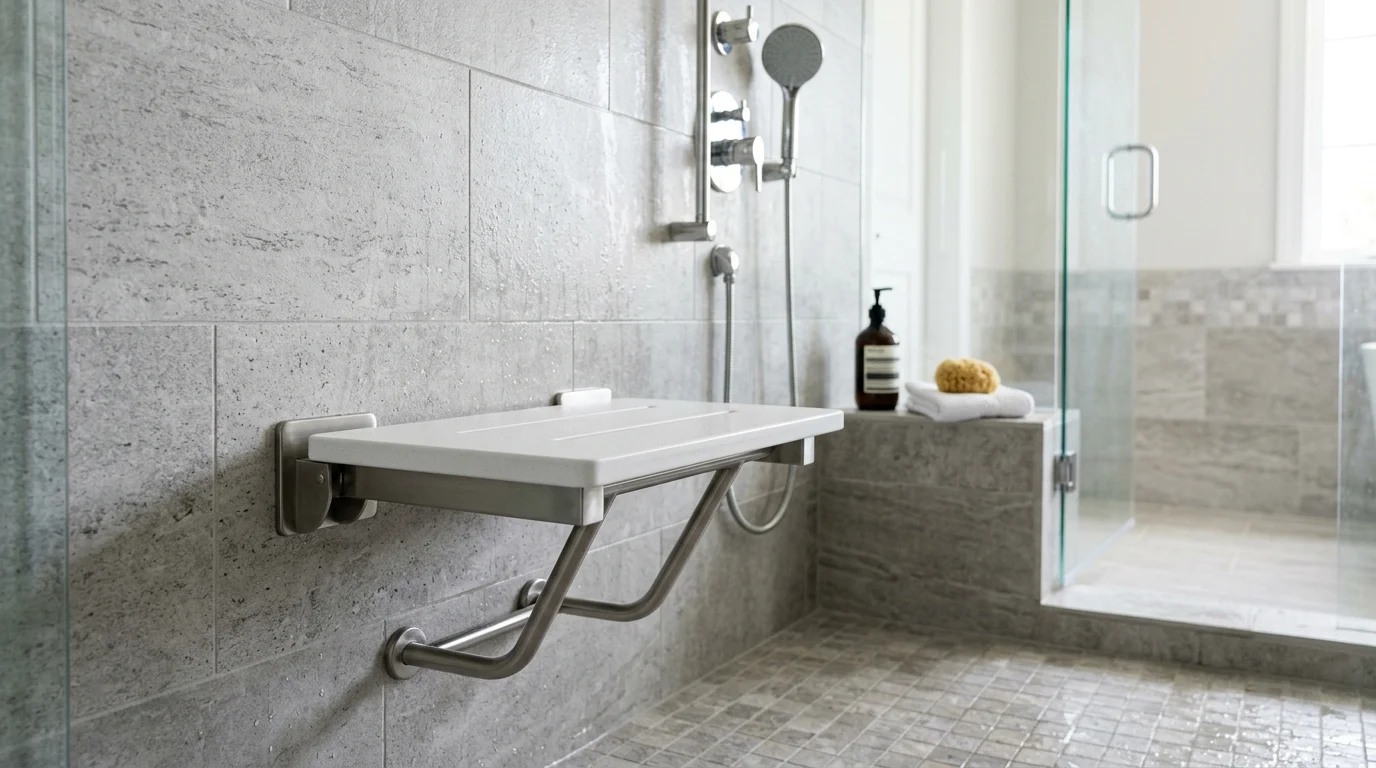
The primary engineering challenge in wall-mounted shower seats is managing shear and pull-out forces at the mounting points. Premium models utilize gusseted support arms and U-shaped mounting flanges that distribute downward kinetic energy across a larger surface area of the wall structure. Instead of relying on a single pivot point, high-capacity seats often feature piano hinges or multi-point articulated joints that prevent torsional twisting when uneven weight is applied.
Furthermore, the integration of deployable support legs transfers a significant portion of the load directly to the floor. For capacities exceeding 600 lbs, floor-supported designs are often engineered with micro-adjustable leveling feet to ensure even weight distribution despite the slope of a standard shower pan, preventing undue stress on the wall anchors.
Materials and corrosion resistance
Corrosion resistance is inseparable from load capacity in wet environments; a rusted structural component will rapidly lose its tensile strength. Premium high-capacity seats predominantly utilize Type 304 or Type 316L stainless steel for all structural frames and fasteners. Type 316L, enriched with molybdenum, offers superior resistance to chloride-induced pitting, making it essential for facilities using harsh hospital-grade disinfectants.
For the seating surface, premium models eschew hollow plastics in favor of solid phenolic core panels, extruded aluminum, or high-density polyurethane. Phenolic surfaces are particularly advantageous; they are non-porous, highly resistant to bacterial growth, and possess exceptional flexural strength, capable of passing 1,000-hour salt spray tests without structural or aesthetic degradation.
How premium models compare
To clearly illustrate the structural divergence between baseline commercial models and premium high-capacity seating, the following comparison highlights key engineering specifications:
Specification Metric | Standard Commercial Seat | Premium High-Capacity Seat |
Static Load Rating | 250 lbs (113 kg) | 500–900 lbs (226–408 kg) |
Frame Material | Powder-coated carbon steel | Type 304 / 316L Stainless Steel |
Seat Material | Blow-molded HDPE | Solid Phenolic / Teak / Polyurethane |
Hinge Mechanism | Dual pivot pins | Continuous stainless piano hinge |
Corrosion Warranty | 1–3 Years | 10+ Years |
This comparative data underscores why specifiers must look beyond basic ADA compliance when outfitting facilities expected to handle high-traffic or bariatric populations.
How Safety and Compliance Are Verified
Verifying the safety and load capacity of premium shower seats requires rigorous, standardized testing protocols. Manufacturers of premium fixtures do not rely on theoretical material strength; they subject their products to exhaustive laboratory testing to provide specifiers with certified documentation of performance under extreme conditions.
Codes standards and required documentation
In the United States, the Americans with Disabilities Act Accessibility Guidelines (ADAAG) Chapter 6 sets the baseline, mandating that shower seats and their mounting hardware withstand a minimum stress of 250 lbs. However, premium international manufacturers often test to more stringent global standards, such as ISO 17966 for assistive products for personal hygiene. ISO 17966 requires that products be tested to 1.5 times their stated maximum user weight.
Specifiers should demand independent laboratory reports from recognized testing bodies (such as SGS, TÜV, or UL) rather than accepting self-certified manufacturer claims. Required documentation for premium hospital or commercial projects typically includes certificates of compliance for static load, dynamic impact, and material composition, ensuring the product meets the exact specifications detailed in the architectural plans.
Static dynamic and fatigue testing
Physical verification involves three distinct testing phases: static, dynamic, and fatigue. Static testing involves applying a continuous, non-moving weight to the seat for a sustained period. For a premium seat rated at 600 lbs, a static test might apply 900 lbs of dead weight for 60 seconds to ensure no permanent deflection or bracket failure occurs.
Dynamic testing simulates real-world usage, such as a heavy user dropping heavily onto the seat. This is often executed via a drop test, where a heavy sandbag is dropped from a specified height onto the center and edges of the seat to test shear strength and hinge resilience. Finally, fatigue testing utilizes pneumatic actuators to repeatedly fold and unfold the seat—often up to 100,000 cycles—verifying that the friction hinges and locking mechanisms will not degrade over a decade of continuous commercial use.
Specification Installation and Procurement Best Practices
Even the most robustly engineered shower seat will fail if specified for the wrong application or installed without adequate structural support. Procurement and installation are critical phases where the theoretical load capacity of a premium seat is translated into actual user safety.
Matching products to project requirements
Matching the product to the project requires a thorough understanding of the facility’s target demographic. For standard luxury hospitality, a wall-mounted premium seat rated for 400 lbs with concealed hardware and high-end aesthetic finishes (such as matte black or brushed brass) provides the necessary balance of design and durability.
Conversely, for bariatric healthcare wards or specialized rehabilitation centers, specifiers must mandate seats rated for 800 lbs or more. These specific applications almost always require models with deployable floor-support legs and oversized seating areas to accommodate larger physical profiles comfortably and safely.
Installation steps that reduce failure risk
The critical point of failure for most wall-mounted accessible seating is not the seat itself, but the wall substrate. To achieve a 500+ lb load capacity, the installation must utilize in-wall backing. Best practices dictate the installation of 2×6 or 2×8 solid wood blocking, or minimum 16-gauge steel backing plates, secured directly to the structural studs before the finished wall is applied.
Fastener selection is equally vital. Installers must use heavy-duty stainless steel lag screws or toggle bolts (if retrofitting into engineered hollow walls with structural plates) capable of exceeding 1,000 lbs of pull-out force per bolt. Waterproofing the penetration points with marine-grade silicone ensures that moisture cannot compromise the wall substrate over time, which would otherwise weaken the anchor points and risk catastrophic failure.
Evaluating total cost of ownership
Procurement teams often face pressure to value-engineer accessible fixtures, but evaluating the Total Cost of Ownership (TCO) over a 10-year facility lifecycle strongly favors premium high-capacity models. The following table illustrates a standard 10-year TCO projection for a high-traffic commercial bathroom:
Cost Factor | Standard Commercial Seat | Premium High-Capacity Seat |
Initial Unit Cost | $150.00 | $650.00 |
Initial Installation Labor | $100.00 | $150.00 |
Replacements Required (10 Yrs) | 4 | 0 |
Replacement Labor & Parts | $1,000.00 | $0.00 |
Total 10-Year TCO | $1,250.00 | $800.00 |
By factoring in the labor costs of repeated replacements and the operational disruption of taking a bathroom out of service, the premium fixture proves to be highly cost-effective, saving facilities hundreds of dollars per unit over a decade while providing superior safety.
How Buyers and Specifiers Should Choose
Navigating the market of premium accessible bathroom fixtures requires a discerning approach. Buyers and specifiers must cut through marketing terminology to assess true engineering value, ensuring the final selection meets rigorous safety standards while aligning with the architectural vision of the space.
How to assess weight capacity claims
When assessing weight capacity claims, specifiers must distinguish between a ‘static load limit’ and a ‘safe working load’ (SWL). Marketing materials often tout the static limit—the point of absolute failure—but the SWL is the crucial metric for human use. A premium seat claiming an 800-lb capacity should have an SWL that accounts for dynamic force multipliers.
Buyers should formally request the technical data sheets (TDS) and independent lab certifications before approval. If a manufacturer cannot provide a multi-point testing certificate detailing shear force resistance and hinge cycle lifespans, the stated weight capacity should be treated as an estimate rather than an engineered guarantee.
Balancing compliance aesthetics and user dignity
Historically, high-capacity bariatric and accessible fixtures suffered from a heavily clinical, institutional aesthetic. Today, specifiers do not have to compromise user dignity or interior design to achieve high load ratings. Premium manufacturers now utilize advanced PVD (Physical Vapor Deposition) coatings to offer finishes like brushed nickel, bronze, and matte black that resist harsh cleaning chemicals.
By selecting seats with slim-profile folding mechanisms, concealed mounting flanges, and warm-touch phenolic surfaces that mimic teak or slate, facilities can provide maximum safety in a discreet, luxurious package. Ultimately, choosing the right premium shower seat is about harmonizing uncompromising structural engineering with an inclusive design philosophy that respects every user.
Key Takeaways
- The most important conclusions and rationale for Premium Shower Seats
- Specs, compliance, and risk checks worth validating before you commit
- Practical next steps and caveats readers can apply immediately
Frequently Asked Questions
What load capacity should a premium shower seat have?
A premium shower seat typically starts from around 440 lbs (200 kg) for standard high-quality models. For residential, hospitality, and general accessible use, this level already provides a strong safety margin when properly installed.
For higher-risk environments such as healthcare or bariatric use, project specifiers may select higher-rated or reinforced models depending on user requirements and local regulations.
Why does material choice matter for shower seat safety?
Wet environments can weaken low-grade metals fast. Premium seats using 304 or 316L stainless steel and solid seat panels resist corrosion, maintain strength, and last longer.
Are wall-mounted shower seats safe for high-capacity use?
Yes, if they use reinforced brackets, multi-point hinges, and proper blocking or structural anchors. For very high capacities, floor-supported designs can further reduce wall stress.
How does a premium shower seat fit Cassbern’s bathroom design approach?
Cassbern focuses on elegant, practical bathroom solutions. A premium shower seat supports accessibility while keeping a clean, modern look that matches stylish, functional shower spaces.
What installation detail matters most for load performance?
Secure mounting into solid wall backing or studs is critical. Even a high-capacity seat can underperform if anchors, spacing, or floor leveling are not installed to spec.


