


Introduction
A folding wall mounted shower seat does more than add convenience to a bathroom. It improves safety, supports accessibility, saves space, and helps a shower work better for users with changing mobility needs. For homeowners, designers, and facility managers, it can also be a practical way to balance universal design requirements with a clean, modern layout. This article highlights five key benefits of installing one, showing how the right seat can enhance comfort, reduce risk, and make a bathroom more adaptable for daily use without overwhelming the space.
Why Folding Wall Mounted Shower Seats Are in Demand
The specification of specialized bathroom fixtures has evolved significantly from purely clinical applications to mainstream architectural design. As architects, builders, and facility managers prioritize universally accessible environments, the integration of folding wall mounted shower seats has transitioned from an optional upgrade to a foundational design requirement.
Market data indicates a compounding annual growth rate in inclusive plumbing fixtures, driven by both demographic shifts and updated regulatory frameworks. These fixtures provide critical support infrastructure while maintaining the aesthetic integrity of modern, minimalist shower enclosures.
Accessibility and aging-in-place trends
Demographic shifts dictate new architectural and interior design standards. With global populations over the age of 60 projected to reach 2.1 billion by 2050, the aging-in-place market is fundamentally reshaping residential construction. Homeowners and developers are proactively outfitting properties with fixtures that accommodate changing mobility needs without sacrificing visual appeal.
Folding wall mounted shower seats offer a discreet solution to this demand. Unlike bulky medical-grade equipment, modern seats are engineered to blend seamlessly with contemporary tile and stone finishes. By installing these fixtures during initial construction or major renovations, property owners increase the functional lifespan of the dwelling, allowing occupants to remain safely in their homes for an average of 5 to 10 additional years compared to those living in non-adapted environments.
Best-fit residential and commercial projects
In the commercial sector, particularly within hospitality and healthcare, the deployment of folding shower seats is largely driven by compliance and risk mitigation. For instance, the Americans with Disabilities Act (ADA) mandates that hotels allocate between 2% and 5% of their total room inventory as fully accessible, which strictly requires compliant seating in roll-in showers.
Beyond hospitality, multi-family residential developers and assisted living facilities utilize these seats to standardize unit layouts. A single, well-specified folding seat allows a bathroom to serve a wide spectrum of tenants, from young professionals seeking spa-like amenities to elderly residents requiring mobility support, thereby maximizing occupancy rates and accelerating return on investment.
What a Folding Wall Mounted Shower Seat Is
A folding wall mounted shower seat is an engineered hardware fixture anchored directly to the structural framing of a shower enclosure. It features a hinged mechanism that allows the sitting surface to be lowered for use and folded flat against the wall when not required, optimizing spatial efficiency in wet environments.
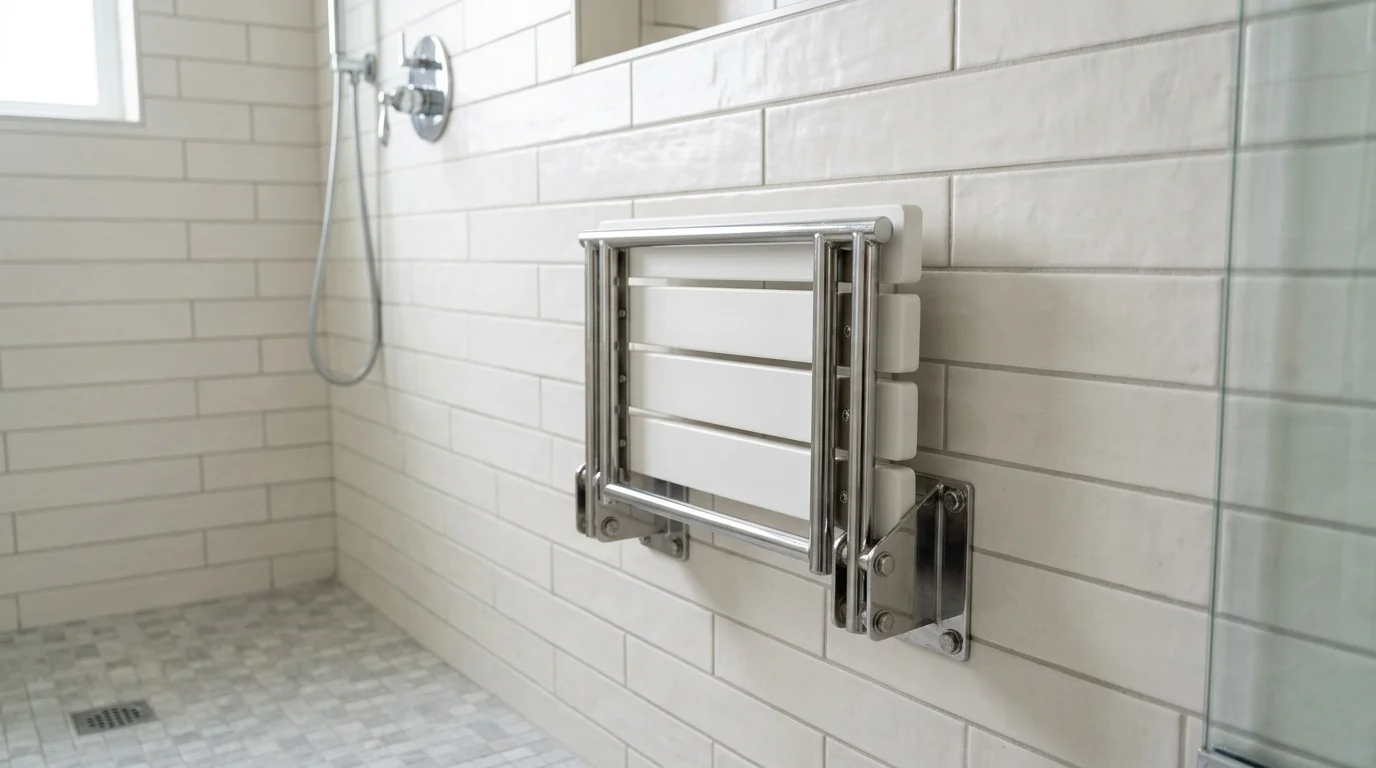
Key types, materials, and load capacity
The structural integrity and longevity of a shower seat depend heavily on its material composition and underlying mechanics. Frames are predominantly manufactured from heavy-duty metals, with Type 304 and Type 316 stainless steel being the industry standards due to their exceptional corrosion resistance. Seat tops are typically crafted from moisture-impervious materials such as phenolic resin, high-density polyethylene (HDPE), or naturally water-resistant woods like Burmese teak.
Load capacity is a critical specification metric. While standard residential models are rated for a dynamic load of 250 lbs, commercial and bariatric models utilize reinforced mounting brackets and thicker gauge steel to support weights ranging from 500 lbs to over 900 lbs.
Material Type | Typical Load Capacity | Moisture Resistance | Best Application Profile |
Phenolic Resin | 250 – 500 lbs | Ultimate (Non-porous) | High-traffic commercial, healthcare |
Teak Wood | 250 – 400 lbs | High (Requires sealing) | Luxury residential, boutique hospitality |
HDPE Plastic | 250 – 350 lbs | Excellent | Cost-effective residential, multi-family |
316 Stainless Steel | 500 – 900+ lbs | Ultimate (Rust-proof) | Bariatric care, institutional facilities |
Compliance and safety standards
Regulatory compliance ensures that folding shower seats meet stringent safety thresholds. In the United States, ADA Accessibility Guidelines (ADAAG) Section 4.21.3 dictates precise dimensional and installation criteria. For example, a compliant seat must be mounted so that the top of the seating surface is between 17 and 19 inches above the finished bathroom floor.
Furthermore, the seat must be capable of withstanding a vertical or horizontal force of 250 lbs applied at any point on the seat, fastener, or mounting device. International standards, such as ISO 10535, impose similar structural testing protocols, ensuring the hinged mechanisms do not suffer from metal fatigue even after 10,000 continuous folding cycles.
Benefits of Installing a Folding Wall Mounted Shower Seat
The integration of folding wall mounted shower seats yields compounded advantages that extend beyond basic utility. For specifiers and end-users alike, these fixtures optimize the physical footprint of the bathroom while simultaneously elevating safety, comfort, and property value.
Space saving, comfort, and accessibility
Spatial efficiency is perhaps the most immediate architectural benefit. In urban residential projects where bathroom square footage is at a premium, a folded seat protrudes a mere 1.5 to 3 inches from the wall. This ultra-slim profile preserves the critical turning radius—which must be a minimum of 60 inches to meet ADA wheelchair clearance standards—allowing the shower to feel expansive when the seat is not in use.
Comfort and accessibility are dramatically enhanced by providing a stable, ergonomic resting place. For individuals with limited stamina, postural instability, or respiratory issues, the ability to sit during a shower transforms a potentially exhausting daily task into a safe, restorative experience. The wall-mounted design eliminates the micro-shifts and wobbling commonly associated with temporary seating, offering rigid, unwavering support.
Safety, hygiene, and long-term value
Fall prevention is a dominant driver for these installations. According to epidemiological data, slip-and-fall incidents account for over 230,000 non-fatal bathroom injuries annually in the United States alone. A permanently anchored seat mitigates this risk by providing a reliable transfer point that cannot slide on wet tile.
From a hygiene perspective, modern folding seats are vastly superior to built-in tiled benches. Tiled benches feature porous grout lines that harbor mold and mildew, whereas phenolic or slatted teak seats feature drainage slots engineered to clear water at a rate exceeding 5 gallons per minute (GPM). This rapid drainage prevents bacterial buildup and simplifies janitorial maintenance. Consequently, the long-term value of the property is preserved, as the shower enclosure remains hygienic and structurally sound without the need for frequent grout remediation.
Folding Shower Seat vs Other Shower Seating Options
Evaluating shower seating requires a comparative analysis of structural impact, spatial consumption, and lifecycle costs. Specifiers must weigh the advantages of folding wall mounted shower seats against alternative options, primarily freestanding shower stools and permanent built-in masonry benches.
Footprint, storage, and usability comparison
Freestanding stools offer immediate, zero-installation utility but consume a permanent footprint of 15 to 20 inches square of floor space. They present a constant tripping hazard, particularly for visually impaired or mobility-restricted users. Built-in tiled benches, while aesthetically cohesive, consume massive volumetric space—often measuring 12 by 24 by 18 inches—permanently reducing the usable standing area of the shower.
In contrast, folding seats provide on-demand utility. When deployed, they match the functional surface area of a built-in bench, but when retracted, they restore nearly 100% of the shower’s footprint.
Seating Type | Spatial Efficiency | Installation Complexity | Typical Weight Limit | Estimated Cost Range (USD) |
Freestanding Stool | Low (Permanent footprint) | None (Out of box) | 200 – 300 lbs | $30 – $150 |
Built-in Tiled Bench | Lowest (Consumes volume) | High (Masonry/Waterproofing) | 500+ lbs | $500 – $1,500+ |
Folding Wall Seat | Highest (Retracts flat) | Moderate (Requires blocking) | 250 – 900 lbs | $150 – $800 |
Key trade-offs to consider
The primary trade-off when selecting a folding wall mounted shower seat lies in the installation phase. Unlike freestanding stools that require no setup, a wall-mounted unit demands structural reinforcement behind the wall. Retrofitting a folding seat into an existing shower without proper backing often necessitates removing tile and re-waterproofing, which can escalate project costs by $600 to $1,200.
Built-in benches also carry significant thermal trade-offs. Masonry and tile act as a thermal mass, frequently remaining cold to the touch and drawing body heat away from the user. Folding seats utilizing phenolic or wood surfaces maintain a neutral temperature, significantly enhancing user comfort. Ultimately, the folding seat represents the optimal middle ground: it requires a moderate initial investment in structural blocking but delivers superior long-term spatial and ergonomic yields.
How to Specify and Choose the Right Folding Shower Seat
Proper specification bridges the gap between ergonomic design and structural integrity. Selecting the correct folding wall mounted shower seat requires a rigorous assessment of the wall assembly, the intended user demographic, and the specific environmental conditions of the wet room.
Wall support and installation requirements
The most critical failure point of any wall-mounted fixture is inadequate anchoring. A folding shower seat cannot be installed using standard drywall anchors or toggle bolts. The architectural specification must mandate in-wall blocking—typically 2×6 or 2×8 nominal lumber, or heavy-gauge steel plates—installed flush between the wall studs prior to the application of cement board and waterproofing membranes.
Fasteners must be driven directly into this blocking to achieve the required shear strength. Engineering standards dictate that the anchoring system must withstand a minimum of 1,000 lbs of pull-out force to safely accommodate the dynamic load of a user sitting down heavily. In commercial concrete applications, specialized masonry anchors or epoxy-set threaded rods are required to achieve this structural threshold.
Selection criteria for buyers and specifiers
For buyers and specifiers, the selection matrix should prioritize hardware grade, surface material, and warranty coverage. In environments subject to hard water or high salinity (such as coastal properties), upgrading the frame to Type 316 marine-grade stainless steel is a mathematical necessity to prevent oxidation, despite a 15% to 20% premium in upfront cost.
Commercial specifiers should also verify that the product carries a robust commercial warranty, typically ranging from 1 to 5 years, and that it ships with ADA-compliant documentation for inspection purposes. By strictly aligning the seat’s load rating, material composition, and blocking requirements with the project’s parameters, developers ensure a safe, compliant, and durable installation that serves the facility’s lifecycle.
Key Takeaways
- The most important conclusions and rationale for folding wall mounted shower seat
- Specs, compliance, and risk checks worth validating before you commit
- Practical next steps and caveats readers can apply immediately
Frequently Asked Questions
What is the main benefit of a folding wall mounted shower seat?
It adds seated shower support for safer bathing while folding flat to keep a modern shower open and uncluttered.
Who should consider installing a folding wall mounted shower seat?
It’s ideal for aging-in-place homeowners, people with limited mobility, families planning ahead, and hotels or multi-family projects needing accessible bathrooms.
How much weight can a folding wall mounted shower seat support?
Many residential models support around 250 lbs, while reinforced commercial options can handle 500 lbs or more. Always verify the product rating before purchase.
What materials are best for a folding wall mounted shower seat?
Stainless steel frames with phenolic, HDPE, or teak seats are popular. For Cassbern-style bathrooms, stainless steel offers a sleek look, durability, and strong moisture resistance.
Does a folding wall mounted shower seat need professional installation?
Yes. It should be anchored into proper wall framing and mounted at the correct height for safety, performance, and code compliance where required.


