

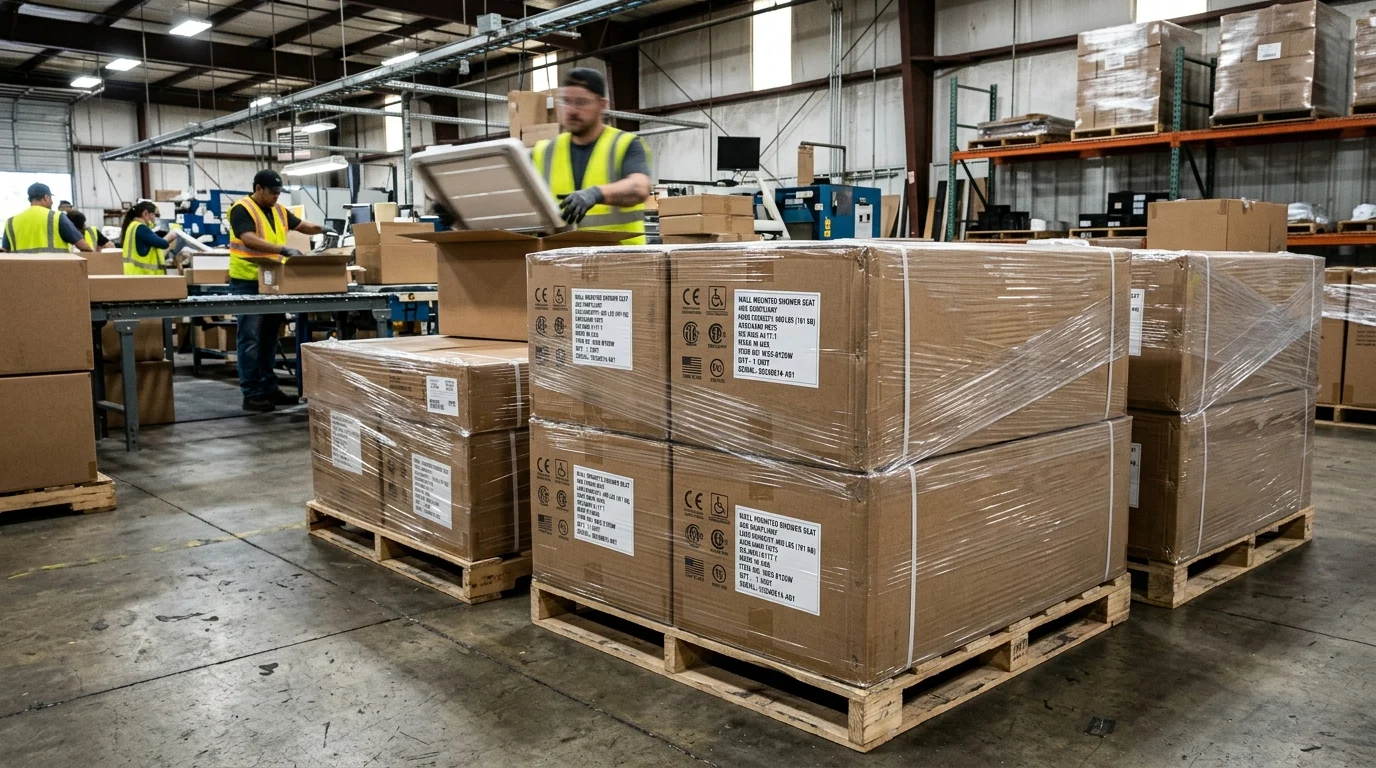
In commercial bathrooms, a wall-mounted shower seat is more than a convenience feature—it is a safety-critical specification with direct implications for accessibility, liability, and lifecycle cost. For B2B buyers serving healthcare, hospitality, senior living, or multifamily projects, the right product must combine verified load performance, compliant installation parameters, durable materials, and dependable documentation. This article explains how to evaluate certifications, distinguish self-declared compliance from independent testing, and identify the records procurement teams should request before purchase. With a design-conscious approach aligned with Cassbern’s focus on modern, functional bathroom solutions, buyers can support both user safety and a refined shower experience.
Why Certifications Matter for B2B Wall Mounted Shower Seats
In sectors such as healthcare, hospitality, and senior living, wall-mounted shower seats are classified as critical safety equipment rather than mere bathroom accessories. Consequently, comprehensive certifications serve as the fundamental baseline for any business-to-business (B2B) purchasing agreement, ensuring products meet rigorous operational demands.
How certifications reduce commercial risk
Commercial risk mitigation is the primary driver for mandating strict certification standards. When a wall-mounted shower seat fails under load, the resulting injuries can lead to severe litigation, facility downtime, and reputational damage. In the United States, premises liability claims involving equipment failure in care facilities frequently result in substantial settlements, far outweighing the initial capital expenditure of compliant hardware.
Certified products provide a documented chain of custody regarding structural integrity and material safety. By procuring seats that have undergone independent third-party testing, institutional buyers help mitigate risk, though they ultimately retain premises liability. Effective indemnification depends on specific contract terms, local jurisdiction, and strict adherence to installation guidelines. This documentation is also frequently required by commercial insurance underwriters to maintain favorable premium rates.
What buyers should distinguish from basic compliance
Procurement professionals must differentiate between basic regulatory compliance and comprehensive third-party certification. Basic compliance often relies on a manufacturer’s self-declaration, such as certain CE markings. While self-declared CE marking is legally valid for many products under the EU Construction Products Regulation (CPR), it is important to note that most wall-mounted shower seats are not automatically classified as Class I devices under the Medical Device Regulation (MDR) unless explicitly marketed as medical assistive products. Self-declaration simply states that the product meets general safety directives without mandating independent oversight.
In contrast, genuine certification involves independent laboratories—such as TÜV SÜD, UL, or SGS—conducting destructive and non-destructive testing on product samples. These facilities verify that the production batches consistently meet specific thresholds. For high-traffic commercial applications, B2B buyers should target supply chains where verified third-party testing correlates with significantly lower defect rates, whereas reliance solely on self-declared compliance can expose buyers to higher, unpredictable failure rates.
Key Standards and Certification Requirements
Navigating the complex landscape of accessibility standards is essential for B2B buyers sourcing wall-mounted shower seats. Regulatory frameworks dictate specific dimensions, load-bearing capacities, and installation parameters that must be met to achieve legal compliance in various global markets.
ADA compliance requirements for wall mounted shower seats
The Americans with Disabilities Act (ADA) establishes the definitive dimensional framework for accessibility fixtures in the United States, mandating that wall-mounted shower seats be installed at a height of 17 to 19 inches from the finished floor to the top of the seat. However, the structural requirement that a seat must withstand a minimum static load of 250 pounds is typically governed by structural standards such as ANSI/ICC A117.1. This force must be safely supported at any point on the seat, fastener, mounting device, or supporting structure.
Beyond static load and height, accessibility guidelines specify the shape and clearance of the seat. L-shaped and rectangular designs must adhere to strict dimensional tolerances, ensuring adequate transfer space for wheelchair users. Procurement teams must verify that manufacturers provide explicit compliance documentation, as non-compliant installations in public accommodations can trigger federal investigations and substantial financial penalties.
Regional accessibility codes and safety standards
International procurement requires familiarity with regional accessibility codes. In Europe, the Medical Device Regulation (MDR) may apply to assistive products, though its applicability to wall-mounted shower seats depends heavily on the manufacturer’s intended use and specific member-state interpretations. When applicable, buyers should look for compliance with standards like ISO 17966, which specifies requirements and test methods for personal hygiene assistive products. In the United Kingdom, UKCA marking has superseded CE marking for localized compliance.
Australia enforces the AS 1428.1 standard, which features stringent load testing requirements. Under AS 1428.1, shower seats and their mounting hardware must withstand high force resistance, with some commercial specifications for heavy-duty applications requiring tests up to 380 kg (approximately 837 lbs) to ensure absolute safety under dynamic loads. Buyers sourcing for multinational portfolios must cross-reference these regional requirements to ensure a uniform standard of safety across all properties.
Load rating and performance comparison criteria
Load rating criteria represent the most critical performance metric for shower seats. Testing protocols evaluate both static load—the maximum weight the seat can hold while stationary—and dynamic load, which simulates the impact force of a user dropping onto the seat.
A comprehensive evaluation requires analyzing how different standards assess these loads. Buyers should demand test reports that clarify whether the stated capacity includes an engineered safety factor, typically 1.5 to 2 times the rated load.
Standard / Region | Minimum Static Load | Height Requirement | Key Focus Area |
ANSI/ICC A117.1 (USA) | 250 lbs (113 kg) | 17″ – 19″ (ADA) | Public accommodation clearance |
AS 1428.1 (Australia) | Up to 380 kg (837 lbs) in heavy-duty specs | 470mm – 480mm | High force resistance |
ISO 17966 (Global) | Variable by class | Ergonomic range | Personal hygiene assistive safety |
CSA B651 (Canada) | 1.33 kN (approx 300 lbs) | 430mm – 480mm | Barrier-free design |
How Certifications Affect Product Design
Certification standards directly dictate the engineering and materials used to manufacture wall-mounted shower seats. To meet rigorous testing criteria, manufacturers must engineer products with specific tolerances, structural reinforcements, and specialized finishes.
Load capacity, folding mechanisms, and mounting hardware
Achieving high load capacities necessitates robust folding mechanisms and mounting hardware. The structural integrity of a wall-mounted seat relies heavily on the shear strength of its brackets and hinges. Certified commercial seats typically utilize 304 or 316-grade stainless steel for all load-bearing components, ensuring resistance to both mechanical stress and corrosive bathroom environments.
The mounting interface is equally critical. Certification testing often requires a minimum of a 6-point mounting bracket system to distribute the load evenly across the wall structure. Crucially, any load-bearing certification is rendered irrelevant without adequate wall infrastructure. Proper installation requires structural stud blocking, heavy-duty backing plates, or load-rated wall construction to safely anchor the mounting hardware. Folding mechanisms must also feature friction hinges or dampeners that prevent the seat from dropping rapidly, a requirement in many safety certifications to prevent pinch hazards and blunt force injuries.
Materials and finishes for hygiene and durability
Material selection is heavily influenced by hygiene and durability standards. Commercial shower environments require surfaces that resist microbial growth and withstand aggressive chemical cleaning agents. Certifications such as ASTM G21 for fungal resistance and ISO 22196 for antibacterial activity are standard benchmarks for premium shower seats.
Seat surfaces are commonly manufactured from phenolic resin, high-density polyethylene (HDPE), or solid surface materials. Phenolic resin is highly favored in certified products due to its non-porous nature, impact resistance, and Class A fire rating. Finishes on metal components must pass salt spray testing (e.g., ASTM B117) for extended durations to prove long-term viability in high-humidity zones.
Standard, bariatric, phenolic, and padded seat options
The market offers distinct seat variations engineered to meet different certification tiers. Standard commercial seats are typically rated for 250 to 300 lbs and utilize HDPE or slotted phenolic tops for water drainage. Bariatric options, however, must meet significantly higher thresholds, often requiring load certifications between 500 and 1,000 lbs, necessitating reinforced heavy-gauge tubular frames. Realizing these certified capacities requires reinforced wall structures or supplementary floor supports, as standard drywall backing will fail under bariatric loads.
Padded seats introduce additional compliance layers regarding material toxicity and water ingress. The polyurethane foam used in padded variants must be closed-cell to prevent water absorption and must comply with flammability standards such as CAL 117.
Seat Type / Material | Typical Load Capacity | Antimicrobial Standard | Cost Premium (vs. Basic) |
Standard HDPE | 250 – 300 lbs | General non-porous | Baseline |
Solid Phenolic | 300 – 400 lbs | ASTM G21 compliant | Moderate Premium |
Padded Polyurethane | 250 – 300 lbs | ISO 22196 | Significant Premium |
Bariatric Stainless | 500 – 1000 lbs | Hospital-grade | High Premium |
How B2B Buyers Should Verify Certification Claims
Claiming compliance is straightforward, but verifying it requires a structured procurement protocol. B2B buyers must implement stringent vetting processes to ensure that the wall-mounted shower seats they purchase genuinely meet the advertised safety and quality standards.
Documents procurement teams should request
Procurement teams must request a specific suite of documents before onboarding a new supplier. The foundational document is the ISO 9001:2015 certification for the manufacturer’s facility, which guarantees a standardized quality management system. However, facility certification does not equate to product certification.
Buyers must demand full Test Reports generated by independent laboratories, explicitly detailing the testing methodology, the applied loads, and the specific standards evaluated. Additionally, a formal Declaration of Conformity (DoC) signed by an authorized compliance officer at the manufacturing firm should be secured, legally binding the supplier to the stated specifications.
How to assess laboratory and testing credibility
The credibility of the testing laboratory is as important as the test results themselves. Procurement professionals should verify that the laboratory issuing the test report is an ILAC-MRA signatory or holds ISO/IEC 17025 accreditation. This accreditation ensures the lab operates with technical competence and impartial testing methodologies.
A common pitfall in global sourcing is the presentation of test reports from unaccredited, internal manufacturer labs or the use of expired certificates. Buyers must check the date of issuance; older test reports may not reflect current production materials or updated regulatory standards. Furthermore, the product model numbers on the test report must precisely match the SKUs being procured.
Verification steps to include in RFQs
To streamline the vetting process, verification steps must be embedded directly into the Request for Quotation (RFQ). The RFQ should explicitly list the mandatory certifications and require that proof of compliance be submitted alongside the initial pricing bid. This filters out non-compliant vendors early in the sourcing cycle.
Buyers should also specify conditions regarding custom production runs. If a buyer requires a unique design to meet a specific regional standard, the RFQ must outline who bears the cost of the new certification testing. Custom certification runs typically require higher Minimum Order Quantities (MOQs) to offset the substantial laboratory fees associated with comprehensive third-party testing.
How to Make the Final Procurement Decision
The final procurement decision for wall-mounted shower seats requires balancing empirical certification data against commercial constraints. Facility managers and purchasing directors must align safety mandates with budgetary realities and project timelines.
Decision criteria for certification evidence and price
When evaluating competing bids, the decision matrix must heavily weight certification evidence alongside price. Fully certified commercial shower seats typically command a notable price premium over unverified alternatives. However, this initial capital expenditure is offset by a significantly lower total cost of ownership.
Calculations should factor in the extended lifespan of certified units, which are engineered to withstand rigorous daily use. A certified phenolic and stainless steel seat will offer a significantly longer operational life in a high-traffic hotel or hospital environment, whereas a lower-cost, uncertified plastic alternative may require replacement prematurely due to hinge failure or material degradation.
Contract clauses that protect against non-compliance
Procurement contracts must contain robust clauses to protect the buyer against post-purchase compliance failures. Indemnification clauses are critical, legally requiring the supplier to cover damages and legal fees if a product fails due to manufacturing defects or false certification claims.
Additionally, contracts should stipulate stringent warranty terms and quality inspection protocols. A standard commercial warranty for a certified shower seat should span several years. Buyers should also mandate pre-shipment inspections using the Acceptable Quality Limit (AQL) standard, typically setting strict thresholds such as AQL 1.5 for major defects and 4.0 for minor defects, ensuring that the mass-produced units match the certified prototype.
Balancing compliance certainty, cost, and lead time
Balancing compliance certainty with cost and lead time is the final hurdle in the procurement cycle. Fully certified products, particularly those requiring specialized bariatric load ratings or custom hospital-grade finishes, often involve extended manufacturing and quality assurance lead times.
In contrast, off-the-shelf uncertified units might be available with much shorter lead times. Procurement teams must forecast their project schedules accurately, allowing sufficient runway for the production and delivery of compliant products. Rushing procurement often leads to compromises on certification validation, a risk that institutional buyers cannot afford to take when outfitting high-liability environments like healthcare and assisted living facilities.
In summary, successful procurement of wall-mounted shower seats relies on a rigorous approach to certification verification. By demanding accredited third-party test reports, understanding regional standards like ANSI/ICC A117.1 and ISO 17966, and embedding compliance checks into RFQs and contracts, B2B buyers can effectively balance cost, lead times, and critical safety mandates.
Key Takeaways
- Treat wall-mounted shower seats as critical safety equipment in healthcare, hospitality, senior living, and other high-use commercial environments.
- Request independent third-party testing from recognized laboratories instead of relying only on manufacturer self-declarations for high-risk projects.
- Verify ADA installation requirements early, including the 17-to-19-inch finished-floor height for shower seats in applicable U.S. projects.
- Include certification files, load-test reports, installation instructions, and material documentation in every B2B procurement review.
- Assess liability exposure by confirming that the specified seat, wall substrate, anchors, and installation method all match the manufacturer’s tested conditions.
Frequently Asked Questions
Which certifications matter most for wall-mounted shower seats?
B2B buyers should prioritize ADA dimensional compliance for U.S. projects, verified load testing, material safety documentation, and third-party testing from recognized labs such as TÜV SÜD, UL, or SGS where applicable.
Is CE marking enough for commercial procurement?
Not always. CE marking may be based on manufacturer self-declaration, depending on product category. For healthcare, hospitality, and senior living projects, buyers should request independent test reports and compliance documentation.
What ADA height is required for shower seats?
ADA guidance requires shower seats to be installed 17 to 19 inches from the finished floor to the top of the seat, subject to the full project accessibility specification.
Why do B2B buyers ask for third-party test reports?
Third-party reports help verify load capacity, structural integrity, and production consistency. They also support insurance reviews, procurement audits, and risk management if a fixture fails in use.
What documents should buyers request before ordering?
Request product specifications, installation instructions, load-test reports, material declarations, certification files, warranty terms, and batch or traceability records when available.


