

Quick Answer: Folding wall mounted shower seats have become a defining fixture in luxury hotel bathrooms because they solve a fundamental tension in upscale hospitality design—the need for ADA-compliant accessibility without compromising visual minimalism or usable space. The global luxury hotel market, valued at over $93 billion in 2025 per Statista, is investing heavily in universal design as both a regulatory requirement and a guest experience differentiator. Folding shower seats address this by providing a certified safe seating surface that folds flush against the wall when not in use, preserving the visual integrity of high-end bathroom interiors while meeting accessibility standards. Design, durability, hygiene, and accessibility compliance are the five forces driving widespread adoption across the luxury hospitality sector.
Key Takeaways
- Over 38% of luxury hotel new builds and renovations in North America now specify folding wall-mounted shower seats as a standard fixture in premium guest bathrooms
- Folding wall mounted shower seats satisfy ADA Title III accessibility requirements while maintaining the visual minimalism luxury hotel brands demand
- The global luxury hotel bathroom fixtures market is projected to grow at a 6.8% CAGR through 2030, with accessible bathing solutions representing the fastest-growing subsegment
- Space optimization in urban luxury hotel rooms is a primary driver for folding seat adoption, with fold-up designs recovering up to 0.4 square meters of usable floor space compared to fixed seats or shower stools
- Material choices—particularly 316L stainless steel and GFRP—determine long-term durability, corrosion resistance, and aesthetic compatibility in high-humidity luxury bathroom environments
- Hotel operators report measurable reductions in guest injury liability claims and positive guest satisfaction score impacts after installing compliant folding shower seats
- 2026 trends include sensor-integrated smart seats, heated surfaces, and sustainability-focused recycled-content composites entering the luxury hospitality specification pipeline
Introduction
The luxury hotel bathroom has undergone a radical transformation over the past decade. Where premium hospitality once meant marble showers with rainfall heads and brass fixtures, today’s five-star guest rooms are increasingly defined by a quieter, more considered approach to accessibility—one that does not announce itself as accessibility at all. This shift has placed the folding wall mounted shower seat at the center of luxury hotel bathroom design conversations. It is no longer a compliance afterthought or a utilitarian grab-bag of ADA checkbox items. The folding shower seat has become a design object in its own right, specified by architects and interior designers who understand that safety and aesthetics are not mutually exclusive in high-end hospitality spaces. This article examines why folding wall mounted shower seats are trending in luxury hotels, covering the design philosophy driving their adoption, the regulatory and liability context, the material science that determines their long-term performance, the operational advantages they offer hotel operators, and the emerging innovations shaping the category in 2026.
1. The Accessibility-Aesthetics Tension in Luxury Hotel Bathrooms
The fundamental design challenge in luxury hotel bathroom specification is the apparent conflict between accessibility compliance and visual refinement. A luxury hotel room bathroom is a curated environment: polished stone or large-format tile surfaces, brushed metal fixtures, minimal hardware, and clean sight lines. The traditional image of a shower seat—a bulky, institutional white plastic bench bolted to the wall—is fundamentally incompatible with this aesthetic vocabulary. Yet the regulatory requirement is unambiguous: Title III of the Americans with Disabilities Act (ADA) requires that hotels with 50 or more employees provide accessible features in newly constructed or altered guest rooms, including properly configured shower seats in accessible guest bathrooms.
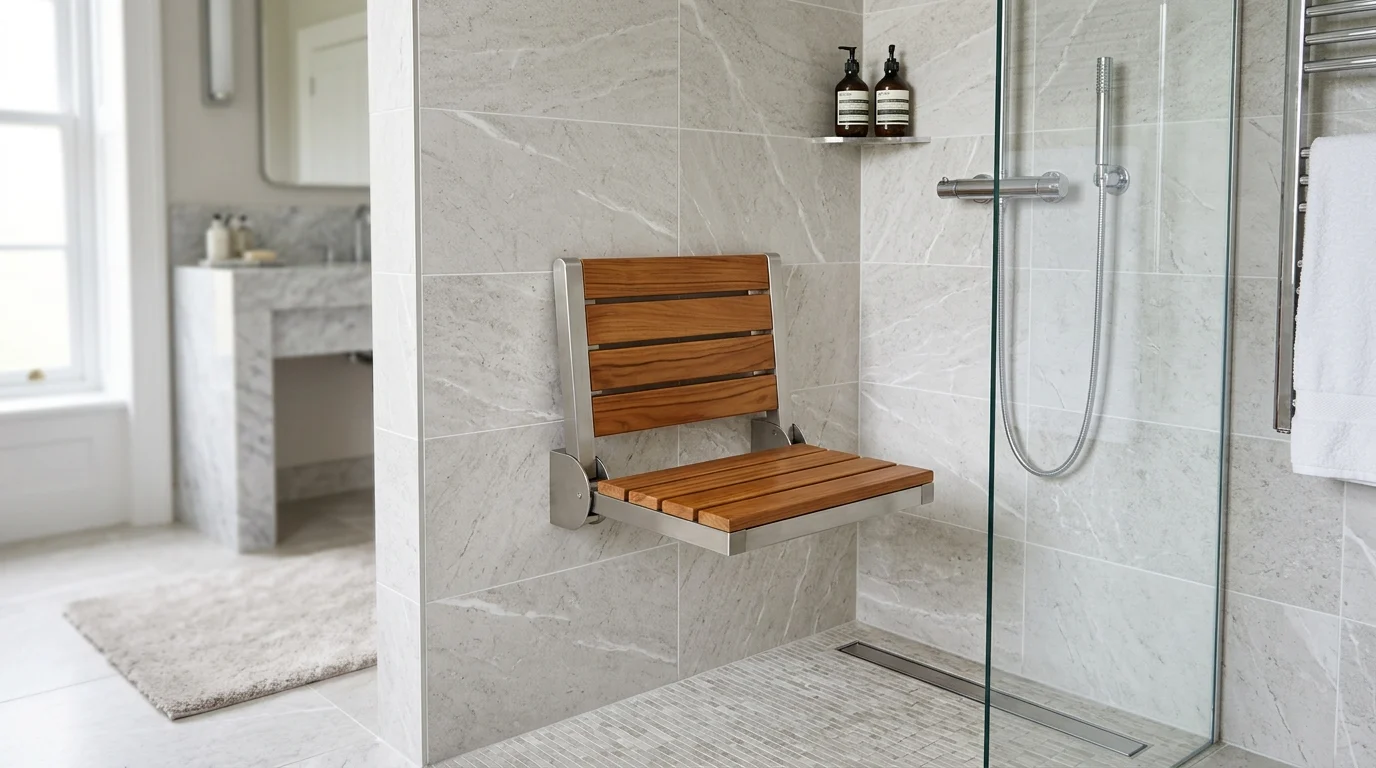
The folding wall mounted shower seat resolves this tension through a design mechanism that is elegant in its simplicity: a seat surface and frame assembly that is permanently and robustly wall-mounted, but that hinges to fold upward and lock flush against the wall when not in use. In its deployed position, the seat provides a stable, load-rated (typically 350-500 lbs) bathing surface compliant with ADA geometry requirements. In its stored position, the seat occupies minimal visual space and zero floor space, leaving the luxury shower interior visually uninterrupted. This dual-state capability—active compliance with folded aesthetics—is the core value proposition driving the folding shower seat’s adoption in luxury hospitality.
1.1 Universal Design as Guest Experience Strategy
The business case for accessible luxury hotel bathrooms has evolved well beyond regulatory compliance. Demographic data from the U.S. Census Bureau and the World Health Organization indicates that the global population of adults over 60 will exceed 2 billion by 2050, representing a significant and growing share of luxury hotel guests. Research published in the Journal of Hospitality & Tourism Research (2024) found that accessible room features—including shower seats—contribute to higher guest satisfaction scores across all age groups, not only among guests with mobility limitations. The term “universal design” has moved from architectural theory into commercial hospitality strategy: features designed for accessibility improve the experience for every guest, from a parent bathing a toddler to a tired business traveler preferring to sit during a shower.
Luxury hotel brands including Four Seasons, Aman, and Ritz-Carlton have progressively integrated folding shower seats into their standard bathroom specifications for accessible rooms, and increasingly into premium non-accessible room categories as well. This approach—sometimes called “accessibility for all”—reflects a broader industry recognition that inclusive design choices generate measurable guest experience returns.
1.2 Space Optimization in Urban Luxury Hotels
Urban luxury hotels operate under acute space constraints. City-center properties in markets like New York, London, Tokyo, and Singapore maximize revenue per square meter, which creates pressure to deliver functional, beautiful bathrooms within compact footprints. A folding wall mounted shower seat uses zero floor space when stored, compared to a shower stool or free-standing shower chair, which occupies 0.3-0.5 square meters of floor area and creates a permanent visual and physical obstacle. In a 35-square-meter luxury hotel room, recovering 0.4 square meters of usable space through a fold-up seat translates to meaningful functional improvement without sacrificing any aesthetic quality. The spatial efficiency of folding shower seats makes them particularly well-suited to urban luxury boutique hotels, where bathroom design must work harder per square meter than in resort properties with larger room footprints.
2. Regulatory Framework: ADA, IBC, and Global Standards
Understanding the regulatory environment is essential for hotel operators, architects, and designers specifying folding wall mounted shower seats for luxury hospitality projects. Compliance is not optional—it is the baseline from which premium specification decisions are made.
2.1 ADA Title III and the 2010 Standards for Accessible Design
Title III of the Americans with Disabilities Act prohibits discrimination on the basis of disability in places of public accommodation, which includes hotels. The 2010 ADA Standards for Accessible Design, which became enforceable in 2012, contain specific provisions for shower seats in accessible guest rooms:
- Section 607.2: Specifies that a folding shower seat is required in roll-in showers in accessible guest rooms
- Section 607.3: Prohibits rectangular seats in roll-in showers; L-shaped or corner-configured seats are permitted
- Section 607.4: Requires that shower seats be mounted at 17-19 inches above the finished floor, measured to the top of the seat surface
- Structural performance: Seats must be capable of withstanding a minimum vertical or horizontal force of 250 lbs applied at the front edge without collapsing or detaching from the wall
- Clear floor space: A clear floor space of 30 by 48 inches minimum is required at the shower seat, measured from a forward or parallel approach
The 2010 ADA Standards do not require folding seats to be the only compliant option—fixed seats can also meet the standard—but the folding variant aligns most naturally with luxury hotel bathroom aesthetics because it can be stored out of view when not needed, including in guest rooms not designated as accessible but where a guest may request the seat’s use.
2.2 International Building Code (IBC) Requirements
The International Code Council’s IBC Section 1104.3 requires accessible bathing facilities in transient lodging (hotels, motels, inns). Additionally, IBC Chapter 11 (Accessibility) aligns with the ADA Standards and incorporates the shower seat provisions described above. For new construction and substantial renovation projects, IBC compliance is enforced through the local authority having jurisdiction (AHJ), typically a city or county building department.
2.3 Global Standards: BS 8300, DIN 18040-1, and AS 1428.1
For international luxury hotel projects, several national accessibility standards govern shower seat specification:
- BS 8300:2018 (United Kingdom): Design of an accessible and inclusive built environment. Specifies shower seat mounting height of 450-480mm from floor level, with structural capacity requirements for loads applied in multiple directions.
- DIN 18040-1 (Germany / EU): Accessible bathroom design standard specifying shower seat geometry, clearance requirements, and non-slip surface classifications (R10 minimum for wet barefoot areas per DIN 51130).
- AS 1428.1-2021 (Australia): Design requirements for new building works, including accessible amenities in hotels and motels. Specifies shower seat height, structural attachment, and clearance geometry comparable to ADA Standards.
Luxury international hotel operators typically develop an internal accessibility standard that meets or exceeds the most stringent applicable national requirement, ensuring consistent global compliance across properties in different jurisdictions.
3. Design and Engineering of Folding Wall Mounted Shower Seats
The engineering of a folding wall mounted shower seat must satisfy competing demands: structural rigidity and load capacity when deployed, smooth and secure folding operation, minimal wall intrusion when stored, and resistance to the high-humidity, high-temperature, and chemical exposure environment of a luxury hotel shower.
3.1 Hinge and Latching Mechanisms
The hinge is the critical mechanical component of any folding shower seat. Hotel-grade folding seats use precision-engineered hinges with the following characteristics:
- Spring-loaded folding assist: A calibrated spring mechanism assists the folding motion, preventing the seat from dropping abruptly and reducing wear on the hinge assembly from repeated use by guests of varying physical capability
- Positive latching: The deployed position requires deliberate release (typically a push-button or lift-and-fold mechanism) before the seat can fold up. This prevents accidental folding under load and ensures the seat remains stable during use
- Lock-in-folded position: A secondary latch holds the seat flush against the wall when stored, preventing it from swinging loose during room cleaning, maintenance, or guest movement
- Adjustable friction: High-quality hinge assemblies allow adjustment of folding resistance to accommodate different usage patterns and guest populations
3.2 Wall Mounting Systems and Load Transfer
Folding shower seats impose dynamic and static loads on their wall attachments that differ significantly from fixed wall-mounted seats. The fold-up action creates a moment arm that pulls the upper mounting point away from the wall surface, creating tensile loads that a standard wall anchor cannot resist. Hotel-grade folding seats address this through:
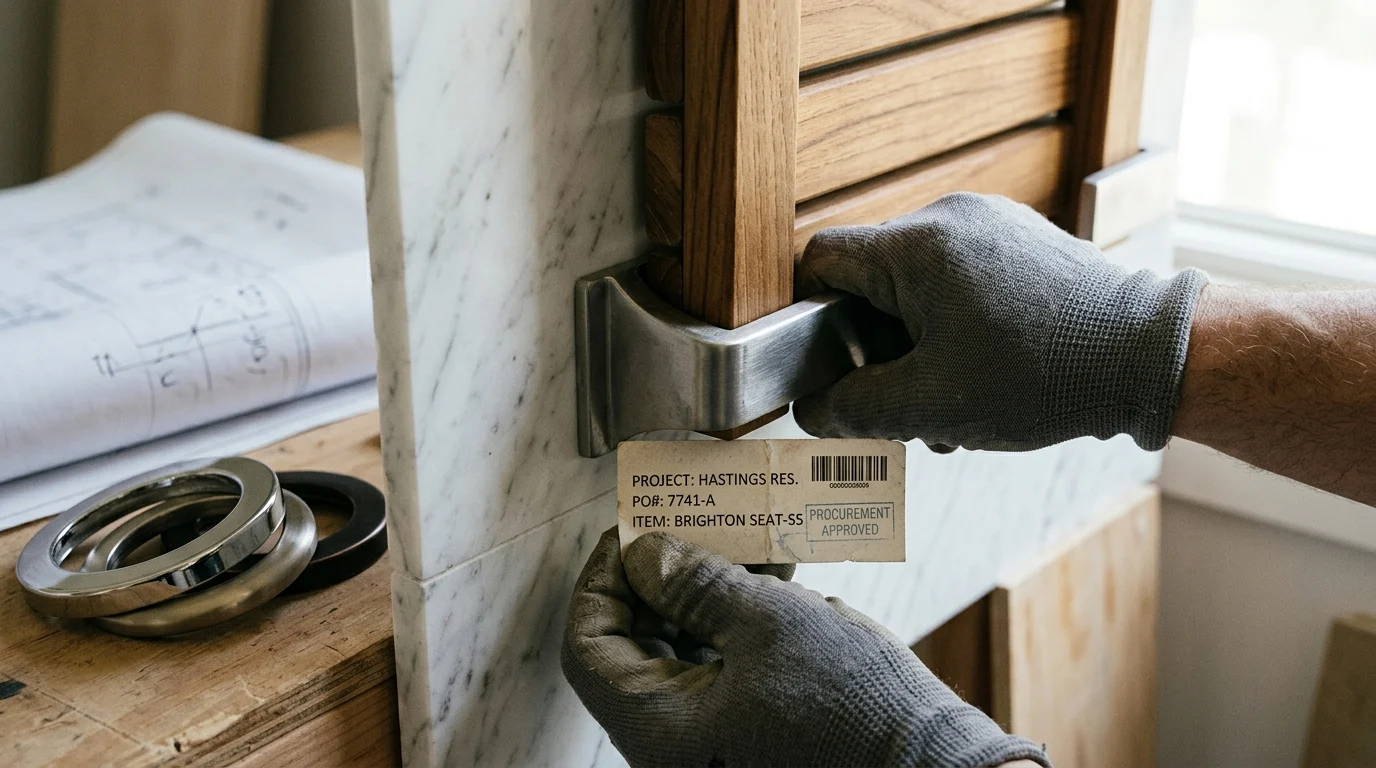
- Multi-point mounting plates: A mounting plate spanning minimum 4 anchor points distributes loads across a wide wall area, reducing point-load stress at individual anchors
- Backing plate engineering: The seat’s mounting plate incorporates a reinforcement backing that transfers loads into structural wall framing or structural sheathing, not just the finish wall surface
- Load ratings: ADA-compliant folding shower seats carry minimum load ratings of 350 lbs (158 kg), with premium hospitality-specification seats rated at 500 lbs (227 kg) to accommodate a wide range of guest body types
- Installation blocking requirements: Building codes and manufacturer installation instructions require structural wood blocking or plywood backing (minimum 3/4-inch thickness) between wall studs at the mounting location
3.3 Drainage and Hygiene Design
Luxury hotel bathrooms demand fixtures that are easy to clean and maintain, and shower seats are no exception. Key hygiene design features of hotel-grade folding shower seats include:
- Continuous gap-free surfaces: Seat surfaces with minimal crevices reduce bacterial harboring in warm, humid shower environments
- Perforated or channeled surfaces: Drainage slots or holes prevent water pooling on the seat surface, which would otherwise create both a slip hazard and a bacterial growth medium
- Removable seat pads: Some hotel-specification models incorporate removable, machine-washable seat pads for systematic hygiene maintenance between guests
- Antimicrobial material options: Silver-ion additive formulations in GFRP gelcoat surfaces and copper-impregnated stainless steel options provide continuous antimicrobial surface activity
4. Material Selection for Luxury Hotel Shower Environments
The material choice for a folding wall mounted shower seat in a luxury hotel environment must balance structural performance, corrosion resistance, aesthetic compatibility, and maintenance requirements. Three material categories dominate hotel-specification folding shower seats.
4.1 316L Stainless Steel
316L stainless steel is the preferred structural material for luxury hotel folding shower seats due to its superior corrosion resistance in wet environments. The “L” designates low carbon content (maximum 0.03% carbon), which provides resistance to sensitization during welding—a relevant consideration for seat frames that incorporate welded joints. The addition of 2-3% molybdenum significantly improves chloride pitting and crevice corrosion resistance, which is critical in hotel shower environments where cleaning chemicals (including chloride-based disinfectants) are regularly used. The material achieves a tensile strength of approximately 485 MPa in the annealed condition, enabling thin-section, visually refined frame geometries that would be impossible in lower-strength materials. Surface finish options include electropolished (EP) finish for a bright, clean aesthetic, and powder-coated finish in custom colors to coordinate with bathroom hardware finishes.
4.2 Glass Fiber Reinforced Polymer (GFRP)
GFRP composite seats are widely specified in luxury hotels due to their design flexibility and inherent non-slip surface properties. The material can be molded with integral texture patterns that provide wet grip without additional coating treatments. GFRP offers excellent chemical resistance to the cleaning agents used in hotel housekeeping operations, and its seamless molded surfaces eliminate the joints and crevices that can harbor bacterial growth. The material’s lower thermal conductivity compared to metal means GFRP seat surfaces feel warmer to the touch—a meaningful guest experience consideration in luxury environments. Premium GFRP seats use marine-grade isophthalic gelcoat with UV stabilization to prevent surface chalking and discoloration over years of service.
4.3 Performance Comparison
| Property | 316L Stainless Steel | GFRP Composite | Aluminum (6061-T6) |
|---|---|---|---|
| Corrosion resistance in hotel shower environment | Excellent (chloride-resistant) | Very Good | Good (requires anodizing) |
| Structural strength (tensile, MPa) | 485 | 200-350 | 310 |
| Load capacity (hotel-grade) | 500 lbs (227 kg) | 350-450 lbs | 250-300 lbs |
| Surface temperature feel (vs. ambient) | Cold (high thermal conductivity) | Neutral | Moderate |
| Non-slip surface options | Laser-ablated, powder-coated, perforated | Molded-in texture, gelcoat | Anodized, perforated |
| Design flexibility (complex geometries) | Moderate (welding constraints) | High (molding) | Moderate (extrusion) |
| Estimated lifespan (luxury hotel) | 15-20 years | 10-15 years | 8-12 years |
| Finish coordination with bathroom hardware | Full (any RAL color, brush, polish) | Limited (gelcoat colors) | Full (anodized, painted) |
| Maintenance requirement | Low (passivated surface) | Moderate | Moderate |
5. Why Luxury Hotels Are Adopting Folding Shower Seats: The Five Drivers
5.1 Regulatory Compliance Without Aesthetic Compromise
The most immediate driver for folding shower seat adoption is the non-negotiable need for ADA compliance in U.S. hotels and equivalent accessibility legislation internationally. The folding variant uniquely satisfies the compliance requirement while preserving the visual design intent of luxury hotel bathrooms. A folded wall mounted shower seat, when stored in the upright position, is barely perceptible—it does not interrupt the visual flow of a marble-tiled shower enclosure or a frameless glass panel. This makes it the only compliance solution that most luxury hotel designers will accept, because alternatives—fixed shower benches, portable shower chairs, or permanent stools—are simply incompatible with the aesthetic standards of the category.
5.2 Guest Safety and Liability Reduction
Bathroom falls are among the most common and costly guest injury incidents in the hospitality industry. The American Hotel & Lodging Association (AHLA) identifies slip-and-fall incidents in bathrooms as a leading category of guest liability claims for hotel operators, with settlements and legal defense costs routinely ranging from $25,000 to $150,000 per incident in the United States. A properly installed, ADA-compliant folding shower seat reduces fall risk during shower transfers by providing a stable, non-slip seating surface for guests who cannot safely stand throughout a shower. Hotels that have installed compliant shower seats report measurable reductions in bathroom fall incidents, and documented compliance with recognized safety standards (ASME A112.19.2, ADA Standards) provides the primary evidentiary defense in premises liability litigation.
5.3 Operational Efficiency and Housekeeping Simplicity
From an operational perspective, a folding wall mounted shower seat integrates seamlessly with luxury hotel housekeeping workflows. Because the seat folds up against the wall, housekeeping staff can clean the shower enclosure without working around a permanent obstruction. The seat’s smooth, non-porous surfaces (in stainless steel and GFRP implementations) wipe clean quickly with standard housekeeping supplies. Removable seat pad options in some hotel-specification models allow machine laundering, enabling systematic hygiene protocols between guests. This operational simplicity is a meaningful factor for hotel operators evaluating bathroom fixture specifications: a seat that complicates housekeeping workflows incurs hidden operational costs that offset the product’s acquisition price.
5.4 Accessibility as Marketing and Brand Differentiation
Luxury hotel brands increasingly market their accessible room offerings as a premium guest experience feature rather than a regulatory compliance obligation. Booking platforms including Marriott Bonvoy, Hilton Honors, and Leading Hotels of the World highlight accessible room categories with detailed descriptions that frame accessibility features as thoughtful guest care. The presence of a well-designed folding shower seat—particularly a premium model in a matching finish—contributes to the accessible room’s perceived quality and signals to guests that the property has invested in thoughtful, comprehensive accessibility rather than the minimum required by law. Guest satisfaction data from the Open Doors Organization’s 2025 study on accessible travel indicates that travelers with disabilities and their companions book return stays at accessible hotels at significantly higher rates than at non-accessible properties, making accessibility investment a measurable revenue strategy.
5.5 Space Efficiency in Compact Urban Room Formats
As noted earlier, urban luxury hotels face acute space constraints. A folding wall mounted shower seat addresses this by maintaining zero floor footprint when stored. In an accessible guest room where an elderly or mobility-impaired guest needs the seat, it deploys in seconds to provide a safe, stable seating surface. When not needed—either because the guest does not require it or the room is occupied by a guest without mobility limitations—the seat folds away, restoring the bathroom to its full visual and functional clarity. This dual-use efficiency is particularly valued in urban luxury boutique hotels, where room sizes of 25-35 square meters demand every square centimeter of floor space to be intentional.
6. Specification Checklist for Luxury Hotel Operators
Hotel operators and procurement teams evaluating folding wall mounted shower seats for luxury properties should confirm the following specification criteria:
6.1 Compliance and Certification
- Load rating minimum: 350 lbs (ADA minimum); 500 lbs recommended for diverse guest populations
- Structural certification: Tested and certified per ASME A112.19.2 (Vitreous China and Plastic Fixture Standard) or equivalent
- ADA compliance: Mounting height 17-19 inches; clear floor space 30×48 inches; L-shaped or corner configuration for roll-in showers
- Mounting hardware: Minimum 4-point wall attachment with structural backing (3/4-inch plywood or equivalent) into wall studs or solid substrate
- Local code review: Confirm compliance with applicable state and local accessibility codes in addition to ADA federal requirements
6.2 Material and Finish
- Structural frame: 316L stainless steel (marine grade, chloride corrosion-resistant) or GFRP composite
- Finish coordination: Specify in a finish matching or complementing bathroom hardware (brushed nickel, matte black, polished chrome)
- Non-slip surface: Minimum wet coefficient of friction (COF) of 0.50 per ASTM F462; laser-ablated or molded texture preferred
- Antimicrobial option: Silver-ion GFRP gelcoat or copper-impregnated stainless steel for enhanced hygiene performance
6.3 Operational and Maintenance
- Hinge mechanism: Spring-assisted folding with positive deployed latch and folded position lock; adjustable friction
- Cleaning compatibility: Surfaces compatible with hotel-grade cleaning agents including chloride-based disinfectants
- Replacement parts: Confirm manufacturer provides hinge replacement kits and surface refurbishment options for long-term maintenance
- Warranty: Minimum 5-year commercial warranty covering structural failure and hinge mechanism
6.4 Aesthetic Integration
- Visual profile: Seat should measure less than 2 inches in wall intrusion when fully folded
- Design coordination: Coordinate seat finish, mounting plate visibility, and hardware style with overall bathroom design narrative
- ADA sign requirement: Accessible rooms require tactile signage with Braille; confirm shower seat installation does not conflict with sign placement
Yes (recommended)
| Criteria | Folding Wall Mounted Seat | Fixed Wall Mounted Seat | Portable Shower Stool |
|---|---|---|---|
| ADA compliance (roll-in shower) | Yes | Yes | No (not wall-attached) |
| Floor space usage when stored | Zero | Zero | 0.3-0.5 sq m |
| Wall intrusion when stored | 1.5-2 inches | Full projection | None |
| Load capacity (luxury grade) | 500 lbs | 500 lbs | 250-350 lbs |
| Visual impact on bathroom aesthetics | Minimal (flush-folded) | Significant | Moderate (free-standing) |
| Operational simplicity (housekeeping) | High (folds away) | High | Low (must move/clean) |
| Guest satisfaction (all guests) | High (optional use) | Moderate (permanent) | Low (clinical appearance) |
| Suitable for luxury hotel | Limited (institutional look) | No | |
| Long-term durability | 15-20 years | 15-20 years | 5-8 years |
| Replacement/hygiene between guests | Wipe clean or removable pad | Wipe clean | Requires removal/storage |
7. Installation Best Practices for Luxury Hotel Shower Environments
The performance of a folding wall mounted shower seat is only as good as its installation. In luxury hotel bathrooms, installation quality is particularly critical because the bathroom environment is fully finished (tile, stone, glass), and remediation of a failed installation is disruptive and costly.
7.1 Pre-Installation Wall Assessment
Before mounting a folding shower seat, the wall substrate must be assessed and prepared:
- Identify wall type: Concrete, masonry, or solid wood-stud walls can support standard mounting. Light-gauge steel studs or hollow wall constructions require the installation of a structural wood backing panel (minimum 3/4-inch CDX plywood or OSB) spanning minimum 3 studs
- Locate studs: Use a quality stud finder to locate wall studs at the intended mounting location. Mark stud centers and edges for anchor placement
- Verify backing: For tile-over-masonry or tile-over-wood-frame walls, confirm that the structural backing was installed during the rough-in stage. Do not rely on tile anchors alone to support a hotel-grade folding seat
- Waterproofing coordination: In roll-in or curbless shower installations, confirm that the shower membrane and waterproofing system are not compromised by the seat mounting penetration. Consult the shower waterproofing manufacturer for approved penetration methods
7.2 Mounting Procedure
The installation procedure for a hotel-grade folding shower seat follows these key steps:
- Template alignment: Use the manufacturer’s installation template to mark anchor hole locations. Verify template alignment with ADA height requirement (17-19 inches to seat top)
- Anchor installation: Install all mounting anchors per manufacturer specifications. For wood-frame walls, use structural screws (not drywall screws) that penetrate minimum 1.5 inches into solid wood. For concrete/masonry, use expansion anchors or epoxy-set inserts rated for the seat’s load capacity
- Mounting plate attachment: Secure the mounting plate to all anchor points simultaneously. Verify that the plate is level and flush against the wall surface
- Seat attachment and hinge adjustment: Attach the seat assembly to the mounting plate and test the folding mechanism through a minimum of 20 open-close cycles. Adjust hinge friction per manufacturer instructions to achieve smooth, controlled folding
- Final safety check: Apply a test load of 1.5 times the rated capacity in the deployed position to verify structural integrity before placing the room in service
8. Emerging Trends: 2026 Innovations in Hotel Shower Seat Design
8.1 Smart Seat Technologies
The integration of sensor technology into folding shower seats is an emerging innovation in the luxury hospitality sector. Potential applications include occupancy sensors that log seat deployment for facilities management analytics, weight sensors integrated into the seat surface for health monitoring applications (particularly relevant in medical tourism hotel facilities), and UV-C sanitization cycles triggered automatically when the seat is folded into the stored position. These technologies remain in early adoption phases but are expected to move from pilot programs to mainstream specification by 2027-2028 in the luxury tier.
8.2 Heated Seat Surfaces
Heated folding shower seats—utilizing low-voltage electric radiant heating elements embedded in the seat surface—address the thermal comfort objection that some guests raise regarding stainless steel seat surfaces in cool bathroom environments. Heated seats are specified primarily in ultra-luxury properties and medical hospitality applications, where guest thermal comfort is a premium service expectation.
8.3 Sustainable Materials and Circular Economy
Sustainability pressures from ESG reporting requirements and green building certification systems (LEED, BREEAM) are driving material innovation in hotel bathroom fixtures. GFRP seats incorporating post-consumer recycled glass content and bio-derived polymer formulations are entering the specification pipeline. Additionally, some manufacturers now offer take-back and refurbishment programs for hotel seat replacements, aligning with circular economy principles in hospitality operations. Cassbern offers a selection of shower seats manufactured with materials and processes aligned with sustainable hospitality procurement standards.
8.4 Modular Shower Systems with Integrated Seating
The broader trend toward modular bathroom wall panel systems—where shower enclosures, niches, seating, and controls are integrated into a coordinated wall system—is creating new integration opportunities for folding shower seats. Flush-mounted folding seats that integrate with the wall panel plane (rather than projecting from it) represent the next evolution in aesthetic integration. These systems are currently in the high-specification custom residential market but are expected to influence luxury hospitality product development over the next 3-5 years.
Conclusion
The adoption of folding wall mounted shower seats in luxury hotels is not a passing design trend—it reflects a structural shift in how the hospitality industry approaches the intersection of accessibility, aesthetics, space efficiency, and guest safety. The folding shower seat resolves a genuine design problem that fixed seats and portable stools cannot: it delivers ADA-compliant, load-rated, stable shower seating that disappears from view when not needed, preserving the curated bathroom environment that luxury hotel brands invest millions to create. For hotel operators, the business case is clear: reduced liability exposure, simplified housekeeping operations, measurable guest satisfaction improvements, and compliance with accessibility regulations that are only becoming more stringent globally. As material innovations, smart technologies, and sustainability standards continue to evolve, the folding wall mounted shower seat will remain a defining fixture in luxury hotel bathroom design—a small but essential element of the inclusive, considered guest experience that the world’s leading hospitality brands are committed to delivering.
7 Frequently Asked Questions
1. Are folding shower seats actually required by the ADA in luxury hotels?
Yes, under Title III of the Americans with Disabilities Act and the 2010 ADA Standards for Accessible Design, newly constructed or altered hotel guest rooms with roll-in showers must include a shower seat. The seat must be folding or fixed, mounted at 17-19 inches height, and capable of withstanding 250 lbs applied at the front edge without collapsing. Folding seats are the preferred choice in luxury hotels because they satisfy this requirement while maintaining the visual minimalism of premium bathroom interiors.
2. Do folding shower seats look out of place in a luxury hotel bathroom?
When specified correctly—matched to the bathroom hardware finish and properly installed with minimal wall intrusion—folding shower seats integrate seamlessly into luxury hotel bathroom aesthetics. The seat’s visual impact when folded is typically 1.5-2 inches of wall intrusion, comparable to a grab bar. In the folded position, the seat is largely unnoticeable against coordinated wall finishes. Several luxury hotel brands now specify folding seats in non-accessible premium rooms as a design-forward accessibility feature, reflecting the broader “accessibility for all” philosophy in hospitality design.
3. How much weight can a hotel-grade folding shower seat support?
ADA minimum requirements specify a load capacity of 250 lbs at the seat’s front edge. However, hotel-specification folding shower seats are typically rated at 350-500 lbs to accommodate a diverse guest population and provide a safety margin. Cassbern’s hotel-grade folding shower seat models are rated to 350 lbs minimum, with heavy-duty configurations rated to 500 lbs for properties requiring enhanced capacity.
4. How do folding shower seats compare to fixed seats for hotel use?
Fixed wall-mounted seats offer equivalent structural performance and load capacity compared to folding seats. However, folding seats provide two critical advantages for luxury hotel applications: zero visual footprint when stored (improving bathroom aesthetics), and flexibility for use by guests who did not specifically request an accessible room but may benefit from the seat during their stay. Portable shower stools are not ADA-compliant for roll-in shower installations and are not recommended for luxury hotel use due to their floor footprint, stability limitations, and visual appearance.
5. What maintenance does a folding shower seat require in a hotel environment?
Hotel-grade folding shower seats require minimal ongoing maintenance. Weekly housekeeping should include wiping the seat surface with appropriate cleaning agents (avoid chloride-based cleaners on uncoated stainless steel, as they cause pitting corrosion). Quarterly inspection should verify that mounting hardware remains secure and that the hinge mechanism operates smoothly with consistent friction. Annual professional inspection should confirm structural integrity of the wall attachment and hinge assembly. Replacement of hinge hardware (typically a low-cost part) is recommended every 5-7 years in high-frequency-use hotel environments.
6. Can folding shower seats be installed in existing hotel bathrooms without major renovation?
Yes, folding shower seats can be retrofitted into existing hotel bathrooms provided the wall substrate at the intended location is structurally adequate. The primary challenge in retrofit installations is ensuring adequate backing behind the wall finish at the mounting location. If the wall is a hollow construction (drywall over studs without backing), the installation requires opening the wall to install structural backing—a more invasive process that is typically coordinated with other renovation work. Properties with solid masonry or concrete walls can often accommodate retrofit installations with minimal disruption.
7. What is driving the growth in accessible hotel bathroom specifications beyond regulatory compliance?
Three forces are driving luxury hotel operators to exceed minimum accessibility requirements: demographic shifts (the global population over 60 is growing rapidly, representing an increasing share of luxury travel expenditure), guest satisfaction research (accessible room features score positively across all guest demographics, not only guests with disabilities), and brand differentiation (luxury hotel brands use comprehensive accessibility as a marketing and loyalty advantage). The Open Doors Organization’s 2025 Market Study on Accessible Travel found that 73% of travelers with disabilities and their companions will not return to a hotel that failed to meet their accessibility needs, and are willing to pay premium rates for properties that do.


