

Quick Answer: A fold down bathroom seat enhances the luxury of a walk in shower by adding functional safety without aesthetic compromise—solving the design challenge that has long constrained luxury shower design. The global luxury bathroom fixtures market is projected to reach $21.4 billion by 2028, with accessibility-integrated design representing the fastest-growing specification category. A fold down seat provides a stable, load-rated shower seating surface that disappears into the bathroom design when not in use, preserving the visual openness that defines the luxury walk in shower experience. Beyond aesthetics, the seat addresses genuine safety needs—reducing fall risk during shower transfers, accommodating aging users, and meeting ADA requirements in accessible installations—while its presence elevates the perceived thoughtfulness and quality of the entire bathroom.
Key Takeaways
- The luxury walk in shower market is growing at 7.2% CAGR, driven by aging populations and universal design adoption in high-end residential construction
- Fold down bathroom seats preserve the visual openness of walk in showers while adding certified safe seating functionality
- ADA-compliant fold down seats satisfy accessibility requirements without disrupting the minimalist design vocabulary of luxury shower spaces
- 316L stainless steel and GFRP are the preferred materials for luxury hotel and residential fold down seat construction
- Proper structural backing and multi-point wall mounting are non-negotiable for safe installation in walk in shower environments
- Luxury hotel operators report improved guest satisfaction scores and reduced liability exposure after installing compliant fold down seats
- 2026 innovations include ultra-thin hinge systems, heated seat surfaces, and smart sensor integration
Introduction
The walk in shower has become the defining element of the luxury bathroom. Unlike the enclosed shower-tub combination that dominated residential bathrooms for decades, the walk in shower is defined by openness: a curbless or low-threshold entry, transparent glass panels or open sides, large-format tile or stone surfaces, and a showerhead that is often ceiling-mounted or exposed as a sculptural fixture. This aesthetic—open, visual, and uncluttered—is the vocabulary of luxury bathroom design across the world’s leading hotel brands and high-end residential projects. But this same visual openness creates a functional tension: a luxury walk in shower, by definition, offers no built-in seating surface. For users who need to sit during showering—the elderly, those recovering from surgery, anyone who finds prolonged standing uncomfortable—the walk in shower’s defining feature becomes its limiting one. The fold down bathroom seat resolves this tension. It is, in essence, a mechanism for having the luxury open shower and the functional seat at the same time.
1. The Design Tension in Luxury Walk in Showers
The luxury walk in shower is architecturally defined by absence: no tub, no curtain, no threshold barrier, no visual obstruction between the shower zone and the rest of the bathroom. This absence creates the sense of space, light, and openness that luxury bathroom design prizes. But the functional requirements of bathing are not absent—showering involves standing, balancing, reaching, and bending, activities that are not equally accessible to all users. The challenge for luxury bathroom designers is to introduce functional accessibility features—grab bars, seating surfaces, threshold accommodations—without reintroducing the visual clutter that the walk in shower design was specifically intended to eliminate.
1.1 Why Walk in Showers Lack Built-in Seating
The architectural convention of the walk in shower deliberately omits built-in seating for two reasons. First, a built-in bench or seat interrupts the floor plane and the visual flow of the shower enclosure—it becomes an obstacle in the shower space and, when not in use, an unused element that breaks the design line. Second, a built-in seat reduces the effective showering area: in a curbless walk in shower with a floor drain, a built-in bench occupies floor area that would otherwise contribute to the shower’s drainage zone. A fold down seat avoids both problems. When folded up, it is effectively invisible against the wall. When deployed, it occupies the wall zone rather than the floor zone, maximizing the retention of the open shower interior.
1.2 The Accessibility-Safety Gap in Open Shower Design
Bathing-related falls are among the most common and consequential injuries in residential and hospitality settings. The National Institute on Aging identifies the shower transfer—from standing to seated and from seated to standing—as the highest-risk moment for falls in the bathing environment. In a conventional shower-tub combination, the bathtub edge provides an implicit seating surface (however unsafe that improvised seating may be). In a walk in shower, there is no such surface. A user who cannot safely stand for the duration of a shower has no built-in option—and is therefore likely to either avoid showering independently, use an improvised seating solution, or sustain a fall attempting to manage without support. The fold down seat directly fills this accessibility-safety gap.
2. Understanding Fold Down Bathroom Seats
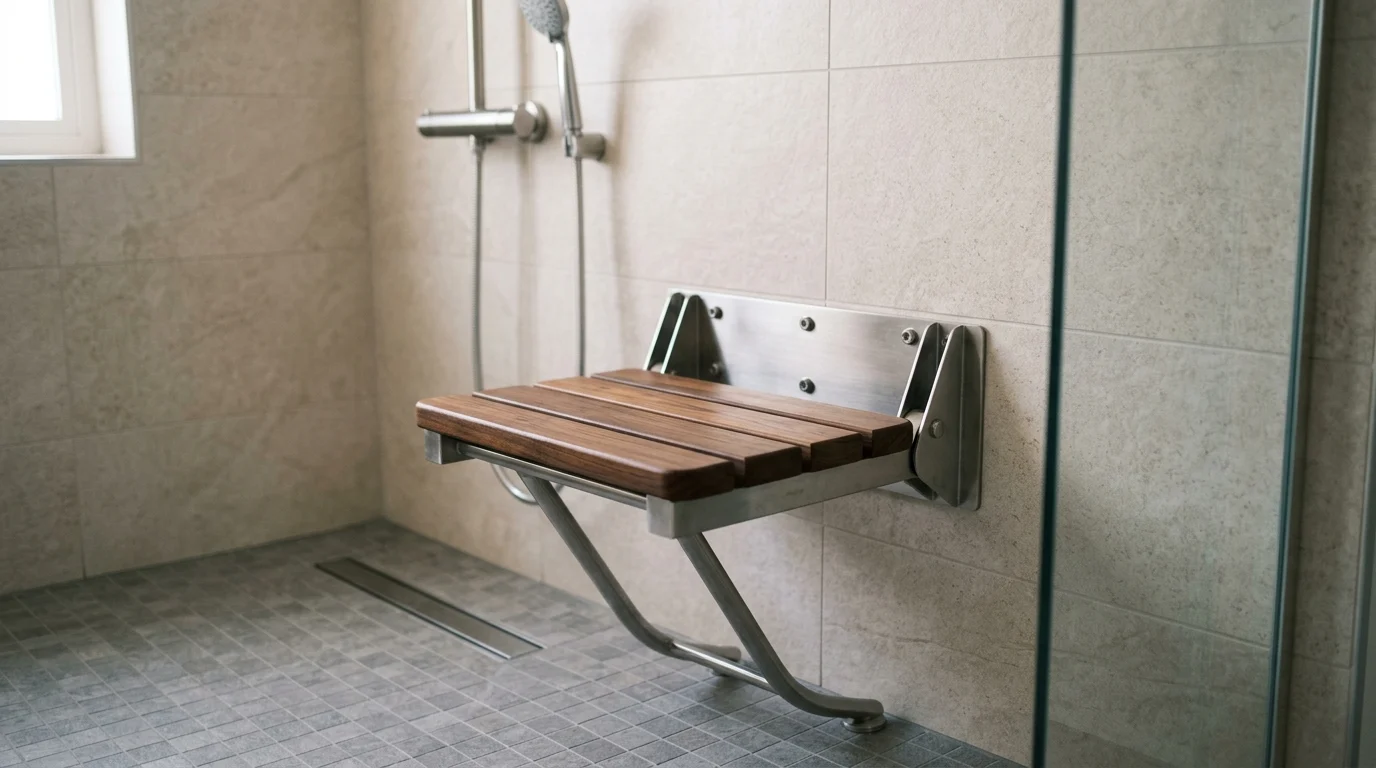
A fold down bathroom seat is a wall-mounted bathing seat that hinges on a horizontal axis and folds upward to a stored position flush against the wall when not in use. The defining characteristic of the fold down seat is its dual-state functionality: it provides a full structural seating surface when deployed, and it virtually disappears when stored. This dual-state capability is what makes it uniquely suited to the luxury walk in shower context.
2.1 Anatomy of a Fold Down Seat
A complete fold down bathroom seat system consists of the following components:
- Seat surface: The horizontal seating platform, available in stainless steel, GFRP, wood, or padded composites
- Frame and mounting plate: The structural support assembly that transfers loads from the seat to the wall
- Hinge mechanism: The pivot joint with spring assistance, friction adjustment, and positive latching
- Deployed latch: Locks the seat in the horizontal deployed position
- Stored latch: Secures the seat against the wall in the stored position
- Structural backing: Wall reinforcement (3/4-inch plywood or OSB between studs, or solid masonry)
2.2 Fold Down vs. Fixed Wall-Mounted vs. Corner Seats
- Fold down wall-mounted seat: Hinges upward against wall; zero floor footprint when stored; 1.5-2 in. wall intrusion when stored; most common in luxury walk in showers
- Fixed wall-mounted seat: Permanently projects from wall; no folding; constant visual presence
- Corner seat: Mounts in shower corner; uses typically unusable corner zone; folds if folding model
- Recessed niche seat: Installed flush in wall recess; zero projection; highest installation complexity
- Free-standing stool: Portable; occupies floor space permanently; not ADA-compliant for roll-in showers
2.3 ADA Compliance Requirements for Walk in Showers
- Section 607.2: A seat is required in roll-in type showers, which describes the typical luxury walk in shower
- Section 607.3: L-shaped or corner seats are permitted; rectangular seats are prohibited in roll-in showers
- Section 607.4: Seat height of 17-19 inches above the finished floor
- Structural requirement: Seat must resist 250 lbs applied vertically or horizontally at the front edge
- Clear floor space: 30 by 48 inches minimum adjacent to the seat
3. Material Science: What Makes a Luxury Fold Down Seat
3.1 316L Stainless Steel Construction
- Corrosion resistance: Molybdenum addition provides chloride pitting resistance critical in wet bathroom environments
- Strength-to-geometry efficiency: 485 MPa tensile strength enables thin-section frames minimizing visual mass while maintaining 350-500 lbs load ratings
- Finish flexibility: Electropolishing, brushing, and powder coating in custom colors coordinate with bathroom hardware
3.2 GFRP Composite Seats
- Molded non-slip surface: Integral texture co-molded into the surface; does not wear off
- Thermal neutrality: Low thermal conductivity; seat feels warmer to the touch than stainless steel
- Seamless construction: One-piece molded GFRP eliminates joints and crevices where bacteria harbor
3.3 Surface Coatings and Textures
- Laser-ablated textures: Achieve wet COF of 0.60-0.80 per ASTM F462
- Powder coating: Polyurethane coating in matte black, white, or custom RAL colors
- Rubber overmold: High friction and thermal isolation but requires more maintenance
3.4 Material Comparison
| Property | 316L Stainless Steel | GFRP Composite | Aluminum 6061-T6 |
|---|---|---|---|
| Load capacity | 350-500 lbs | 300-450 lbs | 250-350 lbs |
| Corrosion resistance (chloride) | Excellent | Very Good | Moderate |
| Wet COF (surface grip) | 0.60-0.80 | 0.50-0.65 | 0.40-0.60 |
| Finish options | Full range | Gelcoat color range | Anodized, painted |
| Thermal feel | Cools quickly | Neutral | Moderate |
| Lifespan (luxury) | 15-20 years | 10-15 years | 8-12 years |
4. The Luxury Equation: How Fold Down Seats Enhance Walk in Showers
4.1 Visual Integration
- Finish matching: Seat hardware coordinated with bathroom hardware finish (brushed nickel, matte black, etc.)
- Positioning: Seat at back wall or corner to minimize visual prominence
- Proportion: 16-22 in. wide, 16-20 in. deep for appropriate scale in luxury enclosures
4.2 Functional Luxury: The Experience Dimension
- Extended showering comfort: Users with pain, injury, or fatigue can shower longer and more comfortably while seated
- Confidence and safety: Availability of a stable seating surface changes the psychological dynamic of showering
- Inclusive hospitality: Signals that the property has considered the needs of all guests
4.3 Space Perception
By providing seating within the shower, a fold down seat eliminates the need for a separate shower stool, which would permanently occupy floor space and interrupt the visual line of the bathroom.
5. Specification and Installation Best Practices
5.1 Structural Backing: The Non-Negotiable Foundation
- Wood-frame walls: Minimum 3/4-inch structural wood panel spanning 3 studs, secured with structural screws
- Steel stud walls: Plywood backing with heavy-duty toggle bolts or expansion anchors rated for load capacity
- Concrete or masonry: Expansion anchors or epoxy-set inserts per manufacturer specs
5.2 Positioning in the Walk in Shower
- Back wall position: Opposite entry; user’s back protected when seated; least visually prominent
- Side wall position: For rectangular showers; seat oriented perpendicular to shower length
- Corner position: L-fold seat uses corner wall zone; visually neutral
- Height: 17-19 inches per ADA; 15-21 inches for non-ADA residential
5.3 Integration with Grab Bars
- Vertical grab bar: Entry side of shower, 33-36 inches above floor
- Horizontal grab bar: Wall adjacent to seat, 33-36 inches above floor
- L-shaped bar: Combines vertical and horizontal for versatile support
6. The Business Case: Why Luxury Properties Specify Fold Down Seats
6.1 Liability Reduction
Bathroom falls are the largest category of guest injury liability for luxury hotel operators. Average U.S. premises liability settlements range from $35,000 to $175,000 per case, with legal defense costs adding $15,000-$50,000. A compliant fold down seat provides documented evidence of safety investment.
6.2 Guest Satisfaction and Repeat Business
The Open Doors Organization’s 2025 study found that 73% of travelers with disabilities will not return to a hotel that failed to provide adequate accessibility. Accessible room features generate positive reviews across all guest demographics.
6.3 Aging in Place and Residential Market Growth
The NAHB reports that 78% of homeowners over 50 prefer to age in place. Accessible bathroom design is a primary renovation investment priority. The fold down seat is a reversible, aesthetically integrated feature that enhances safety without signaling disability.
7. Maintenance and Long-Term Performance
7.1 Routine Maintenance Protocol
- Weekly: Wipe seat surface with soft cloth; avoid abrasive scrubbers; rinse hinge area
- Monthly: Test hinge operation, latching, and mounting hardware security; apply lubricant if stiffness detected
- Quarterly: Inspect wall attachment, mounting plate flushness, and surface condition
- Annual: Professional inspection; hinge adjustment or replacement; load verification test
7.2 Common Failure Modes and Prevention
- Hinge play: Prevented by periodic lubrication and adjustment; corrected by hinge replacement
- Mounting hardware loosening: Prevented by structural screws into solid backing; most common structural failure
- Corrosion (stainless steel): Prevented by non-abrasive, chloride-free cleaners
- Coating failure: Prevented by avoiding impact loading and using manufacturer-specified cleaners
8. Emerging Trends: 2026 Innovations
8.1 Ultra-Thin Hinge Systems
New hinge mechanisms reduce folded storage depth from 1.5-2.0 inches to 0.75-1.0 inches, improving aesthetic integration in minimalist luxury bathrooms.
8.2 Heated Seat Surfaces
Low-voltage radiant heating elements embedded in the seat surface address thermal comfort objections to metal seats. Operating at 12-24V for wet environment safety.
8.3 Smart Sensor Integration
Occupancy sensors for facilities analytics and weight sensors for health monitoring are emerging in medical hospitality applications.
8.4 Sustainable Materials
GFRP seats with post-consumer recycled glass content and bio-derived polymer formulations are entering the specification pipeline.
Conclusion
The fold down bathroom seat does more than fill a safety gap in the luxury walk in shower—it elevates the shower’s design and functional quality. By providing a stable, accessible seating surface that folds away when not in use, the fold down seat resolves the core design tension of the open shower: how to be simultaneously open and accessible, visually uncluttered and functionally complete. For luxury hotel operators, the business case is measurable: reduced liability exposure, improved guest satisfaction, and ADA compliance without aesthetic compromise. For residential homeowners investing in aging-in-place design, the fold down seat is a long-term safety feature that preserves the visual quality of the bathroom.
7 Frequently Asked Questions
1. Does a fold down bathroom seat make a luxury walk in shower look like a hospital bathroom?
No—when correctly specified, a fold down seat is nearly invisible. The seat’s metal surfaces coordinate with bathroom hardware finishes, and its folded position creates minimal 1.5-2 inch wall intrusion. Luxury hotel brands including Ritz-Carlton, Four Seasons, and Aman specify fold down seats in their walk in showers for this reason.
2. What is the load capacity of a luxury hotel-grade fold down seat?
ADA minimum is 250 lbs at the front edge. Luxury hotel-specification seats are typically rated at 350-500 lbs to provide a safety margin. The load rating applies to the entire system—not just the seat surface, but the frame, mounting plate, and wall attachment combined.
3. How is a fold down seat installed in a walk in shower with curbless entry?
The curbless roll-in configuration is the most common luxury shower type and is specifically addressed by ADA accessible bathing requirements. The fold down seat is mounted on the wall using structural backing requirements. The curbless entry does not affect the seat installation. The primary consideration is ensuring wall mounting does not penetrate the shower waterproofing membrane.
4. Can a fold down seat be installed after the bathroom is finished?
Yes, depending on wall construction. Concrete or masonry walls allow relatively straightforward installation with expansion anchors. Wood-frame walls without structural backing require opening the wall to install backing—typically coordinated with tiling or wall paneling work. Retrofit feasibility should be assessed by a qualified contractor first.
5. What is the difference between a fold down seat and a fold up seat?
The terms are often used interchangeably. Both hinge on a horizontal axis and fold against the wall. Some manufacturers distinguish by whether the seat lowers to deploy (fold down) or raises to store (fold up), but the mechanical outcome is equivalent.
6. How does a fold down seat compare to a built-in shower bench?
A built-in bench is a permanent architectural element occupying floor and visual space in the shower. A fold down seat occupies zero floor space and minimal wall space when stored. The built-in bench offers superior durability but at the cost of permanent occupation. The fold down seat offers superior spatial efficiency and aesthetic integration at the cost of mechanical complexity.
7. Do I need a grab bar if I have a fold down seat in my walk in shower?
Yes. The shower transfer—from standing to seated and back—is the highest-risk moment for falls, and this transfer requires something to hold onto. A properly equipped walk in shower with a fold down seat should also include grab bars at the entry, at the seat, and at the shower controls.


