

A wall-mounted foldable shower seat is no longer just an accessibility add-on; it is a performance fixture that influences safety, durability, maintenance cost, and the visual quality of a modern bathroom. In high-use spaces such as hotels, healthcare facilities, assisted living environments, and premium residences, material choice determines whether the seat resists corrosion, supports repeated loading, and maintains smooth operation over thousands of cycles. This article examines how premium metals, engineered surfaces, concealed hardware, and tested hinge systems improve reliability in wet environments. It also explains why thoughtful specification supports both practical comfort and the refined bathroom experience Cassbern describes as Enduring Elegance.
Strategic Value of Premium Wall-Mounted Foldable Shower Seats
Specifying a wall-mounted foldable shower seat has evolved significantly from a basic utility fixture to a critical architectural component in healthcare, hospitality, and premium residential design. In modern commercial and institutional environments, these fixtures represent the intersection of accessibility, user safety, and spatial efficiency. The shift toward premium materials is driven by the rigorous demands of wet environments, where sub-standard metals and plastics rapidly degrade, leading to mechanical failures and increased liability.
For architects, facility managers, and procurement specialists, understanding the strategic value of high-grade shower seats is paramount. Upgrading to premium materials shifts the procurement paradigm from a short-term capital expense to a long-term operational investment. High-quality fixtures mitigate the risks of structural fatigue, galvanic corrosion, and pathogen retention, ultimately delivering a lower total cost of ownership while maintaining aesthetic integrity in high-end bathroom environments.
What Defines a Premium Wall-Mounted Foldable Shower Seat
A premium wall-mounted foldable shower seat is defined by its engineering tolerances, material provenance, and rigorous testing certifications. Unlike entry-level models that rely on thin-walled tubular steel and basic injection-molded plastics, premium variants utilize heavy-gauge architectural metals and advanced composites. These seats are designed with concealed mounting hardware, constant-torque friction hinges, and precision-machined brackets that eliminate lateral sway during use.
Furthermore, premium classification is quantitatively measurable. High-end shower seats typically exhibit a manufacturing defect rate of less than 0.5% over a 10-year period. They are subjected to accelerated life testing, often enduring over 50,000 folding cycles without a loss of hinge tension or structural integrity. A true premium seat also integrates seamlessly into modern bathroom aesthetics, offering customized finishes such as brushed nickel, matte black powder coating, or polished chrome that resist peeling and blistering in high-humidity environments.
Why Material Quality Matters in Commercial Projects
In commercial projects such as hospitals, luxury hotels, and assisted living facilities, a wall-mounted foldable shower seat may experience between 50 and 150 usage cycles per week. This high frequency of use, combined with constant exposure to hot water, steam, and aggressive hospital-grade cleaning chemicals, creates an exceptionally harsh operating environment. Low-grade materials, such as 201 stainless steel or untreated carbon steel, are highly susceptible to chloride-induced stress corrosion cracking and pitting under these conditions.
Material quality directly impacts facility liability and operational downtime. A mechanical failure of a shower seat under load can result in severe user injury, triggering substantial legal and medical costs that far exceed the initial savings of a cheaper fixture. Premium materials ensure consistent load-bearing performance, typically supporting dynamic loads exceeding 400 lbs (181 kg) with an integrated safety factor of 2.0 or higher. By specifying superior materials, commercial projects safeguard end-users while simultaneously reducing the labor costs associated with premature replacement and maintenance.
Best Premium Materials for Durability and Performance
The longevity and structural reliability of a wall-mounted foldable shower seat depend entirely on the physical properties of the materials selected for its frame and seating surface. Modern manufacturing leverages a variety of specialized alloys and composites to balance tensile strength, corrosion resistance, tactile comfort, and weight.
Stainless Steel, Aluminum, and Reinforced Alloy Frames
The internal frame and mounting chassis form the structural backbone of any foldable shower seat. Premium fixtures overwhelmingly rely on austenitic stainless steel, specifically grades 304 and 316L. Type 304 stainless steel offers excellent baseline corrosion resistance and a minimum yield strength of approximately 205 MPa, making it suitable for most high-end residential and standard commercial applications. For marine environments, coastal properties, or facilities utilizing highly concentrated chlorine or quaternary ammonium disinfectants, Type 316L is the superior choice. The addition of 2-3% molybdenum in 316L provides exceptional resistance to localized pitting and crevice corrosion.
Beyond stainless steel, extruded aluminum alloys—particularly 6061-T6—are frequently utilized in modern, minimalist seat designs. Anodized aluminum provides a high strength-to-weight ratio, reducing the dead load placed on the shower wall structure. When aluminum is used, premium manufacturers apply a hard-coat anodized finish (typically exceeding 25 microns in thickness) to seal the porous metal surface against oxidation. In highly specialized bariatric models, reinforced titanium or hybrid alloy brackets may be deployed to handle extreme shear forces without adding excessive bulk.
Phenolic, Compact Laminate, Teak, and HDPE Seats
The seating surface requires a different set of material properties, prioritizing thermal comfort, slip resistance, and hygiene. Phenolic resin, also known as compact laminate, is a leading choice for heavy commercial use. Manufactured by applying heat and pressure to layers of kraft paper impregnated with synthetic resins, phenolic seats are entirely impervious to water. Premium phenolic tops are typically specified at a thickness of 12mm to 16mm, providing immense rigidity and resistance to vandalism or impact.
For luxury hospitality and high-end residential markets, Burmese Teak remains a highly sought-after material. Teak possesses natural silica and high oil content, making it inherently resistant to rot, fungi, and water intrusion. While it requires periodic oiling to maintain its aesthetic warmth, it offers an unmatched tactile experience. Alternatively, High-Density Polyethylene (HDPE) is frequently utilized in healthcare settings. Premium HDPE is non-porous, highly resistant to chemical degradation, and can be embedded with silver-ion antimicrobial agents during the molding process to inhibit the growth of bacteria and mold.
Material Strength and Lifecycle Comparison
Comparing these materials reveals distinct advantages depending on the project application. The lifecycle of a premium wall-mounted foldable shower seat is maximized when the frame and seat materials are correctly paired with the intended operational environment.
Material Component | Typical Yield Strength / Density | Water Resistance | Estimated Lifecycle (Commercial Use) | Relative Cost Index |
304 Stainless Steel Frame | 205 MPa | High | 10 – 15 Years | Moderate |
316L Stainless Steel Frame | 170 MPa | Exceptional | 20+ Years | High |
6061-T6 Aluminum Frame | 276 MPa | Moderate-High (if anodized) | 10 – 12 Years | Moderate |
Phenolic Compact Laminate | 1.4 g/cm³ | Exceptional | 15 – 20 Years | High |
Burmese Teak Wood | 0.65 g/cm³ | High (requires maintenance) | 10 – 15 Years | Very High |
Antimicrobial HDPE | 0.95 g/cm³ | Exceptional | 10 – 15 Years | Low-Moderate |
Engineering Specifications That Ensure Reliability
While premium materials provide the foundation, the engineering specifications and mechanical design dictate how a wall-mounted foldable shower seat performs under stress. Rigorous engineering ensures that the seat transitions smoothly between its folded and deployed states, supports heavy dynamic loads, and complies with stringent accessibility regulations.
Load Rating, Hinges, and Bracket Design
Load rating is the most critical safety specification for a shower seat. Standard commercial seats are engineered to support a static load of 250 to 300 lbs (113 to 136 kg). However, premium models and bariatric-specific designs push these thresholds significantly higher, often rated to support static loads of 400 to 500 lbs (181 to 227 kg). Some heavily reinforced models tested under specialized laboratory conditions can withstand temporary dynamic loads up to 900 lbs (408 kg). Achieving these ratings requires robust bracket design, typically utilizing 8mm to 10mm thick stainless steel backing plates that distribute shear forces evenly across the wall studs or blocking.
The hinge mechanism is equally vital. Premium seats utilize constant-torque or dampening hinges. Unlike free-swinging hinges that can slam against the wall or drop suddenly and cause injury, constant-torque hinges allow the seat to remain stationary at any angle during deployment. These hinges are often sealed with specialized synthetic lubricants and utilize advanced polymer thrust washers (such as Delrin or PTFE) to prevent metal-on-metal wear, ensuring silent operation and consistent friction over tens of thousands of cycles.
Waterproofing, Drainage, and Surface Texture
Effective water management is essential to maintain hygiene and prevent user discomfort. Engineering specifications for premium seating surfaces include precise drainage capabilities. Seat tops are either slotted or perforated to allow rapid water evacuation. Industry best practices dictate drainage gap widths of 8mm to 10mm; this sizing is deliberately calculated to be wide enough to prevent water pooling via surface tension, yet narrow enough to prevent finger entrapment or discomfort for the user.
Surface texture is heavily engineered to mitigate slip-and-fall hazards. Premium shower seats are manufactured to meet or exceed a dynamic coefficient of friction (DCOF) of 0.42, with many high-end phenolic and HDPE seats achieving a DCOF greater than 0.60 under wet conditions. This is achieved through micro-texturing the mold for plastics, applying specialized matte finishes to metals, or routing precise tactile grooves into solid surface materials. Furthermore, the internal mechanics of the frame are designed to be self-draining, preventing stagnant water from accumulating inside tubular structures, which could otherwise lead to internal corrosion or bacterial growth.
ADA Compliance and Safety Standards
Compliance with regional accessibility standards is a non-negotiable engineering requirement for commercial projects. In the United States, the Americans with Disabilities Act (ADA) provides strict dimensional and structural guidelines. Under ADA Section 4.21.3, a shower seat must be capable of withstanding a minimum of 250 lbs of force applied at any point. Furthermore, the engineering must allow the seat to be installed so the top of the seating surface is between 17 inches and 19 inches (432 mm to 483 mm) above the finished bathroom floor.
Beyond load and height, ADA compliance dictates the exact dimensions of the seat depending on the shower stall type (e.g., L-shaped seats for transfer showers vs. rectangular seats for roll-in showers). Premium manufacturers engineer their products to not only meet these dimensional requirements but also to ensure that the folding mechanism requires less than 5 lbs (22.2 N) of force to operate, accommodating users with limited upper body strength or manual dexterity. Similar rigorous standards, such as the EN 12182 standard for assistive products in Europe, mandate extensive fatigue and biocompatibility testing.
Sourcing and Verification for Premium Shower Seats
Procuring a premium wall-mounted foldable shower seat involves more than selecting a visually appealing design. For large-scale architectural projects, rigorous supplier verification, supply chain transparency, and adherence to regional certifications are critical to ensure that the delivered product matches the specified engineering standards.
Supplier Qualification and Material Certification
Supplier qualification begins with evaluating the manufacturer’s quality management systems. Premium suppliers operate under ISO 9001:2015 certification, ensuring consistent manufacturing processes and traceability of raw materials. Procurement specialists must request material test reports (MTRs) to verify the exact chemical composition of the metals used, ensuring that the specified 304 or 316L stainless steel has not been substituted with inferior grades.
Furthermore, environmental testing certifications serve as a benchmark for premium quality. Reputable manufacturers submit their shower seats to independent laboratories for ASTM B117 salt spray testing. A premium shower seat frame should easily withstand 500 to 1,000 hours of continuous salt fog exposure without exhibiting any signs of red rust or finish degradation. Additionally, compliance with RoHS (Restriction of Hazardous Substances) ensures that the plastics, coatings, and alloys do not contain dangerous levels of lead, cadmium, or hexavalent chromium, which is particularly crucial in healthcare and residential environments.
Logistics, Packaging, and Spare Parts Support
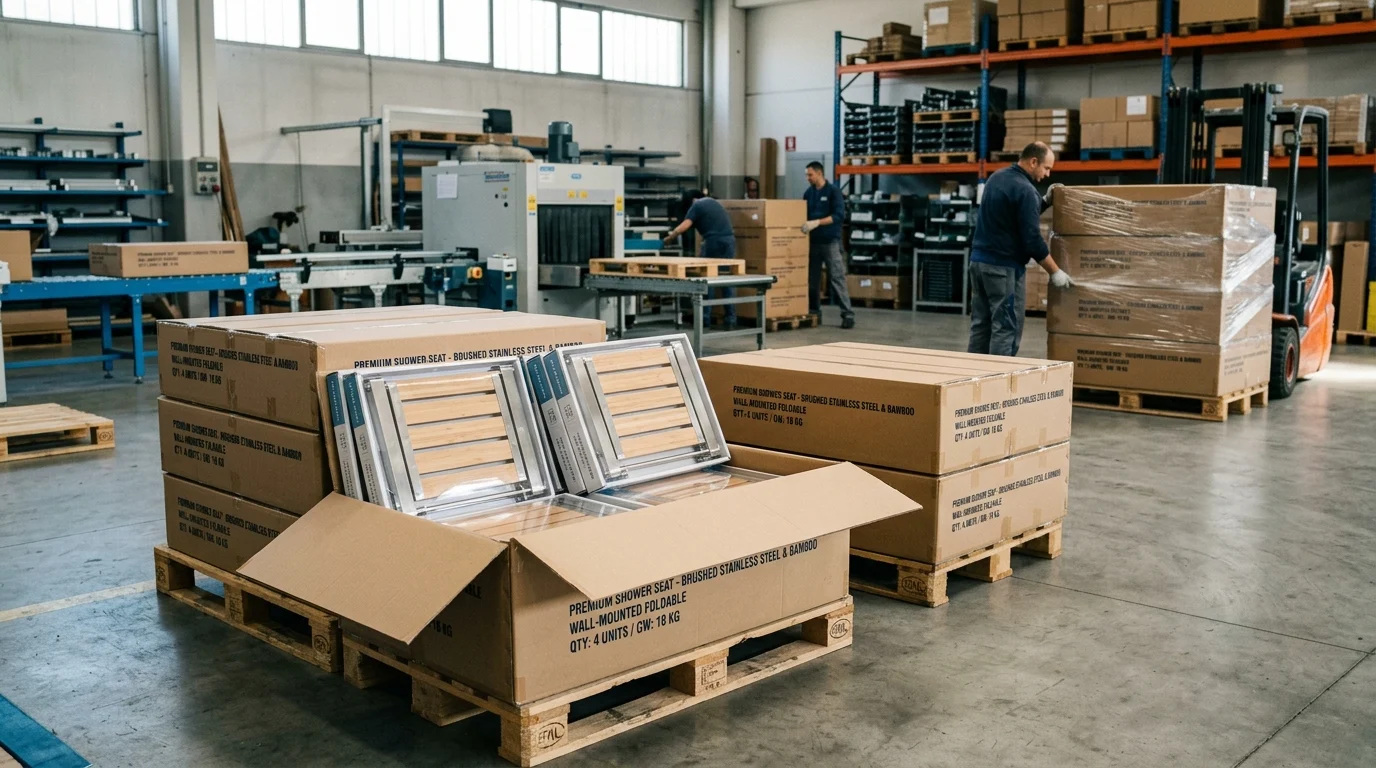
In commercial procurement, logistics and packaging are vital to ensure products arrive at the job site undamaged. Premium manufacturers utilize high-density, custom-molded EPE foam packaging designed to pass ISTA 2A drop-test standards. This prevents the heavy metal brackets from puncturing the packaging or damaging the seating surface during international transit. For large projects, Minimum Order Quantities (MOQs) play a role; while standard finishes may have an MOQ of 10 to 50 units, custom powder-coated finishes or specific teak variations often require an MOQ of 100 to 200 units to justify the production run.
Long-term performance is heavily reliant on spare parts support. A key differentiator of a premium supplier is the availability of replacement wear components. Even the highest quality PTFE hinge washers, gas struts, or decorative screw covers may require replacement after 7 to 10 years of heavy commercial use. Premium manufacturers maintain detailed CAD schematics and commit to supplying spare parts for a minimum of 10 years post-production, preventing the need to replace the entire fixture due to a single worn component.
Regional Standards and Project Procurement Channels
Navigating regional standards is a complex aspect of global procurement. A wall-mounted foldable shower seat that is compliant in North America may not meet the specific regulatory requirements of the European Union or Australasia. Procurement managers must ensure the selected product aligns with the local building codes of the project destination.
Region | Primary Standard/Regulation | Key Focus Areas for Shower Seats |
United States | ADA / ANSI A117.1 | Dimensions (17″-19″ height), 250+ lbs load, L-shape requirements |
European Union | CE / EN 12182 | Biocompatibility, structural fatigue testing, risk mitigation |
Australia / NZ | AS 1428.1 | Minimum load 1100 N, specific mounting clearances, slip resistance |
United Kingdom | Doc M (Building Regs) | Visual contrast (LRV), safe folding mechanisms, accessibility dimensions |
Choosing the Right Premium Shower Seat
Selecting the optimal premium wall-mounted foldable shower seat requires a strategic balance between upfront capital expenditure, long-term operational costs, and the specific functional requirements of the installation environment. A one-size-fits-all approach inevitably leads to either over-specification and wasted budget, or under-specification and premature failure.
Balancing Safety, Cost, and Application Needs
The selection process must be driven by the primary application of the facility. In a high-traffic healthcare or assisted living environment, safety and infection control take absolute precedence. In these scenarios, specifying an antimicrobial HDPE seat with a heavy-duty 316L stainless steel frame capable of supporting over 400 lbs is essential. Conversely, in a luxury boutique hotel, aesthetic integration and tactile experience are paramount. Here, a minimalist matte-black aluminum frame paired with a slotted Burmese teak seat provides the necessary visual impact while still offering robust performance.
Cost bands for wall-mounted foldable shower seats vary significantly based on these material and engineering choices. Entry-level commercial seats typically range from $100 to $150. Mid-tier premium seats, featuring standard 304 stainless steel and phenolic tops, generally fall into the $200 to $350 bracket. True luxury or highly specialized bariatric models, utilizing 316L stainless steel, custom PVD finishes, or advanced dampening hinges, command prices from $500 to well over $800 per unit. Procurement teams must weigh these costs against the expected daily usage volume and the demographic profile of the end-users.
When Higher Upfront Cost Delivers Long-Term Value
While value engineering often tempts project managers to select lower-cost fixtures, the higher upfront cost of a premium shower seat consistently delivers superior long-term value. A comprehensive Return on Investment (ROI) analysis reveals the hidden costs of budget fixtures. For instance, a $150 seat may succumb to hinge fatigue or galvanic corrosion within 2 to 3 years in a commercial locker room. The cost to remove the failed unit, repair the compromised waterproofing membrane in the wall, and install a replacement far exceeds the initial savings.
Furthermore, the risk of catastrophic failure under load carries immense financial liability. A premium seat costing $400, engineered with a 15-year lifecycle and a 500-lb load rating, effectively neutralizes this risk. By investing in premium materials, precision engineering, and verified compliance, facility owners protect their users, reduce maintenance overhead, and ensure that the architectural integrity of the space is preserved for decades.
Key Takeaways
- Specify premium wall-mounted foldable shower seats as long-term operational investments rather than low-cost utility fixtures.
- Choose corrosion-resistant materials and finishes for wet environments exposed to steam, chlorides, and harsh cleaning chemicals.
- For commercial projects, prioritize seats tested for more than 50,000 folding cycles to reduce maintenance and replacement risk.
- Select models designed to support dynamic loads exceeding 400 lbs with an appropriate safety factor and certified installation method.
- Use concealed hardware and durable finishes such as brushed nickel, matte black, or polished chrome to preserve modern bathroom aesthetics.
- Avoid low-grade metals such as untreated carbon steel or inferior stainless steel in high-use hospitality, healthcare, and assisted living bathrooms.
Frequently Asked Questions
Why choose a premium wall-mounted foldable shower seat?
Premium models offer stronger load support, better corrosion resistance, smoother folding action, and longer service life in wet environments. They are especially valuable in hotels, healthcare spaces, assisted living facilities, and elegant residential bathrooms.
What materials perform best in a wall-mounted foldable shower seat?
High-grade stainless steel, heavy-gauge architectural metals, advanced composites, and durable corrosion-resistant finishes perform best. These materials resist humidity, cleaning chemicals, pitting, peeling, and structural fatigue.
How much weight should a premium shower seat support?
A well-specified premium shower seat should typically support dynamic loads above 400 lbs (181 kg) with a safety factor of 2.0 or higher, depending on wall structure, mounting hardware, and installation quality.
Are foldable shower seats suitable for luxury bathrooms?
Yes. Modern foldable shower seats combine accessibility with refined design. Concealed hardware, brushed nickel, matte black, or polished chrome finishes help them blend into contemporary bathrooms without compromising style.
How long should a premium foldable shower seat last?
Premium models are often tested for more than 50,000 folding cycles and can maintain hinge tension and structural integrity for years when properly installed and maintained.


