

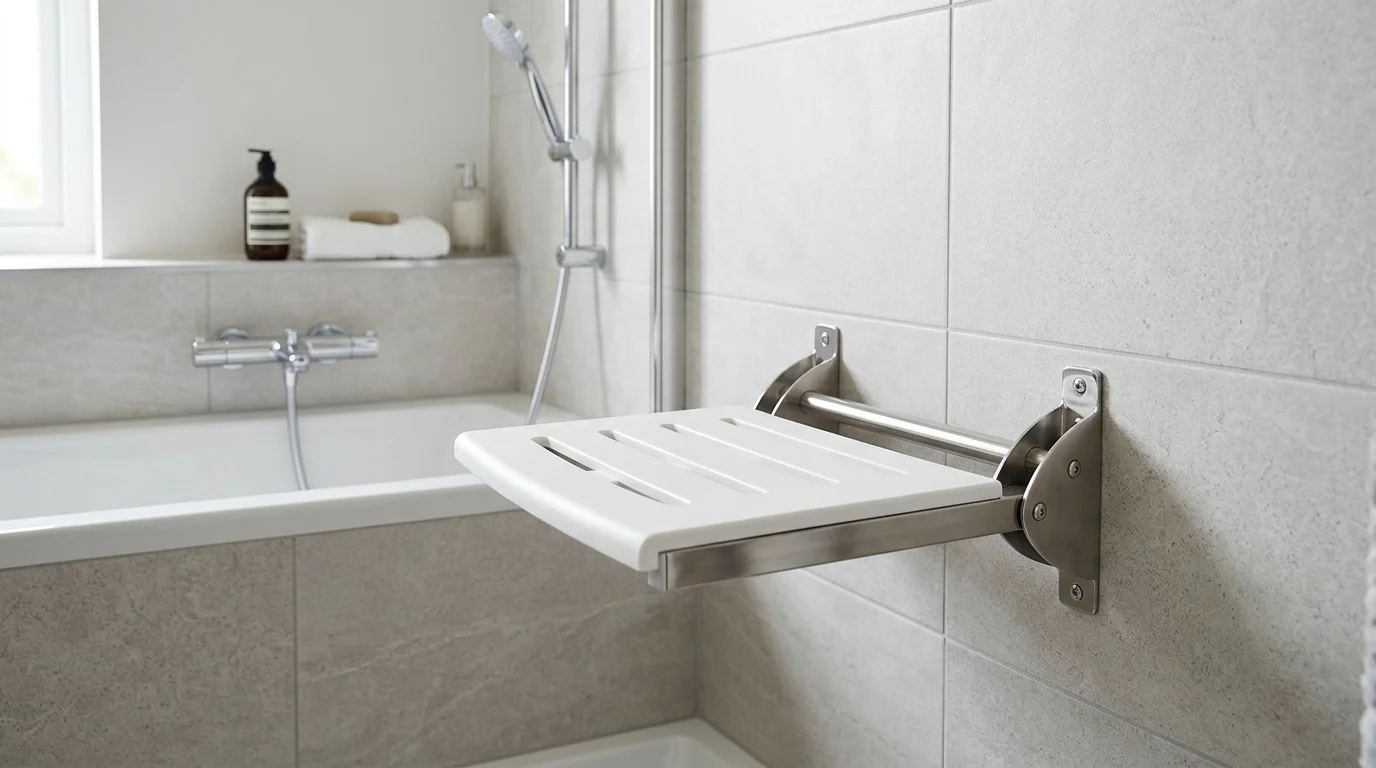
A marble shower can look effortless, but adding a wall mounted bath seat turns the design into a structural and waterproofing challenge. Natural stone is far less forgiving than porcelain; many marbles offer only about 10 to 15 MPa of flexural strength, making poor anchoring a costly risk. This guide explains how to plan the seat before construction, protect high-end stone from stress cracks, coordinate membranes and mounting hardware, and select finishes that complement premium shower fixtures. For homeowners, designers, and contractors pursuing Cassbern-style enduring elegance, the goal is simple: create a shower seat that feels integrated, secure, and visually refined from day one.

Why Specify a Wall Mounted Bath Seat Early
Integrating a wall mounted bath seat into a shower enclosure clad in high-end marble requires meticulous upfront engineering. Unlike standard ceramic or porcelain tile, natural marble presents unique structural and chemical vulnerabilities. Failing to specify the bath seat during the initial architectural design phase often results in compromised waterproofing, cracked stone panels, or aesthetically disjointed hardware that detracts from the luxury envelope.
Early specification ensures that the structural backing, waterproofing membrane, and stone fabrication are engineered as a cohesive system. When dealing with premium materials such as Calacatta Gold, Statuario, or Nero Marquina, the cost of retrofitting or replacing damaged slabs far exceeds the investment in proper preliminary coordination. A proactive approach dictates that the seat’s mounting footprint, dynamic load requirements, and hardware finishes are finalized before the first stud is placed.
Preventing Stone and Tile Damage
Natural stone, particularly marble, exhibits relatively low flexural strength compared to engineered porcelain. While a high-quality porcelain tile might boast a flexural strength exceeding 35 MPa, typical marble ranges only between 10 and 15 MPa. This inherent brittleness makes marble highly susceptible to cracking under localized shear stress or compression.
When a wall mounted bath seat is anchored directly through the marble without proper structural isolation, the dynamic loads generated by a user sitting or shifting weight are transferred directly to the stone fascia. Early specification allows architects to design isolated mounting nodes—utilizing specialized standoffs or oversized sleeve anchors—that transfer the load directly to the structural blocking behind the wall, entirely bypassing the marble and eliminating the risk of stress fractures.
Coordinating Structure, Waterproofing, and Finishes
The integrity of a luxury shower depends heavily on its continuous waterproofing envelope. Retrofitting a heavy-duty bath seat necessitates penetrating the finished stone and the underlying moisture barrier, creating high-risk pathways for water ingress. In a properly sequenced project, structural blocking—typically comprising 2×8 timber or 6mm thick steel plates—is installed between the studs prior to the application of cement board and waterproofing membranes.
By specifying the seat early, contractors can integrate the mounting hardware with the waterproofing system. Liquid-applied membranes or sheet membranes can be sealed directly to the anchoring flanges or threaded rods before the marble is installed. This sequence ensures a 100% watertight seal around the penetrations, mitigating the risk of hidden mold growth, substrate rot, and subsequent efflorescence on the marble surface.
Aligning Design Intent with Project Priorities
High-end residential and commercial hospitality projects rely on strict adherence to a unified design language. The hardware of a wall mounted bath seat must harmonize with the shower fixtures, hinges, and linear drains. Specifying the seat early allows designers to custom-order hardware finishes—such as physical vapor deposition (PVD) brushed brass or matte black—that perfectly match the primary plumbing fixtures.
Furthermore, early coordination allows the stone fabricator to map the veining of the marble around the seat’s exact location. The seat can be positioned to avoid interrupting a dramatic vein or to align precisely with the grout joints if a specific modular tile layout is utilized. This level of granular design alignment separates standard installations from true luxury architecture.
What Defines a High End Wall Mounted Bath Seat
A high-end wall mounted bath seat is defined by its ability to deliver uncompromising structural integrity while maintaining a refined, architectural aesthetic. In luxury applications, the seat ceases to be merely an accessibility accessory; it becomes a deliberate design feature. The distinction between a standard institutional seat and a premium architectural fixture lies in the precision of its moving parts, the caliber of its materials, and the sophistication of its ergonomic design.
Manufacturers of luxury bath seats prioritize concealed fasteners, ultra-slim profiles, and materials that offer tactile warmth and visual elegance. The engineering must be invisible, ensuring that the heavy-duty mechanics required to support substantial weight do not disrupt the clean lines of the marble enclosure.
Fixed, Folding, and Removable Seat Options
The choice between fixed, folding, and removable configurations depends heavily on the spatial dynamics of the shower enclosure and the specific needs of the end user. Fixed seats, often cantilevered from the wall using heavy-duty concealed brackets, offer a monolithic appearance and maximum rigidity. However, they demand significant square footage and are generally reserved for expansive, walk-in wet rooms.
Folding seats are the premier choice for maximizing space without sacrificing utility. High-end folding mechanisms utilize precision-machined, marine-grade stainless steel hinges equipped with soft-close dampeners. These hinges are rigorously tested, often exceeding 50,000 deployment cycles, to guarantee a lifetime of silent, frictionless operation. Removable options, which interlock with permanently mounted wall nodes, offer ultimate flexibility for multi-generational bathrooms, though they require meticulous engineering to ensure the nodes themselves remain visually unobtrusive when the seat is detached.
Materials, Finishes, and Visual Integration
Visual integration with high-end marble demands materials that complement, rather than compete with, the stone’s natural beauty. Sustainably sourced Burmese teak remains a hallmark of luxury, offering natural resistance to moisture and rot while introducing organic warmth against the cool surface of the marble. Alternatively, solid surface materials (such as high-performance acrylic resins) can be color-matched to the dominant tones of the stone, creating a seamless, floating effect.
The metallic components of the seat—brackets, hinges, and mounting escutcheons—must be fabricated from 316L marine-grade stainless steel to prevent oxidation in highly corrosive, damp environments. Premium manufacturers utilize PVD coatings rather than traditional electroplating. PVD finishes bond at the molecular level, offering exceptional resistance to the abrasive cleaners and hard water deposits that frequently degrade standard finishes.
Comfort, Safety, and User Experience
Beyond aesthetics and durability, a high-end wall mounted bath seat must deliver superior comfort and safety. The seating surface must provide adequate drainage to prevent water pooling, typically achieved through precisely milled slots or a subtle, engineered slope of 1 to 2 degrees toward the shower floor.
Slip resistance is a critical safety metric. The seating surface should maintain a dynamic coefficient of friction (DCOF) greater than 0.42, even when wet and coated with soapy residue. Furthermore, the thermal mass of the material impacts user comfort; solid wood or composite resins are preferred over bare metal surfaces, as they do not draw heat away from the user’s body, ensuring a comfortable experience immediately upon contact.
Key Technical Specifications
Translating a design concept into a durable, safe reality requires strict adherence to technical specifications. A wall mounted bath seat exerts severe biomechanical forces on its mounting points. When a user sits, the seat acts as a lever, converting the downward vertical load into immense pull-out (tensile) forces at the top anchors and compressive forces at the bottom anchors.
Managing these forces within a marble-clad environment demands rigorous engineering. Architects and installers must evaluate load ratings, fastener pull-out strength, and the chemical compatibility of waterproofing agents to ensure the installation survives decades of daily use without compromising the structural envelope.
Load Rating, Reinforcement, and Anchoring
While standard accessibility guidelines (such as the ADA) mandate that a shower seat withstand a minimum static load of 250 lbs (approx. 113 kg), high-end residential and commercial specifications consistently demand much higher thresholds. Premium wall mounted bath seats are typically engineered for dynamic load ratings of 400 to 500 lbs (181 to 226 kg). Achieving this requires substantial behind-the-wall reinforcement.
Anchoring directly into timber studs is rarely sufficient for luxury applications. Best practices dictate the installation of a continuous 6mm to 8mm thick stainless steel or aluminum backing plate, securely bolted across a minimum of three vertical studs. The seat’s mounting hardware—usually M8 or M10 stainless steel lag bolts or machine screws—must thread directly into this metal plate, ensuring that the pull-out capacity exceeds 1,000 lbs per fastener, thereby neutralizing the leverage effect of the cantilevered seat.
Waterproofing, Penetrations, and Grout Joint Planning
Penetrating a marble slab requires exacting precision to avoid initiating micro-fractures. Core drilling must be utilized, and the diameter of the hole in the marble must be slightly larger than the anchor shaft (typically a 2mm to 3mm over-drill) to prevent the metal hardware from expanding against the stone during temperature fluctuations. This annular space must be filled with a high-performance, mold-resistant structural silicone or polyurethane sealant.
Whenever possible, mounting points should be planned to align with grout joints rather than the center of a marble tile, though this depends entirely on the hardware template and tile format. If drilling through the tile face is unavoidable, the penetrations must be located a minimum of 25mm from any tile edge to prevent edge spalling. The use of EPDM (ethylene propylene diene monomer) rubber gaskets behind the mounting escutcheons is non-negotiable; these gaskets isolate the metal from the stone, preventing galvanic corrosion and absorbing micro-vibrations.
Seat Material and Hardware Comparison
Selecting the appropriate material for the seating surface involves balancing structural capacity, maintenance requirements, and user comfort. The following table outlines the comparative technical properties of common high-end seat materials:
Material Type | Density (g/cm³) | Thermal Comfort | Maintenance Requirement | Typical Lifespan |
Burmese Teak | 0.65 – 0.75 | High (Warm) | Periodic oiling required | 15 – 20+ Years |
Solid Surface (Acrylic) | 1.70 – 1.80 | Moderate (Neutral) | Low (Non-porous) | 20+ Years |
Phenolic Resin | 1.30 – 1.45 | Moderate | Very Low (High chemical resistance) | 25+ Years |
316L Stainless Steel | 7.99 | Low (Cold) | Low (Requires regular wiping) | 50+ Years |
Phenolic resin offers the highest strength-to-weight ratio and is entirely impervious to moisture, making it ideal for high-traffic commercial spas. However, for luxury residential applications where tactile warmth is prioritized, solid surface acrylics or natural teak remain the preferred choices, provided the client accepts the associated maintenance schedules.
Installation and Coordination Workflow
The installation of a heavy-duty fixture over premium marble is a zero-tolerance operation. Unlike drywall or standard ceramic tile, marble cannot be easily patched or concealed if an error occurs. A misaligned drill hole or an overtightened bolt can instantly ruin a slab worth thousands of dollars.
Consequently, the coordination workflow must be highly structured, involving close collaboration between the architect, the structural engineer, the waterproofing contractor, and the stone fabricator. This multi-disciplinary approach ensures that structural requirements are met without compromising the aesthetic integrity of the marble finish.
Shop Drawings, Site Verification, and Sequencing
The workflow begins with detailed shop drawings. The seat manufacturer’s mounting template must be digitally overlaid onto the stone fabricator’s CAD drawings. This allows the team to visualize exactly where the anchors will penetrate the marble in relation to the veining and the grout lines. Site verification is mandatory before fabrication begins; the framing and structural blocking must be laser-scanned or physically measured to confirm they align perfectly with the proposed tile layout.
Sequencing is equally critical. The structural backing is installed first, followed by the cementitious backer board and the primary waterproofing membrane. The stone installer must then coordinate with the hardware installer to ensure the precise transfer of the mounting template onto the finished marble surface before the final core drilling commences.
Tolerance Control and Finish Alignment
High-end installations operate on exceedingly tight tolerances, often requiring alignments within <2mm of the design specification. Core drilling through marble must be executed using water-cooled diamond bits at low RPMs to maintain a clean, chip-free aperture. Once the holes are established, the alignment of the seat hardware must be verified using laser levels to ensure the seat is perfectly horizontal; even a 1-degree tilt will cause water to pool or make the seat uncomfortable.
During final assembly, torque control is paramount. Installers must use calibrated torque wrenches when securing the mounting bolts. The required torque typically ranges from 15 to 20 Nm depending on the anchor type. Exceeding this torque spec can compress the EPDM gaskets too aggressively, transferring crushing force directly into the marble fascia and causing catastrophic cracking.
Accessibility, Compliance, and Final Inspection
While aesthetic integration is a primary goal, the installation must also comply with relevant accessibility codes, particularly in commercial or hospitality settings. In the United States, ADA guidelines dictate that the top of the shower seat must be mounted between 17 and 19 inches (432mm to 482mm) above the finished shower floor. The seat must also extend a specific distance from the wall to accommodate safe transfers.
Final inspection involves a rigorous load test and a thorough examination of the waterproofing seals. Inspectors will verify that the seat operates smoothly (if folding), that all escutcheons sit perfectly flush against the marble without gaps, and that the structural integrity of the wall remains uncompromised under maximum dynamic load. Only after these criteria are met is the installation certified for use.
How to Select the Right Wall Mounted Bath Seat
Selecting the optimal wall mounted bath seat for a high-end marble shower requires synthesizing aesthetic desires with practical realities. The specification process should be driven by the anticipated frequency of use, the maintenance capabilities of the facility or homeowner, and the specific environmental conditions of the bathroom.
Procurement must be handled strategically. Custom finishes and specialized materials often carry significant lead times that can derail a project schedule if not ordered well in advance of the stone fabrication phase.
When to Prioritize Visual Discretion
In minimalist architectural designs where the marble is intended to be the undisputed focal point, visual discretion is paramount. In these scenarios, specifiers should prioritize folding seats featuring ultra-slim profiles. Premium folding seats can achieve a folded depth of <40mm from the wall, allowing them to virtually disappear when not in use.
Color-matching plays a crucial role in visual discretion. Specifying a solid surface seat that closely matches the background color of a Carrara or Statuario marble ensures the fixture blends into the envelope. Additionally, selecting hardware with concealed hinges and internal mounting flanges eliminates visible screw heads, preserving the monolithic aesthetic of the shower space.
When to Prioritize Durability and Maintenance
For luxury hospitality environments, wellness centers, or homes located in areas with exceptionally hard water (high calcium and magnesium content), durability and ease of maintenance must take precedence over organic aesthetics. In these environments, natural woods like teak, while beautiful, require prohibitive levels of maintenance to prevent soap scum buildup and discoloration.
Instead, specifiers should opt for aeronautical-grade phenolic resins or high-density polymers. These materials are non-porous, highly resistant to chemical cleaners, and will not warp or degrade under continuous exposure to steam and high-mineral water. Paired with PVD-coated 316L stainless steel hardware, these seats offer a “install and forget” lifecycle, requiring nothing more than routine wiping to maintain their factory appearance.
Final Procurement Checklist
To ensure a seamless integration with high-end marble tiles, architects and procurement managers must adhere to a strict checklist before finalizing the purchase order. This includes verifying the dynamic load rating (>400 lbs), confirming the hardware finish matches the plumbing fixtures, and ensuring the mounting template is compatible with the structural blocking design.
Procurement Category | Standard Off-the-Shelf | Custom Finish (PVD / Powder Coat) | Bespoke Sizing / Material |
Typical Lead Time | 1 – 2 Weeks | 6 – 8 Weeks | 10 – 14 Weeks |
Minimum Order Quantity (MOQ) | 1 Unit | 10 – 20 Units | 25+ Units |
Cost Multiplier | 1.0x (Baseline) | 1.5x – 2.0x | 3.0x+ |
Understanding the lead times associated with custom finishes is critical. As demonstrated in the procurement table, specifying a custom PVD brushed brass finish to match a specific brand of luxury shower valves can extend lead times to 8 weeks or more. Ordering the bath seat concurrently with the rough plumbing valves ensures that the structural backing and hardware are on-site precisely when the stone fabricator requires them, guaranteeing a flawless, high-end execution.
Key Takeaways
- Specify the wall mounted bath seat before framing so structural blocking, waterproofing, stone layout, and hardware finishes can be coordinated correctly.
- Do not let marble carry the seat load, because typical marble flexural strength is only about 10 to 15 MPa compared with high-quality porcelain that can exceed 35 MPa.
- Use structural supports such as 2×8 timber blocking or 6mm steel plates behind the wall to transfer dynamic seat loads into the framing.
- Seal all seat anchor points into the waterproofing membrane before marble installation to reduce the risk of water ingress, mold, rot, and efflorescence.
- Coordinate the seat finish with shower fixtures, hinges, drains, and niches to maintain a unified luxury design language.
Frequently Asked Questions
When should a wall mounted bath seat be specified for a marble shower?
Specify it during the initial design phase, before framing, waterproofing, or stone fabrication begins. Early planning ensures the seat’s load points, backing, waterproofing, and finish details are coordinated as one system.
Can a wall mounted bath seat be installed directly through marble tile?
It should not rely on the marble for support. Marble is brittle, so the seat must transfer weight into structural blocking or steel plates behind the wall, with the stone isolated from stress.
What backing is recommended for a wall mounted bath seat?
Common backing options include 2×8 timber blocking or steel plates installed between studs. The correct choice depends on seat design, user load requirements, wall construction, and local code expectations.
Why is waterproofing critical around a wall mounted bath seat?
Seat fasteners penetrate the shower wall, so every anchor point must be sealed into the waterproofing system. Poor sealing can lead to hidden leaks, mold, substrate rot, and marble discoloration.
How do I match a bath seat finish with luxury shower fixtures?
Choose hardware finishes early and coordinate them with shower systems, drains, hinges, and accessories. Cassbern’s design-led approach favors cohesive finishes such as brushed brass, stainless, or matte black for a refined bathroom.


