

Introduction
Choosing a premium shower seat for a commercial project affects far more than accessibility. In healthcare, hospitality, and senior living settings, this fixture must withstand frequent use, moisture exposure, aggressive cleaning protocols, and significant load demands without compromising safety or the surrounding wall assembly. This guide explains the criteria that matter most when evaluating premium options, including structural performance, material durability, compliance, installation requirements, and long-term maintenance implications. By the end, readers will have a practical framework for comparing products and specifying a shower seat that supports user safety, reduces lifecycle costs, and aligns with the operational demands of commercial environments.
Why Premium Shower Seat Selection Matters in Commercial Projects
Specifying premium shower seats in commercial projects transcends basic accessibility compliance, representing a critical intersection of risk management, operational efficiency, and user experience. In high-traffic facilities such as hospitals, senior living communities, and luxury hotels, the shower seat is a high-liability fixture subjected to constant moisture, dynamic weight loads, and harsh chemical cleaners.
Commercial specifiers must navigate strict performance metrics to protect both the user and the facility’s bottom line. Selecting a substandard fixture often leads to mechanical failure, water ingress into the wall cavity, and catastrophic liability claims, making the initial specification a foundational element of commercial bathroom design.
Impact on lifecycle cost
Commercial facilities face substantial maintenance burdens when specifying commodity fixtures. While a standard residential-grade shower seat might present an initial acquisition cost of $150 to $300, premium commercial models ranging from $500 to $1,200 yield a significantly lower total cost of ownership. Over a 15-year facility lifecycle, commodity units typically fail and require replacement every 3 to 5 years due to hinge corrosion or substrate degradation.
Replacing a failed unit is not merely a matter of hardware costs. When factoring in specialized labor rates at $85 to $120 per hour, potential wall repairs, and the downtime of a revenue-generating hotel room or patient ward, the lifecycle costs for cheap fixtures can escalate by up to 300% compared to a single premium installation. Investing in heavy-duty structural integrity upfront effectively eliminates these recurring maintenance expenditures.
Application needs by commercial setting
Different commercial environments dictate highly specialized specifications. Acute care and assisted living facilities require stringent infection control and bariatric capacities. In these settings, seats must frequently support dynamic loads exceeding 500 pounds and feature seamless, non-porous surfaces that withstand hospital-grade disinfectants without degrading.
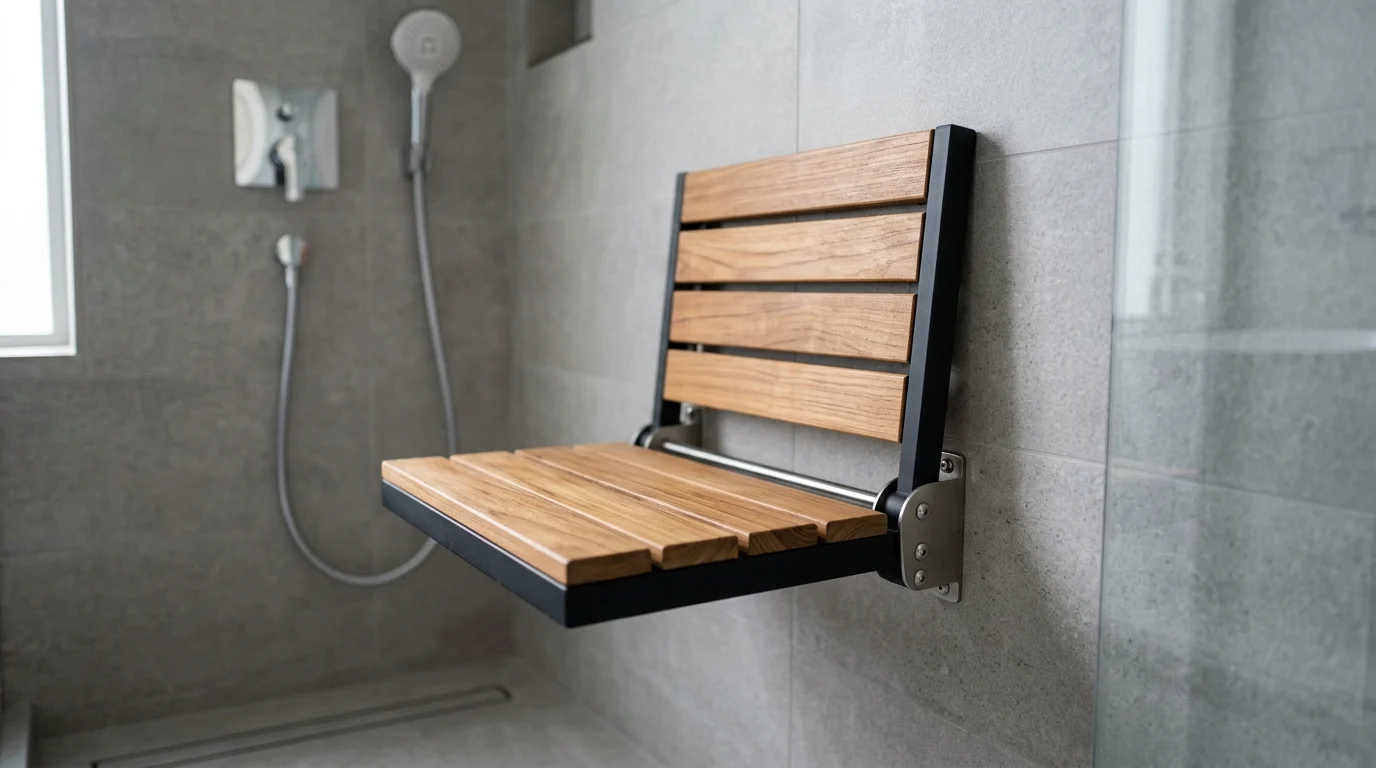
Conversely, luxury hospitality projects prioritize aesthetic integration alongside durability. These environments demand phenolic, teak, or custom-molded composite surfaces that resist continuous moisture while aligning with high-end interior design palettes. Fitness centers and country clubs face a different challenge, requiring seats that can endure near-constant daily cycles of use and high ambient humidity without developing mechanical fatigue in the folding mechanisms.
What Defines a Premium Shower Seat in Commercial Specifications
A premium specification is characterized by uncompromised structural integrity, advanced material science, and precision engineering. Unlike residential variants, commercial shower seats are designed to withstand high-frequency use, aggressive cleaning protocols, and extreme cantilevered forces without degrading or presenting safety hazards.
Material, load rating, finish, and mounting criteria
The baseline requirement for commercial accessibility is a 250-pound static load capacity, but premium specifications mandate a minimum of 500 pounds, with bariatric models engineered for 900 to 1,000 pounds of static load. To achieve this, frame construction must utilize 18-gauge, Type 304 or Type 316 stainless steel to prevent oxidation in high-humidity environments.
Seat tops typically feature 1/2-inch thick solid phenolic or high-density polyethylene (HDPE), providing superior resistance to water ingress.
Surface Material | Water Resistance | Impact Strength | Ideal Commercial Application |
Solid Phenolic | Excellent (<1% absorption) | Very High | Healthcare, High-Traffic Public Facilities |
High-Density Polyethylene (HDPE) | Excellent (0% absorption) | High | Gyms, Institutional Settings |
Type 304 Stainless Steel | Ultimate | Ultimate | Corrections, Heavy Industrial |
Sealed Teak Wood | Moderate (Requires maintenance) | Medium | Luxury Hospitality, Spas |
Mounting criteria for premium units demand heavy-duty flanges with multiple anchor points, ensuring the shear forces generated by a seated user are distributed evenly across the structural backing.
Fixed, folding, and wall-mounted seat types
Wall-mounted folding seats dominate commercial applications due to their spatial efficiency. These units typically extend 21 to 24 inches from the wall when deployed, providing ample transfer space, yet fold to a minimal profile of less than 3 inches to preserve turning radiuses for wheelchair users when not in use.
Fixed bench seats are generally reserved for expansive custom enclosures where space optimization is not a primary constraint. Floor-supported folding models represent a hybrid approach, specified when structural wall backing is insufficient or retrofit constraints exist. These models utilize adjustable stainless steel legs to transfer up to 70% of the shear load directly to the shower pan, mitigating the pull-out risk on the wall anchors while still offering folding functionality.
How to Evaluate Compliance, Durability, and Safety
Rigorous evaluation of shower seats requires navigating a complex matrix of federal accessibility codes, mechanical testing protocols, and environmental resistance standards. Safety in a wet commercial environment leaves no margin for error, making third-party compliance verification a mandatory step in the specification process.
Codes, accessibility requirements, and testing standards
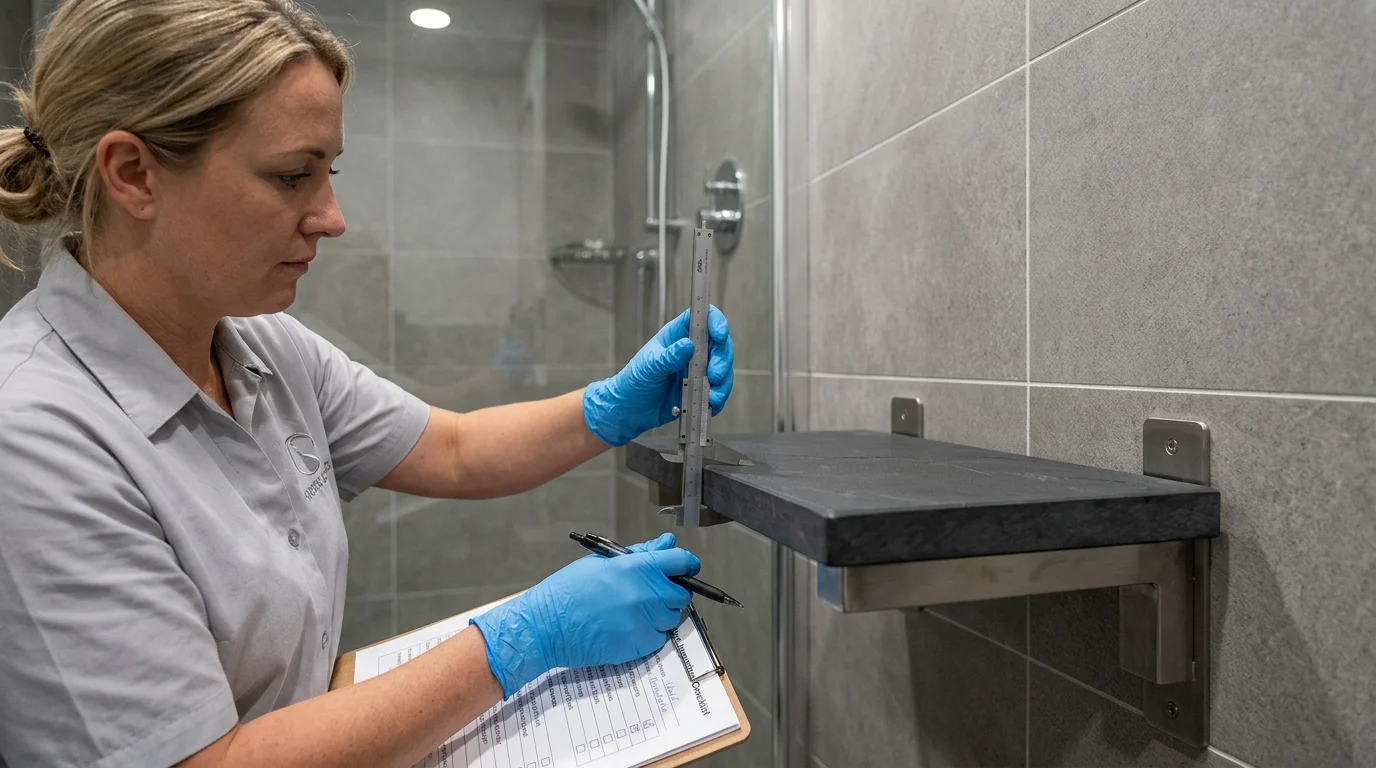
Accessibility compliance in the United States centers on the Americans with Disabilities Act (ADA) and ICC A117.1 standards. These codes mandate precise geometrical and positional criteria: the top of the seat must be positioned between 17 and 19 inches above the finished floor, and the seat edge must be located a maximum of 1.5 inches from the shower control wall.
Furthermore, the L-shaped or rectangular seat must withstand a vertical or horizontal force of 250 pounds applied at any point. Premium manufacturers do not rely on internal estimates; they validate these mechanical requirements through independent ISO 17025 accredited testing laboratories, providing specifiers with certified engineering reports that shield facility owners from ADA litigation.
Corrosion resistance, cleanability, and hardware design
Durability in wet environments relies heavily on exceptional corrosion resistance. Premium hardware undergoes ASTM B117 salt spray testing, typically expected to exceed 1,000 hours of continuous saline exposure without exhibiting red rust. This ensures the structural integrity of the hinges and mounting flanges over a decade of use.
Cleanability is optimized through continuous-seam welding and concealed flange mounting systems. These design choices eliminate micro-crevices where biofilm, mold, and methicillin-resistant Staphylococcus aureus (MRSA) can proliferate. Additionally, premium hardware design must feature constant-friction or dampening hinges. This prevents the seat from slamming down in an uncontrolled drop—a critical safety feature in geriatric and healthcare settings that protects fragile users from impact injuries.
Procurement and Installation Factors
Successful deployment of premium shower seating hinges on strategic procurement planning and rigorous structural coordination during the rough-in phase of construction. Even the most robustly engineered seat will fail if the supply chain introduces delays or if the installation environment lacks the requisite structural support.
Manufacturers, lead times, warranties, and support
The commercial supply chain for architectural hardware requires proactive lead time management. Standard premium stainless steel models typically ship within 2 to 4 weeks, whereas custom phenolic colors, bariatric sizes, or non-standard dimensions may extend lead times to 8 to 12 weeks. Procurement teams must align these schedules with the framing and waterproofing phases of the project.
Warranty terms serve as a reliable proxy for manufacturing quality. While commodity units offer standard 1-year limited warranties, premium manufacturers provide 5-year to 10-year commercial warranties covering mechanical failure and finish degradation. For large-scale developments like 300-room hotels, procurement teams should negotiate staggered deliveries, often requiring a Minimum Order Quantity (MOQ) of 50 to 100 units to secure volume pricing discounts of 15% to 25%.
Site conditions, backing requirements, and coordination
Installation failure is rarely a product defect; it is overwhelmingly caused by inadequate structural backing. Wall-mounted seats exert massive cantilevered forces on the mounting substrate. Specifications must demand heavy-gauge steel backing plates or minimum 3/4-inch fire-retardant treated (FRT) marine plywood installed flush with the studs before the installation of cement board and waterproofing membranes.
Substrate Backing Material | Fastener Pull-Out Strength | Deflection Risk | Recommended Application |
16-Gauge Steel Plate (Welded) | > 1,500 lbs per anchor | Zero | Bariatric Healthcare, Heavy Commercial |
3/4″ FRT Marine Plywood | 800 – 1,000 lbs per anchor | Low | Standard Commercial, Hospitality |
Standard 2×4 Wood Blocking | 400 – 600 lbs per anchor | Moderate | Light Commercial, Residential |
Hollow Wall Anchors / Toggle Bolts | < 200 lbs per anchor | Critical Failure | NEVER PERMITTED IN COMMERCIAL |
Fasteners must achieve a minimum pull-out strength of 1,000 pounds per anchor to safely support dynamic loads. Coordination between the architectural specifier, the framing contractor, and the tile installer is paramount to ensure the backing is located at the precise elevation required to achieve the 17-to-19-inch finished seat height.
Selection Framework for Commercial Projects
Establishing a standardized selection framework ensures that architects, specifiers, and procurement managers objectively evaluate shower seats against project-specific performance thresholds rather than initial purchase price alone. A systematic approach mitigates risk and aligns the final product with the facility’s operational goals.
Comparison criteria and weighted evaluation
A weighted evaluation matrix optimizes the decision-making process by assigning priority values to different product attributes. For high-traffic healthcare environments, specifiers should weigh load capacity and structural integrity at 40%, infection control and cleanability at 30%, lifecycle cost at 20%, and aesthetics at 10%.
Conversely, boutique hospitality projects might shift 35% of the evaluation weight to finish options and aesthetic integration, provided the baseline 250-pound ADA structural compliance is met. Implementing this quantitative scoring system creates a defensible specification that prevents value-engineering exercises from stripping critical safety and durability features out of the final build during budget reviews.
Final recommendation and specification checklist
To finalize the specification, commercial project teams should utilize a rigorous checklist prior to issuing purchase orders. This ensures no technical or compliance details are overlooked during the procurement phase.
- Compliance Verification: Ensure the selected model explicitly provides third-party certification of compliance with ICC A117.1 and ADA guidelines.
- Material Validation: Verify that the frame utilizes minimum 18-gauge Type 304 or 316 stainless steel with constant-friction hinges.
- Structural Coordination: Confirm that blocking details (e.g., 16-gauge steel plates or 3/4-inch plywood) are explicitly detailed in the architectural drawings.
- Lifecycle Documentation: Secure documented cleaning and maintenance protocols from the manufacturer to hand over to the facility management team.
By adhering to this strict specification checklist, commercial developers ensure that the installed premium shower seats will deliver their intended 10-to-15-year lifecycle, providing safe, compliant, and aesthetically pleasing functionality for end users.
Key Takeaways
- The most important conclusions and rationale for Premium Shower Seat
- Specs, compliance, and risk checks worth validating before you commit
- Practical next steps and caveats readers can apply immediately
Frequently Asked Questions
What load rating should a premium shower seat have for commercial projects?
Specify at least 400 lb static capacity for most commercial settings. For healthcare, senior living, or bariatric use, look for models rated closer to 900–1,000 lb with reinforced wall backing.
Which shower seat material is best for high-traffic commercial bathrooms?
Solid phenolic and HDPE are top choices because they resist water, impact, and frequent chemical cleaning. Type 304 or 316 stainless frames add the durability needed for long-term commercial use.
Why are wall-mounted folding shower seats popular in commercial design?
They save space, maintain clear floor area, and support accessibility when folded away. This makes them ideal for hotels, healthcare rooms, and other projects where circulation and safety matter.
How does a premium shower seat reduce lifecycle costs?
It lowers replacements, labor, wall repair, and room downtime over time. A higher upfront investment often costs less across a 15-year commercial lifecycle than repeatedly replacing residential-grade units.
How can Cassbern shower seats fit a luxury commercial bathroom aesthetic?
Choose finishes and seat materials that match modern shower systems, niches, and other bathroom details. This helps create the polished, functional look Cassbern is known for while meeting commercial performance needs.


