

Introduction
Choosing a reliable Chinese supplier for a premium wall-mounted foldable shower seat involves more than comparing prices. UF resin models are often specified for healthcare, hospitality, senior living, and accessible residential projects because they combine durability, hygiene, and a clean architectural finish. This article highlights seven leading suppliers in China and explains what sets them apart, from material quality and load performance to compliance, manufacturing capability, and project support. If you are sourcing for large-scale developments or specification-driven environments, the overview will help you narrow the field and move into supplier evaluation with clearer criteria.
Why Source Premium Wall-Mounted Foldable Shower Seats from China
Procurement professionals and facility developers increasingly recognize the strategic value of sourcing architectural bathroom hardware from specialized overseas manufacturers. Among these fixtures, the premium wall-mounted foldable shower seat represents a highly technical product category that merges structural engineering with sophisticated industrial design.
Selecting a top-tier supplier for Urea-Formaldehyde (UF) resin shower seats requires navigating a complex global supply chain. Chinese manufacturers have established a dominant position in this niche, successfully transitioning from high-volume commodity production to precision-engineered, specification-grade architectural hardware suitable for stringent international markets.
Key demand in healthcare hospitality senior living and accessibl
e bathrooms
The global specification market for accessible bathroom fixtures has expanded significantly beyond basic institutional applications. In modern healthcare facilities, shower seats must withstand rigorous daily sanitization protocols involving harsh chemical disinfectants, making porous materials obsolete. Hospitality brands and luxury senior living developments require fixtures that do not compromise on aesthetics while adhering strictly to accessibility mandates.
Consequently, premium wall-mounted foldable shower seats must meet stringent dimensional and structural requirements. For example, the Americans with Disabilities Act (ADA) mandates a minimum structural load capacity of 250 lbs (113.4 kg), though premium UF resin models are typically engineered to support dynamic loads exceeding 400 lbs (181 kg). This convergence of aesthetic expectation and regulatory compliance drives the demand for thermosetting UF resin, a material prized for its ceramic-like finish, high density, and inherent antimicrobial properties.
Why China remains cost competitive for UF resin shower
seats
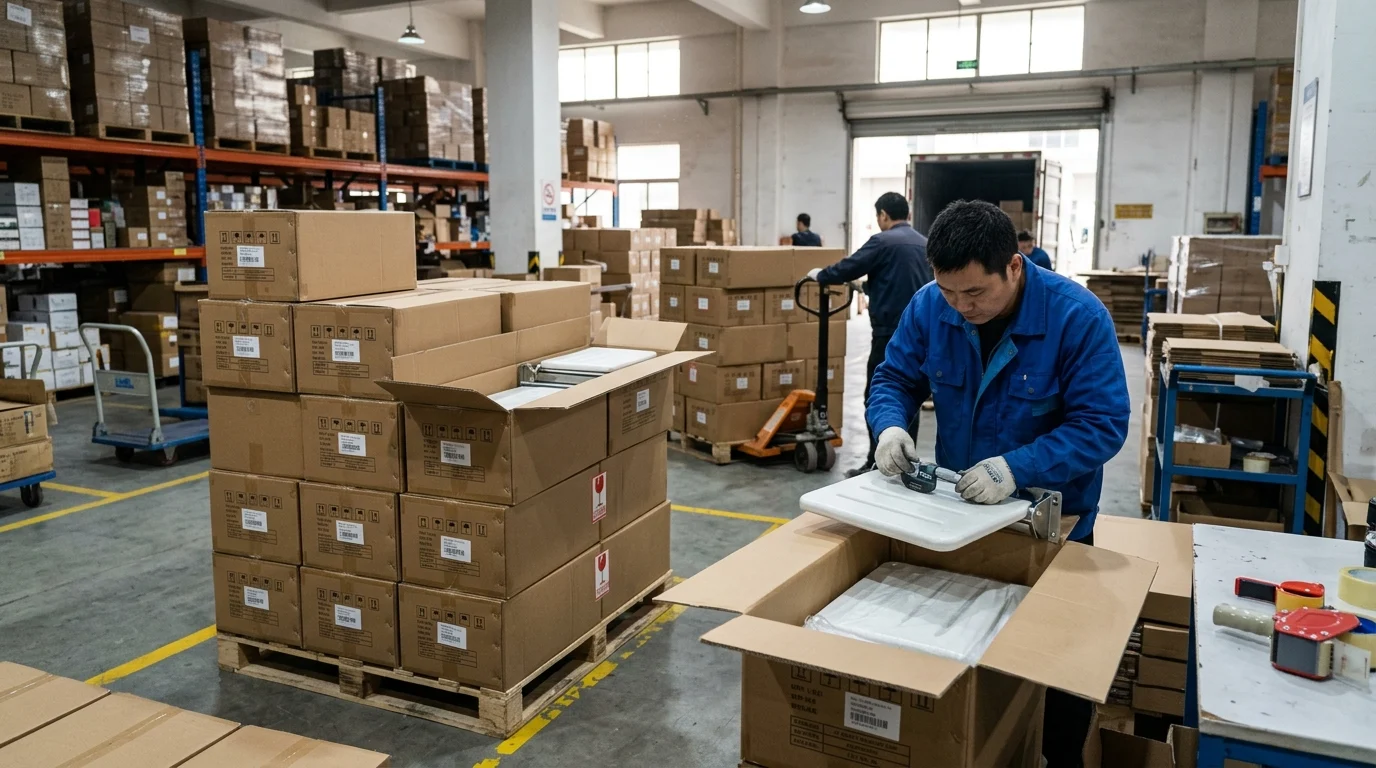
The Chinese manufacturing ecosystem maintains a distinct competitive advantage in the UF resin sanitary ware sector, driven by deep supply chain integration. Unlike generic plastics, UF resin requires specialized compression molding equipment and precise thermal control. By concentrating these specialized molding facilities in specific industrial clusters, such as Xiamen and Guangdong, Chinese suppliers achieve substantial economies of scale.
This localized concentration of raw material suppliers, tooling workshops, and assembly lines translates to a 20% to 30% cost reduction compared to European manufacturing hubs, without sacrificing material integrity. Furthermore, leading Chinese factories offer scalable Minimum Order Quantities (MOQs)—often starting between 300 and 500 units—allowing mid-sized distributors and institutional buyers to procure custom-branded, premium-grade products at factory-direct pricing.
Technical Criteria for Premium UF Resin Shower Seats
Distinguishing a premium wall-mounted foldable shower seat from a residential-grade alternative requires a rigorous evaluation of its technical specifications. Procurement teams must scrutinize the physical properties of the core materials, the engineering of the load-bearing mechanisms, and the empirical data validating the product’s lifespan.
Material load capacity hinge mounting and surface finish
The fundamental differentiator of a premium shower seat is the use of Urea-Formaldehyde (UF) resin, also known as Duroplast. Unlike thermoplastics (such as PP or ABS) which can flex and scratch easily, UF resin is a thermosetting polymer. Once cured at temperatures exceeding 160°C, it forms a rigid, scratch-resistant, and non-yellowing surface that closely mimics the tactile quality of ceramic.
Equally critical is the structural mounting system. A premium seat relies on heavy-duty mounting brackets and hinges manufactured from corrosion-resistant 304 or 316-grade stainless steel. The combination of dense UF resin and reinforced stainless steel frameworks allows top-tier models to achieve static load capacities ranging from 200 kg to 250 kg (440 to 550 lbs), ensuring absolute stability under dynamic human weight.
How to compare product quality and durability
Evaluating product durability extends beyond reviewing technical data sheets; it requires analyzing the manufacturer’s testing protocols. Quality is quantified through cyclical and environmental stress testing. The folding mechanism, which incorporates dampeners for a controlled soft-close action, should be certified for a minimum of 50,000 continuous folding cycles without mechanical degradation.
Additionally, the metallic components must undergo rigorous salt spray testing to verify corrosion resistance in high-humidity environments. Premium suppliers will provide documentation showing their hinges and wall brackets have passed 96-hour neutral salt spray tests (NSS) without exhibiting surface oxidation, a critical indicator of longevity in commercial shower enclosures.
Evaluation table for leading suppliers
To systematically differentiate suppliers, procurement teams utilize comparative matrices that benchmark standard market offerings against premium specifications. The following table illustrates the technical divergence between standard plastic seats and premium UF resin models sourced from top-tier Chinese manufacturers.
Technical Specification | Standard Grade Market Offering | Premium UF Resin Standard |
Core Seat Material | Polypropylene (PP) or ABS | Urea-Formaldehyde (UF) Resin |
Static Load Capacity | 120 kg (264 lbs) | 200 kg – 250 kg (440 – 550 lbs) |
Hinge & Bracket Material | 201 Stainless Steel or Aluminum | 304 or 316 Stainless Steel |
Folding Mechanism | Exposed spring, abrupt closure | Concealed damper, soft-close |
Surface Hardness | Low (Prone to micro-abrasions) | High (Thermosetting hardness) |
Salt Spray Resistance | 24 hours | 96+ hours |
How to Assess and Shortlist Top Suppliers
Identifying the top 7 suppliers from thousands of export profiles requires a systematic vetting process. Buyers must look beyond polished marketing materials and meticulously audit both the commercial viability and the technical manufacturing capabilities of potential partners.
Commercial and manufacturing indicators to review
The first phase of supplier assessment involves analyzing core commercial and manufacturing indicators. A premium UF resin manufacturer should possess a facility exceeding 10,000 square meters, allowing for dedicated compression molding, assembly, and quality assurance zones. Buyers should verify ISO 9001:2015 certification to ensure standardized production management.
Furthermore, in-house tooling capability is a critical indicator of a top-tier supplier. Factories that design and maintain their own steel molds can control dimensional tolerances more strictly and respond faster to design modifications. Defect rates must also be scrutinized; premium manufacturers maintain strict statistical process controls, guaranteeing a batch defect rate of less than 0.5%.
How to compare product range references and service
Once baseline manufacturing competence is established, buyers must evaluate the breadth of the product range and the flexibility of the supplier’s services. Top suppliers do not merely offer off-the-shelf items; they provide comprehensive OEM and ODM services. This includes the ability to match custom RAL colors for the UF resin and engineering bespoke mounting plates to accommodate varying wall stud widths.
Service responsiveness is equally vital. Procurement teams should measure lead times and communication efficiency. A robust supplier typically requires 30 to 40 days for standard mass production and demonstrates transparent communication regarding raw material bottlenecks or production scheduling. Requesting client references from similar global regions (e.g., EU or North America) helps validate their reliability and familiarity with regional export logistics.
Shortlist methodology for top suppliers
To finalize the shortlist of the top 7 suppliers, procurement directors should employ a weighted evaluation methodology. This quantifiable approach strips away subjective bias and ranks factories based on measurable risk and capability factors.
Evaluation Criterion | Weighting | Minimum Acceptable Threshold |
Quality Systems & Certifications | 30% | ISO 9001, CE marking, ADA compliance data |
Production Capacity & Scale | 20% | Minimum 10,000 units/month capacity |
Quality Control & Defect Rate | 20% | Documented defect rate < 0.5% per batch |
Lead Time & Logistics | 15% | 30-40 days mass production turnaround |
R&D and Tooling Capability | 15% | In-house mold design and maintenance |
Compliance Testing and Supply Chain Risk Control
Procuring structural bathroom hardware carries inherent liability risks. A mechanical failure in a wall-mounted foldable shower seat can result in severe user injury, particularly in healthcare or senior living environments. Therefore, implementing stringent compliance testing and supply chain risk control is non-negotiable.
Required certifications load testing and corrosion testing
Regulatory compliance serves as the baseline for risk mitigation. Depending on the target market, the shower seats must conform to specific architectural standards, such as the ADA in the United States, CE marking under the Construction Products Regulation in Europe, or AS1428 in Australia. Suppliers must provide verifiable third-party test reports from accredited laboratories like SGS, TUV, or Intertek.
Physical testing protocols must be rigorously documented. This includes static load testing, where the seat is subjected to a constant downward force (e.g., 250 kg applied for 10 to 15 minutes) to monitor for micro-fractures in the UF resin or deflection in the stainless steel brackets. Additionally, corrosion testing via ASTM B117 standards ensures the internal mechanisms will not degrade prematurely due to water ingress or high ambient humidity.
Packaging spare parts and after sales risk factors
Risk control extends beyond the product itself to encompass packaging and post-market support. Premium UF resin, while highly durable against scratches and chemical exposure, is a brittle material under severe impact. Consequently, transit packaging must adhere to ISTA 1A drop-test standards, utilizing custom-molded EPE foam to prevent transit damage.
Furthermore, after-sales risk factors must be managed proactively. Procurement contracts should stipulate the inclusion of 2% to 5% spare parts per shipment, specifically targeting high-wear components like decorative hinge covers or damper cartridges. Ensuring the supplier provides comprehensive installation manuals and a minimum 3-to-5-year warranty against manufacturing defects secures the long-term viability of the investment.
Procurement Strategy for Reliable Sourcing
Transitioning from supplier selection to active procurement requires a structured commercial strategy. Establishing clear contractual expectations and phased validation steps protects capital and ensures the delivered shower seats match the approved specifications.
Step by step sourcing process from inquiry to order
The sourcing execution begins with a detailed Request for Quotation (RFQ) that outlines precise technical specifications, required load capacities, and target MOQs. Following the initial commercial alignment, buyers must order physical samples to conduct internal evaluations of the UF resin finish, the smoothness of the soft-close mechanism, and the precision of the bracket alignment.
Upon sample approval, risk-averse buyers execute a pilot run—typically a small batch of 50 to 100 units. This trial order tests the supplier’s mass production consistency and packaging integrity. Commercial terms for these initial phases generally follow a standard 30% deposit via T/T, with the remaining 70% balance paid after passing a third-party pre-shipment inspection and upon presentation of the Bill of Lading.
How to make the final supplier selection
Making the final supplier selection hinges on calculating the Total Cost of Ownership (TCO) rather than merely looking at the lowest unit price. A supplier quoting $45 per unit with a 5% defect rate and poor packaging will ultimately cost more than a premium supplier quoting $55 with flawless quality control and robust warranty terms.
The final decision should be awarded to the manufacturer that demonstrates total transparency during the pilot phase, readily accommodates third-party quality inspections (such as AQL 1.5/4.0 standards), and proves capable of acting as a long-term strategic partner for future product iterations and architectural hardware expansions.
Key Takeaways
- The most important conclusions and rationale for Wall mounted foldable shower seat
- Specs, compliance, and risk checks worth validating before you commit
- Practical next steps and caveats readers can apply immediately
Frequently Asked Questions
What makes a premium wall-mounted foldable shower seat different?
Look for UF resin seating, 304/316 stainless steel brackets, soft-close hinges, and tested load capacity around 200–250 kg for commercial-grade reliability.
Why source UF resin shower seats from China?
Specialized factories in clusters like Guangdong and Xiamen offer mature tooling, stable quality, and often 20–30% cost advantages for bulk procurement.
What load capacity should I specify for accessible bathrooms?
At minimum, verify compliance with 250 lbs ADA-related requirements. Premium projects often specify 400 lbs+ dynamic support or 200–250 kg static capacity.
How can I check if a supplier’s shower seat is durable?
Ask for test reports covering 50,000 folding cycles, 96-hour salt spray resistance, and material details for UF resin plus 304/316 stainless hardware.
Does Cassbern offer stylish yet practical wall-mounted shower seat solutions?
Yes. Cassbern focuses on modern bathroom solutions that combine premium materials, space-saving wall-mounted design, and elegant styling for functional, refined spaces.


