

Quick Answer: Architectural bathroom seat design in premium homes is not a functional afterthought—it is a design decision that shapes the spatial character, accessibility, and long-term value of the entire bathroom. The global luxury residential market is projected to exceed $650 billion by 2027, and high-net-worth homeowners are increasingly treating bathroom design with the same architectural rigor applied to kitchens and living spaces. A poorly selected shower seat—a plastic institutional bench, a miscoordinated free-standing stool—can undermine the visual and material coherence of a bathroom that has cost $50,000 to $150,000 to build. Conversely, a thoughtfully specified architectural bathroom seat—coordinated in material and finish, engineered for structural performance, and integrated into the bathroom’s spatial logic—contributes to the bathroom’s sense of completeness and intentionality. This article examines why architectural bathroom seat design matters in premium homes across design philosophy, spatial theory, material selection, universal design, and return on investment.
Key Takeaways
- Luxury residential bathroom renovation costs range from $50,000 to $150,000+; the shower seat is a disproportionately visible element that can undermine or reinforce the entire design
- Architectural bathroom seat design integrates structural engineering, material science, spatial aesthetics, and human factors engineering into a single fixture decision
- Premium bathroom seats are designed around universal design principles that serve all users across age and ability spectrums
- Material coordination—316L stainless steel, GFRP, natural stone—determines how the seat integrates with the bathroom’s overall design language
- Aging-in-place bathroom design is a $28 billion market segment growing at 6.4% annually, driven by homeowners planning for multi-decade occupancy
- ADA-compliant bathroom seats meet statutory requirements while contributing to the premium aesthetic when correctly specified
- 2026 premium bathroom seat design trends include modular integrated systems, sustainable composites, and smart sensor technologies
Introduction
The bathroom has become one of the most invested-in rooms in the premium home. Where luxury residential construction once concentrated budget in kitchens, living rooms, and master suites, the master bathroom has emerged as a primary arena for architectural expression and material expenditure. High-resolution tile, heated floors, ceiling-mounted rain showers, freestanding soaking tubs, integrated smart controls—these are now expected elements of a premium bathroom specification. Yet the shower seat—arguably the most functionally critical fixture in the bathroom for a significant portion of users—often receives the least architectural consideration. It is selected last, from a catalog, as an afterthought to the design. This gap between the architectural ambition of the bathroom and the utilitarian default of the shower seat is precisely where premium bathroom seat design matters most. The seat is not merely a comfort feature. In a well-designed premium bathroom, every element—including the seat—should reflect the same level of intentionality, material quality, and spatial integration as the tile, the fixtures, and the lighting.
1. What Architectural Bathroom Seat Design Actually Means
Architectural bathroom seat design refers to the application of architectural design principles—spatial coordination, material coherence, structural integrity, human factors, and visual composition—to the selection and specification of shower seats and bathing seating. It is not merely a matter of aesthetics; it encompasses structural engineering, material science, building code compliance, and user experience. A bathroom seat designed architecturally is one that has been considered in relation to the bathroom as a whole: how it occupies space, what materials surround it, how it performs under load, how it ages, and how it contributes to or detracts from the spatial experience of the room.
1.1 The Difference Between a Fixture and an Architectural Element
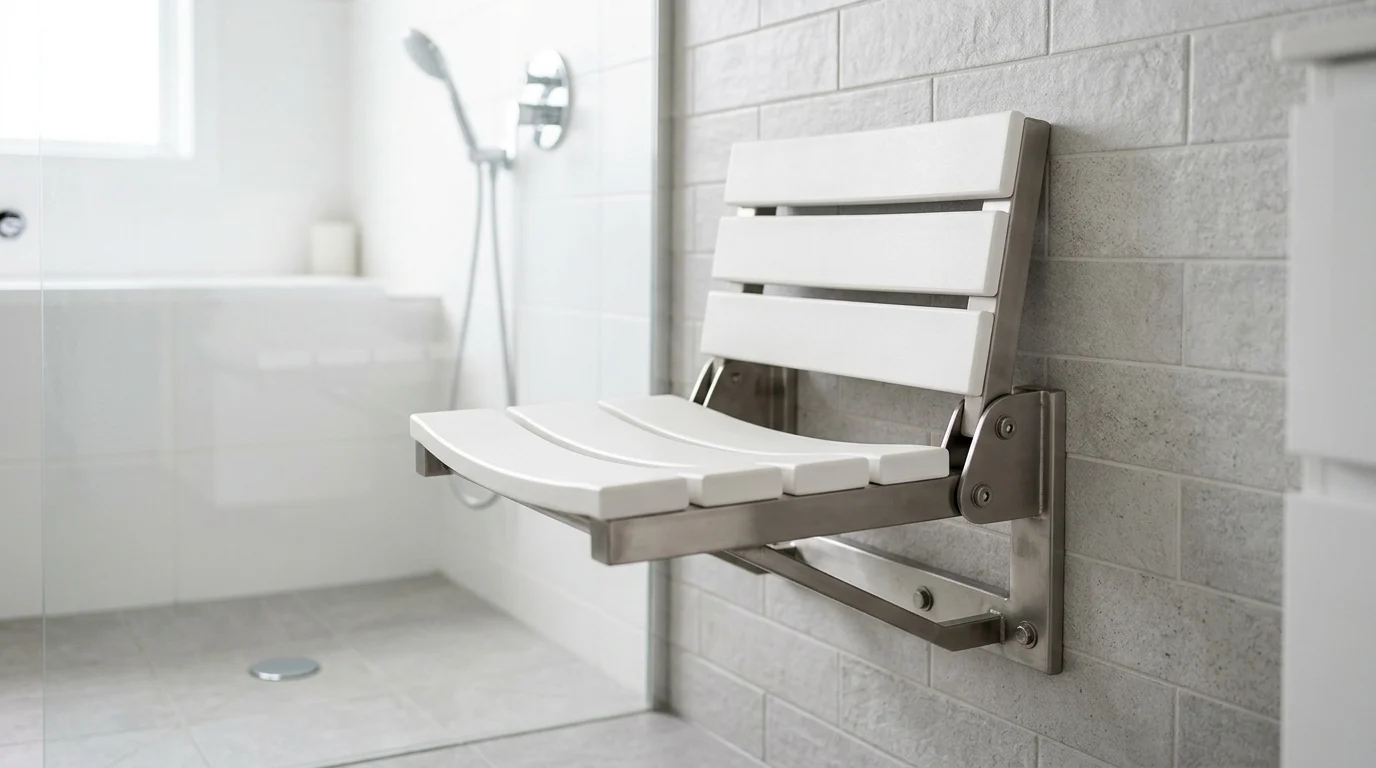
A standard bathroom fixture is selected for individual performance—does it work, does it fit the budget, does it meet code. An architectural element is selected for its relationship to everything else in the space. A plastic shower seat from a big-box retailer is a fixture. A brushed stainless steel wall-mounted folding shower seat, coordinated in finish with the bathroom’s towel bars, robe hooks, and shower hardware, specified with a structural load rating verified by third-party testing, and positioned in the shower enclosure to optimize both spatial composition and accessibility—that is an architectural element. The distinction matters because premium homes are experienced as compositions, not as collections of components. Every element that fails to participate in the composition weakens the whole.
1.2 The Bathroom as Spatial System
The premium bathroom functions as a spatial system—a series of zones (entry, vanity, shower, bathing, toilet) connected by visual and physical pathways. Each zone must work independently and contribute to the coherence of the whole. The shower seat occupies a specific position in this spatial system. When it is misaligned—wrong material, wrong proportions, wrong position—it disrupts the spatial logic of the bathroom. When it is architecturally integrated, it reinforces the spatial system by occupying its designated zone with the right material, the right form, and the right relationship to adjacent elements. This spatial integration is what distinguishes architectural specification from fixture procurement.
2. The Material Dimension: Why Materials Matter More in Premium Bathrooms
Premium bathrooms are defined by their materials. A marble-tiled shower enclosure, a quartz vanity top, a brushed brass shower system—these materials communicate quality, permanence, and intentionality. The bathroom seat must participate in this material conversation or it undermines the entire material narrative.
2.1 Material Coordination with Bathroom Hardware
In a premium bathroom, the hardware finishes throughout the room are typically coordinated—brushed nickel towel bars, matching robe hooks, coordinated shower controls, and a coordinated shower seat. This coordination is not merely aesthetic; it signals that the bathroom was designed rather than assembled. A bathroom where the shower seat is a white plastic bench while the hardware is brushed stainless steel is a bathroom with a design inconsistency that trained eyes immediately register. The material options for premium architectural bathroom seats include:
- Brushed 316L stainless steel: Coordinates with brushed stainless and brushed nickel bathroom hardware; durable, corrosion-resistant, timeless
- Matte black powder-coated steel: Coordinates with matte black and graphite bathroom hardware; contemporary aesthetic with strong visual presence
- Polished stainless steel: Coordinates with polished chrome and polished nickel; creates a more formal, reflective visual character
- GFRP (gelcoat-finished): Can be specified in custom gelcoat colors to coordinate with tile grout, vanity colors, or accent elements
- Natural stone: Matching the shower floor or vanity stone creates material continuity but requires more structural consideration due to weight
- Teak wood: Provides warmth and natural material contrast; requires ongoing maintenance to preserve appearance in wet environments
2.2 Material Properties and Performance
Beyond coordination, material selection determines the seat’s long-term performance in the wet bathroom environment. The key material properties for premium bathroom seat specification are:
- Corrosion resistance: 316L stainless steel provides superior resistance to chloride pitting and crevice corrosion from waterborne minerals and cleaning chemicals
- Surface friction: Wet coefficient of friction (COF) per ASTM F462 determines slip resistance; laser-ablated textures on stainless steel achieve 0.60-0.80 wet COF
- Thermal behavior: Material thermal conductivity affects how the seat surface feels against skin; GFRP and wood feel warmer than bare metal
- Structural strength-to-weight: Determines the section thickness required; 316L stainless steel’s 485 MPa tensile strength enables visually refined, thin-profile frames
- Longevity: Premium materials (316L stainless, GFRP) offer 15-20 year service lifespans; lower-cost materials (ABS plastic) degrade faster in the wet bathroom environment
2.3 Table: Material Properties for Premium Bathroom Seats
| Property | 316L Stainless Steel | GFRP Composite | ABS Plastic | Teak Wood |
|---|---|---|---|---|
| Corrosion resistance (chloride wet environment) | Excellent | Very Good | Good (surface scratches) | Moderate (requires sealing) |
| Finish coordination with premium hardware | Full range (brush, polish, color coat) | Gelcoat color range | Limited (molded color) | Natural warm tone only |
| Wet COF (slip resistance) | 0.60-0.80 | 0.50-0.65 | 0.20-0.45 | 0.35-0.50 |
| Load capacity | 350-500 lbs | 300-450 lbs | 200-300 lbs | 250-350 lbs |
| Service lifespan | 15-20 years | 10-15 years | 5-8 years | 8-12 years with maintenance |
| Structural profile (visual mass) | Thin (2-3mm sections) | Moderate (molded) | Moderate | Thick (wood sections) |
| Maintenance requirement | Low | Moderate | Moderate | High (sealing, sanding) |
| Aesthetic contribution | Industrial-refined | Seamless-modern | Institutional | Warm-natural |
3. Spatial Theory and the Bathroom Seat
The bathroom seat occupies a specific position in the bathroom’s spatial hierarchy. Understanding this spatial role is fundamental to architectural specification.
3.1 Floor Space vs. Wall Space
The most significant spatial decision in bathroom seat specification is whether the seat occupies floor space or wall space. A free-standing shower stool occupies 0.3-0.5 square meters of floor area permanently—floor area that could be used for movement, for a bath mat, or simply for visual breathing room. A wall-mounted folding seat occupies wall space (approximately 1.5-2 inches of wall intrusion when folded) but zero floor space. In a premium bathroom where spatial composition is intentional, the distinction between floor space occupation and wall space occupation is not trivial. Floor space is the most valuable commodity in a bathroom; wall space is generally less contested. The wall-mounted folding seat is, in spatial terms, the more architecturally efficient choice.
3.2 The Visual Line and Bathroom Composition
Premium bathrooms are designed with intentional visual lines—sight lines from the entry, from the vanity mirror, from the bath. These visual lines create the spatial experience of the room. A free-standing shower stool sitting in the middle of a marble-tiled shower interrupts every visual line in the space. A wall-mounted folding seat, folded flush against the wall, is nearly invisible from most viewing angles. When specified in a matching finish and positioned in a coordinated location, the folded wall-mounted seat participates in the visual composition rather than disrupting it.
3.3 Proportion and Scale
The seat must be proportionate to the bathroom and the shower enclosure. A seat that is too small for the space looks inadequate. A seat that is too large looks bulky and institutional. Premium bathroom seat design applies the same proportional principles used in furniture design: the seat’s dimensions should be calibrated to the human body (ergonomic proportions) and to the space (visual scale). Standard dimensions for premium wall-mounted seats include seat widths of 16-22 inches and seat depths of 16-20 inches, with mounting heights adjusted to the specific user’s needs and ADA requirements when applicable.
4. Universal Design: The Architecture of Inclusion
Universal design—the practice of designing spaces and products that are usable by all people without specialized adaptation—is one of the most significant theoretical frameworks shaping premium bathroom design in 2026. The principle, articulated in Ron Mace’s foundational work at North Carolina State University and codified in standards including ANSI A117.1 and the ADA, holds that accessibility features should be incorporated into the design of spaces rather than added on as afterthoughts. In premium bathroom design, universal design is not a compliance checkbox—it is a design philosophy that produces better bathrooms for everyone.
4.1 Universal Design Principles Applied to Bathroom Seats
The seven principles of universal design, applied to architectural bathroom seat specification:
- Equitable use: The seat is useful to people with diverse abilities—aging homeowners, users recovering from injury, users of different heights and body types
- Flexibility in use: A folding seat provides two modes (deployed and stored), accommodating different users and different bathroom configurations
- Simple and intuitive use: The folding mechanism requires no training or instruction to operate; the deployed latch provides clear tactile feedback
- Perceptible information: The seat’s position, material, and function are self-evident from the visual context—no signage or instruction required
- Tolerance for error: The positive latch mechanism prevents accidental folding under load; the stored latch prevents unexpected opening
- Low physical effort: Spring-assisted folding mechanisms reduce the force required to operate, accommodating users with limited upper body strength
- Size and space for approach and use: ADA-compliant mounting geometry (17-19 inches height, 30×48 inches clear floor space) ensures the seat is usable from a wheelchair parallel approach
4.2 Aging in Place and the Premium Bathroom
Aging in place—the concept of designing a home to support its occupants as they age rather than requiring relocation to assisted care—is a primary driver of premium bathroom renovation investment. The NAHB reports that 78% of homeowners over 50 prefer to age in place in their current home. The Center for Universal Design’s research demonstrates that aging-in-place modifications—grab bars, shower seats, lever faucet handles—have a positive ROI when measured against the cost of assisted living or nursing home care. In the premium bathroom, aging-in-place design is implemented as architectural quality rather than as disability accommodation: the grab bars are designer fixtures, the shower seat is an architectural element, the lever controls are standard specification. The result is a bathroom that serves its occupants across the full arc of their lives without signaling that it was designed for limitation.
4.3 ADA Compliance as Minimum Standard, Not Maximum Goal
In premium residential applications, ADA compliance is the baseline, not the aspiration. The geometric requirements (17-19 inch seat height, structural attachment for 250 lb loads, clear floor space) represent the minimum accessibility standard established for public accommodations. Premium residential bathrooms that incorporate these requirements—and often exceed them—do so because the underlying principles (ergonomic geometry, structural integrity, spatial accessibility) produce a better bathroom for all users, regardless of age or ability. The ADA’s 2010 Standards for Accessible Design provide the minimum framework; premium bathroom design applies those principles with higher material quality, better aesthetics, and more considered spatial integration.
5. Return on Investment: The Economic Case for Architectural Bathroom Seats
The economic argument for investing in architectural bathroom seat design extends across property value, renovation cost recovery, maintenance costs, and liability exposure.
5.1 Property Value Impact
Premium bathroom quality is among the highest-ROI improvements in residential real estate. Remodeling Magazine’s 2025 Cost vs. Value Report documents that bathroom renovation projects in the mid-to-upper range recover 65-75% of construction cost in increased property value, with luxury bathroom renovations in metropolitan markets recovering even higher percentages. While no granular data isolates the shower seat’s individual contribution to property value, the principle is established: a bathroom that is perceived as comprehensively designed—where every element reflects quality and intentionality—commands a higher market value than a bathroom with a design inconsistency (such as an institutional shower seat in an otherwise premium space).
5.2 Renovation Cost Recovery
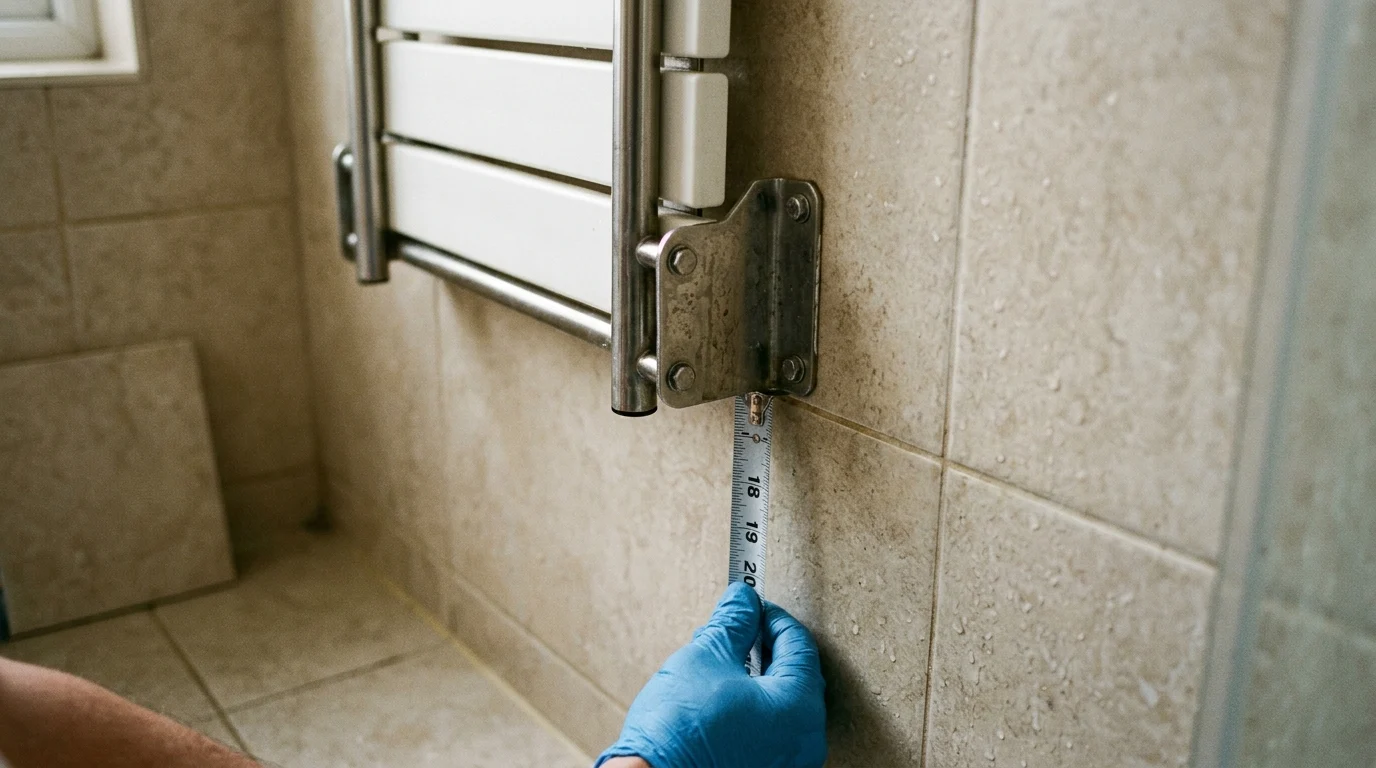
A premium wall-mounted folding shower seat constructed from 316L stainless steel with coordinated hardware finish costs $200-$500 in product and installation, compared to $30-$80 for a basic ABS plastic shower stool. The $170-$420 product premium is a small fraction of a $50,000-$150,000 bathroom renovation budget—typically 0.3-0.8% of total project cost—yet it is one of the most visible and frequently used elements in the bathroom. The cost recovery ratio strongly favors architectural specification.
5.3 Long-Term Maintenance Costs
A premium 316L stainless steel or GFRP bathroom seat has a service life of 10-20 years with minimal maintenance beyond routine cleaning. A basic ABS plastic seat has a service life of 5-8 years and requires replacement when the surface becomes scratched, stained, or unstable. Over a 20-year period, the cost of replacing two or three basic seats ($60-$240 in product costs, plus installation labor) approaches or exceeds the initial cost premium of a single premium seat. Additionally, the disruption of replacing a failed seat in a finished premium bathroom—removing tile or wall panels, patching, re-tiling—can be disproportionately expensive relative to the seat cost.
5.4 Table: Total Cost of Ownership Comparison
| Cost Factor | 316L Stainless Steel (Premium) | GFRP (Mid-Premium) | ABS Plastic (Basic) |
|---|---|---|---|
| Initial product cost | $200-$500 | $120-$300 | $30-$80 |
| Installation cost | $100-$200 | $100-$200 | $50-$100 |
| Expected service life | 15-20 years | 10-15 years | 5-8 years |
| Replacements in 20 years | 0-1 | 1-2 | 2-4 |
| Replacement product cost (20 yr) | $0-$500 | $120-$600 | $60-$320 |
| Maintenance cost (20 yr) | $50-$100 | $100-$200 | $100-$200 |
| Total 20-year cost | $350-$1,300 | $440-$1,300 | $240-$700 |
| Cost per year | $17-$65 | $22-$65 | $12-$35 |
6. Specification Framework for Premium Bathroom Seats
6.1 The Four-Part Specification Checklist
Premium bathroom seat specification should follow a systematic four-part evaluation framework:
- Part 1 — Structural performance: Load rating (minimum 350 lbs recommended; 500 lbs preferred), third-party testing certification (ASME A112.19.2 or equivalent), mounting plate engineering (multi-point, minimum 4 anchor points), and wall substrate requirements (3/4-inch structural backing in wood-frame walls)
- Part 2 — Material quality: Corrosion-resistant material (316L stainless or GFRP), surface friction performance (wet COF per ASTM F462), finish coordination with bathroom hardware, and surface cleaning compatibility with premium cleaning agents
- Part 3 — Mechanical reliability: Hinge mechanism quality (spring-assisted, with positive deployed latch and stored position lock), friction adjustment capability, audible and tactile feedback, and manufacturer warranty (minimum 5 years commercial)
- Part 4 — Aesthetic integration: Visual profile when folded (wall intrusion under 2 inches), proportional dimensions relative to the shower enclosure, finish matching with bathroom hardware, and visual mass of frame sections (thinner is better in premium applications)
6.2 Common Specification Errors
- Selecting a seat for the bathroom instead of the shower: A seat that looks beautiful beside the vanity but fails to perform in the wet, hot, humid shower environment is a specification error. Always evaluate the seat for shower environment performance first.
- Prioritizing price over structural backing: The most expensive seat mounted on drywall without structural backing will fail. Structural backing is non-negotiable regardless of budget.
- Ignoring hinge quality: The hinge mechanism is the critical failure point. A seat with a high-quality frame and a cheap hinge will fail at the hinge. Evaluate the hinge mechanism specifically.
- Mismatching the finish: A brushed nickel seat in a polished chrome bathroom is a design error. Confirm the finish match before purchasing.
- Selecting for aesthetics alone: A beautiful seat that cannot safely support the expected user load is a safety hazard. Always verify structural ratings before evaluating aesthetics.
7. Design Integration: Coordinating the Seat with the Bathroom System
7.1 Coordinating with Shower Enclosures
The shower enclosure geometry determines the optimal seat type and position. For frameless glass walk-in showers—the most common premium shower enclosure type—a folding wall-mounted seat mounted on the back wall or side wall is typically the best integration choice. The seat’s folded profile should align with the vertical hardware of the glass system or the tile plane. For tiled walk-in showers, the seat can be positioned to align with tile course lines, creating a more integrated visual relationship between the seat and the wall surface.
7.2 Coordinating with Grab Bars and Accessories
In premium bathrooms, grab bars are not safety afterthoughts—they are designer fixtures that participate in the bathroom’s hardware composition. The grab bars and the shower seat should be specified as a coordinated system: same material, same finish, same manufacturer if possible, and positions that complement each other’s spatial contribution to the bathroom. A coordinated grab bar and seat system creates a sense of completeness that separately specified elements cannot achieve.
7.3 Coordinating with Lighting and Controls
The shower seat’s position affects—and is affected by—the bathroom’s lighting design. The seat should not block the intended distribution of shower lighting (ceiling-mounted fixtures, recessed lights, or body jets). In bathrooms with automated lighting systems, the seat’s deployed position may affect the positioning of occupancy sensors or the programming of scene lighting. These coordination decisions should be made during the electrical design phase, not after the seat is installed.
8. Emerging Design Trends in Premium Bathroom Seats
8.1 Integrated Modular Wall Systems
The trend toward modular bathroom wall systems—integrated wall panels that incorporate niches, seating, shelving, and controls as a coordinated system—is influencing premium bathroom seat design. In these systems, the shower seat is not an add-on component but an integral part of the wall system, sharing the same material, finish, and visual language as the surrounding wall. This integration produces the highest level of aesthetic coherence but requires specification during the system design phase rather than as a post-installation addition.
8.2 Heated Seat Surfaces in Premium Applications
Radiant heating elements embedded in the seat surface address the thermal comfort concern that some users raise regarding metal seats in cooler bathroom environments. Heated seats are specified primarily in ultra-premium residential applications and luxury hospitality projects where thermal comfort is a service differentiator. The heating element operates at low voltage (12-24V) for safety in the wet environment.
8.3 Sustainable and Health-Focused Materials
Premium homeowners are increasingly specifying bathroom materials based on environmental and health impact. GFRP seats with post-consumer recycled glass content, bio-derived polymer formulations, and low-VOC manufacturing processes are entering the premium specification market. WELL Building Standard and LEED v4.1 certification requirements are accelerating this adoption in new construction and major renovation projects.
8.4 Smart Bathroom Integration
Smart home integration in bathrooms is expanding from lighting and climate control to fixtures. Emerging applications for bathroom seats include occupancy detection (seat deployment logging for facilities management), integrated lighting activation (LED lighting triggered when the seat is deployed), and humidity management (enhanced ventilation activation during shower use). These technologies remain in early adoption for mainstream premium applications but are expected to influence specification within the next 3-5 years.
Conclusion
Architectural bathroom seat design matters in premium homes because every element in a premium space either participates in the design or undermines it. A bathroom that has been designed with material intentionality, spatial precision, and structural rigor—a bathroom that costs $50,000 to $150,000 to build—deserves a shower seat that reflects the same level of consideration. The architectural bathroom seat is not a utilitarian fixture procured from a catalog at the end of a project; it is a designed element that is specified, coordinated, and installed as part of the bathroom’s spatial and material system. When it is done well, the seat contributes to the bathroom’s sense of completeness, its material coherence, and its long-term performance. When it is done poorly, it is the element that trained eyes notice first. For architects, designers, and homeowners building or renovating premium bathrooms, the shower seat is an opportunity to demonstrate that the quality of a space is in its details.
7 Frequently Asked Questions
1. Why does a bathroom seat deserve architectural consideration when it is such a small element of the bathroom?
The bathroom seat is disproportionately visible relative to its size. In a premium shower enclosure, the seat is often at eye level from the bathroom entry, and its material, finish, and proportions are immediately registered by anyone entering the space. A design inconsistency in the seat—a mis-matched finish, an institutional material, a disproportionate form—creates a negative signal disproportionate to the seat’s physical footprint. In premium design, every element either reinforces or undermines the whole, and the seat is no exception.
2. What makes a bathroom seat “architectural” rather than just expensive?
Architectural quality is determined by how well the seat performs in relation to the bathroom as a system—its material coordination with surrounding elements, its spatial efficiency (occupying wall space rather than floor space), its structural integration with the wall substrate, its ergonomic geometry, and its contribution to the spatial experience of the room. An expensive seat that is the wrong material, the wrong proportion, and the wrong position is not an architectural seat. A well-selected mid-priced seat that is correctly coordinated, properly installed, and structurally sound is.
3. Is a wall-mounted folding seat the best choice for all premium bathrooms?
A wall-mounted folding seat is the most spatially efficient and visually unobtrusive option for most premium bathroom configurations. However, the optimal seat type depends on the specific shower enclosure geometry, wall construction, and user requirements. Corner-mounted seats work well in quadrant showers. Recessed niche seats offer the highest aesthetic integration but require construction-phase installation. Free-standing stools are not recommended for premium applications due to their permanent floor footprint and limited load capacity. A qualified bathroom designer or architect should evaluate the specific conditions before committing to a seat type.
4. How does a premium bathroom seat age over a 15-20 year period?
A 316L stainless steel or GFRP premium bathroom seat ages through gradual surface changes rather than structural degradation. Stainless steel may develop minor surface oxidation (tea-staining) in high-humidity environments with inadequate ventilation, which is prevented by maintaining the chromium oxide passive layer through periodic cleaning. GFRP may develop surface chalking from UV exposure if installed in sun-facing locations, which is prevented by specifying UV-stabilized gelcoat formulations. Both materials maintain their structural integrity and functional performance for 15-20 years with routine maintenance. The hinge mechanism may require adjustment or replacement at approximately year 10-12 in high-frequency-use applications.
5. Can a premium bathroom seat be installed in an existing bathroom without opening walls?
Yes, depending on the wall construction. Concrete or masonry walls accept expansion anchors without opening the wall. Wood-frame walls without existing structural backing require opening the wall to install the required 3/4-inch plywood backing between studs—a process typically done in coordination with tiling or wall paneling work to minimize cost and disruption. The feasibility of retrofit installation should be assessed by a qualified contractor before specifying the seat, as the cost of opening and repairing a wall can approach the cost of the seat itself.
6. How does bathroom seat design relate to the aging-in-place investment in a premium home?
The average cost of one year in an assisted living facility in the United States is approximately $58,000-$90,000 per year, while the cost of a comprehensive aging-in-place bathroom renovation—including premium shower seats, grab bars, and accessible fixtures—is typically $25,000-$75,000. A well-designed aging-in-place bathroom, with an architectural shower seat specified from the outset, is a long-term investment that can defer or eliminate the need for assisted living. The shower seat is one of the highest-ROI elements of this investment because it addresses the primary activity (bathing) where fall risk is highest and independence is most valued.
7. What is the relationship between bathroom seat design and luxury hotel bathroom design?
Luxury hotel bathroom design has been the primary driver of premium bathroom seat specification innovation for the past two decades. Hotel brands including Four Seasons, Ritz-Carlton, Aman, and W Hotels demand bathroom fixtures that meet rigorous performance, aesthetic, and durability standards, and they specify these elements with the same rigor applied to architectural finishes. The specification decisions made in luxury hospitality design flow down to premium residential design through architects, designers, and homeowners who encounter these products in hotel bathrooms and seek equivalent performance and aesthetics in their own homes.


