


A folding shower seat can transform a bathroom by adding comfort, accessibility, and space-saving convenience—but its safety depends on more than a number printed on a product label. In wet environments, even a small installation error can turn a supportive fixture into a serious fall hazard. This article explains how load ratings, safety factors, wall blocking, fasteners, hinges, and material choices determine whether a wall-mounted seat can safely support heavier users. It also highlights why architects, contractors, facility managers, and homeowners should evaluate the full system, not just the seat. With the right specification and installation, strength and elegant bathroom design can work together confidently.
Why Load Capacity Matters
Understanding the load capacity of a folding wall mounted shower seat is critical for mitigating liability and ensuring long-term structural integrity in commercial, healthcare, and residential environments.
How load capacity affects user safety
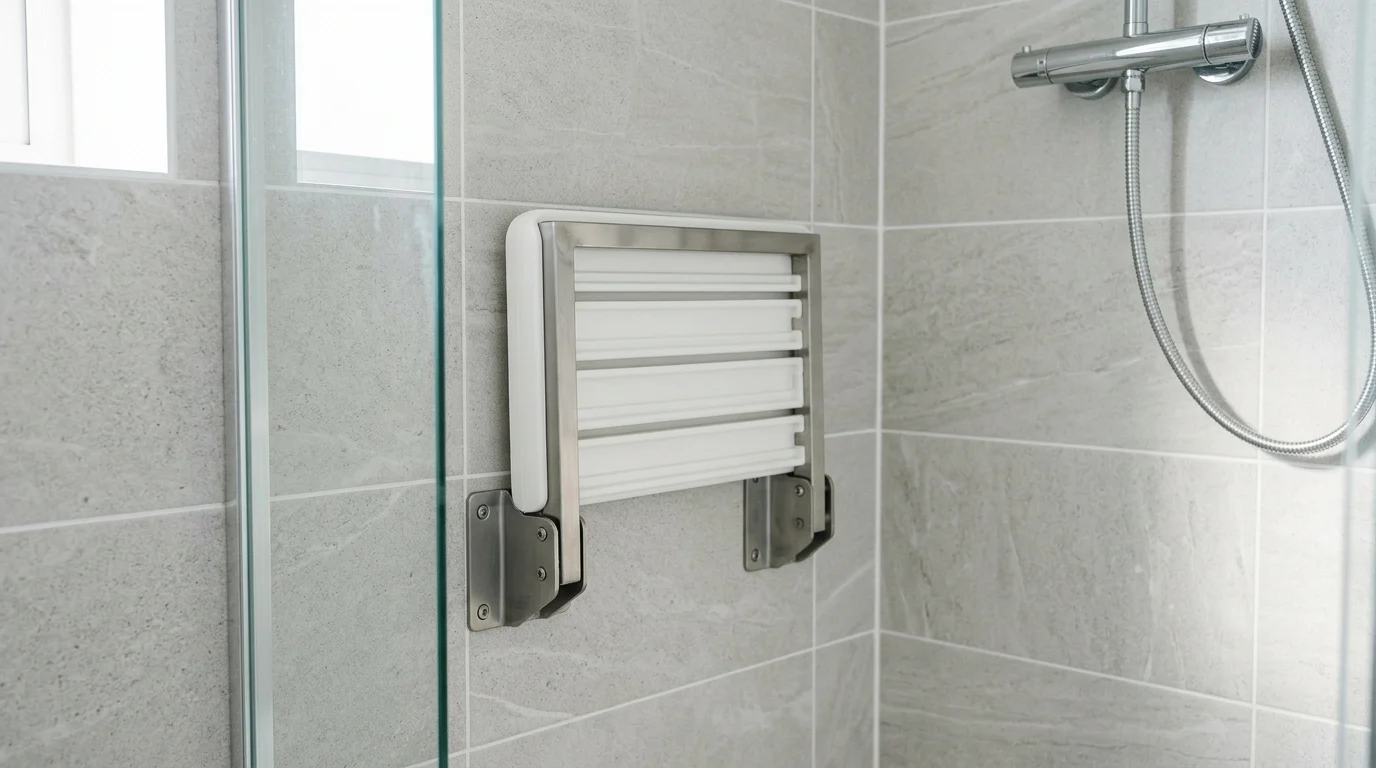
Load capacity directly dictates the mechanical threshold of the fixture. When a user transfers onto a folding wall mounted shower seat, they exert dynamic forces that often exceed their static body weight. High-capacity models constructed from heavy-duty aluminum alloy can support up to 250 kg (550 lbs), preventing catastrophic structural failures. Selecting a seat with an inadequate load capacity risks shear failure at the hinge points or bracket detachment, which can lead to severe fall injuries in wet, hazardous environments.
Why stated weight ratings need verification
Manufacturers frequently advertise maximum weight capacities, such as 440 lbs or 550 lbs, but these figures reflect controlled laboratory testing under ideal conditions. In practice, a stated weight rating is only valid if the installation environment meets stringent structural prerequisites. As noted by safety equipment providers like HealthCraft Products, a seat can only support its maximum rated load when secured to proper wall backing. Without adequate structural reinforcement inside the wall cavity, the drywall or tile becomes the weakest link, rendering the manufacturer’s advertised load rating entirely irrelevant.
Who is responsible for confirming suitability
Ensuring a folding wall mounted shower seat operates safely at its maximum capacity is a multi-party responsibility:
- Manufacturers: Must conduct rigorous mechanical testing and clearly publish maximum static load limits alongside required installation parameters.
- Architects and Specifiers: Responsible for integrating adequate in-wall blocking—such as solid wood structural panels or steel plates—during the initial design and blueprint phase.
- Contractors and Installers: Tasked with verifying that the wall substrate can handle the specified shear and pull-out forces before mounting the hardware, ensuring the physical installation matches the engineered requirements.
What Determines Real-World Strength
Real-world strength depends on the interplay between the fixture’s materials, the architectural substrate to which it is anchored, and the physical forces exerted by the user. A high-capacity folding seat is only as resilient as its weakest structural link.
Frame, seat, hinge, and bracket construction
The structural integrity of the fixture relies heavily on its frame and hinge construction. Commercial-grade units typically utilize Type 304 or Type 316 stainless steel tubing with a minimum wall thickness of 1.2mm to 1.5mm to resist bending. The hinges, which bear the brunt of rotational stress during deployment, must feature high-tensile pivot pins. Seat tops constructed from solid phenolic core or high-density polyethylene (HDPE) provide superior shear strength compared to hollow ABS plastics, helping prevent the seating surface from bowing under concentrated weight.
Wall substrate, blocking, studs, and anchors
The wall substrate ultimately dictates the maximum safe load. Standard half-inch drywall has a negligible pull-out strength (often estimated at less than 50 pounds), making it generally unsuitable for load-bearing fixtures without additional support. Secure installation typically requires solid wood blocking—such as 2×6 or 2×8 dimensional lumber—spanning between structural studs, or heavy-gauge steel backing plates welded to metal studs.
Substrate Material | Fastener Type | Est. Pull-Out Strength per Fastener (lbs) |
1/2″ Drywall (No Stud) | Toggle Bolt | 40 – 60 |
Wood Stud / Blocking | 3″ Stainless Lag Screw | 350 – 500 |
Concrete / Masonry | Sleeve Anchor | 600 – 800 |
Metal Stud (20 Gauge) | Toggle with Backing Plate | 200 – 300 |
Static loads, dynamic loads, and user movement
Engineers differentiate between static loads (a stationary mass resting on the seat) and dynamic loads (the forces generated by a user sitting down heavily or shifting abruptly). Dynamic loading can multiply the effective force by 1.5 to 2 times the user’s actual body weight. Consequently, a 250-pound user dropping onto the seat can momentarily exert upwards of 500 pounds of force on the cantilevered brackets. This necessitates hardware engineered to absorb sudden impact energy.
Standards, Testing, and Compliance
Navigating the landscape of accessibility standards and testing protocols is essential for specifying wall-mounted shower seats that mitigate liability and ensure equitable access. Compliance requires verifiable documentation of mechanical performance.
ADA guidance and building code considerations
The Americans with Disabilities Act (ADA) provides specific guidelines for accessible shower compartments. Under the 2010 ADA Standards for Accessible Design (Section 610) and equivalent international building codes, shower seats must withstand a minimum structural force of 250 pounds applied at any point on the seat, fastener, mounting device, or supporting structure. However, modern healthcare environments often exceed these baseline minimums, specifying bariatric seating capable of supporting 500 to 1,000 pounds to accommodate changing demographic needs and enhance universal design.
Load testing, certification, and documentation
Objective load testing and certification separate commercial-grade fixtures from residential consumer goods. Rigorous testing protocols, such as those outlined in ISO 17966 for assistive products, subject these fixtures to both static load tests and dynamic cycle testing. As a general industry benchmark, a high-quality commercial unit may undergo upwards of 10,000 deployment and retraction cycles under load to verify that the hinge mechanisms resist metal fatigue and that fasteners maintain their torque specifications over time.
How to compare rated capacity claims
Comparing rated capacity claims requires specifiers to scrutinize a manufacturer’s technical data sheets. It is vital to distinguish between the “working load limit” (the maximum safe load for daily operation) and the “ultimate failure load” (the point of structural collapse). Specifiers should look for third-party testing certificates rather than relying solely on in-house marketing claims, ensuring that the stated capacity incorporates an adequate safety margin for the intended environment.
Installation and Inspection Requirements
Translating a well-engineered product into a safe facility asset hinges heavily on the execution of the installation process. Rigorous pre-installation assessments and strict adherence to mechanical fastening protocols and local building codes are essential.
Pre-installation wall strength checks
Prior to installation, contractors must conduct checks of the wall structure. This includes verifying the exact location and depth of in-wall blocking. Wood blocking should ideally span at least three studs (32 to 48 inches) to distribute lateral forces adequately. Furthermore, moisture mapping is critical in retrofit applications. If the moisture content in existing wood studs exceeds 20%, the structural integrity of the wood fibers may be compromised. This can drastically reduce the holding power of lag screws and necessitate structural remediation before seat installation.
Step-by-step installation and inspection
The step-by-step installation of these fixtures demands precision. Fasteners must be driven perpendicular to the substrate to maximize thread engagement. Stainless steel fasteners require specific torque settings—often provided as general guidelines by manufacturers—to prevent shearing the screw heads while ensuring adequate clamping force.
Fastener Diameter | Recommended Substrate | Target Installation Torque (ft-lbs) |
1/4″ Lag Screw | Wood Blocking | 10 – 12 |
5/16″ Lag Screw | Wood Blocking | 15 – 20 |
3/8″ Sleeve Anchor | Concrete | 25 – 30 |
Additionally, all penetrations through the waterproof membrane must be meticulously sealed with marine-grade silicone to prevent moisture ingress. Failing to do so could lead to hidden substrate rot and subsequent fastener failure. Always consult specific manufacturer instructions and local codes during installation.
Warning signs of unsafe installation
Post-installation inspections should focus on identifying early warning signs of mechanical distress. If a wall-mounted seat exhibits more than a 5-degree downward deflection when fully loaded, the installation may be structurally deficient. Other red flags include micro-cracking in the grout or tile immediately surrounding the mounting escutcheons, audible creaking from the wall cavity during use, and signs of galvanic corrosion around the fasteners. These indicators suggest a potential issue that requires immediate evaluation and possible decommissioning of the seat until repaired.
How to Choose the Right Shower Seat
Selecting the optimal folding shower seat requires evaluating load capacities, material longevity, and capital budgets. The specification process must align the physical capabilities of the hardware with the operational realities of the facility.
Balancing rated capacity, durability, and cost
Specifiers must balance rated capacity and durability against procurement costs. As a general estimate, a standard ADA-compliant seat rated for 250 pounds typically costs between $150 and $300, making it suitable for standard residential or light-commercial use. Conversely, a heavy-duty bariatric model constructed from Type 316 stainless steel with an 800-pound rating can range from $600 to $1,200. While the initial capital expenditure is higher for bariatric models, the extended lifecycle and reduction in liability risks often justify the investment in high-traffic or healthcare settings.
When to choose a heavy-duty model
The decision to specify a heavy-duty or bariatric model should be driven by demographic data and facility use cases. In commercial healthcare facilities, rehabilitation centers, and high-turnover hospitality environments, the user base frequently exceeds the 95th percentile for weight (approximately 250 pounds for adult males). In these environments, specifying a seat with a minimum 500-pound dynamic load rating is a practical risk management strategy that accommodates a wider range of users safely.
Final specification and buying criteria
Final buying criteria should encompass the totality of the product’s design. Key specifications include non-porous seat materials like phenolic resin that resist hospital-grade disinfectants, constant-friction hinges that prevent the seat from slamming down and causing injury, and a robust commercial warranty. A minimum 5-year warranty against mechanical and structural defects often serves as a reliable indicator of the manufacturer’s confidence in their load-bearing engineering.
Key Takeaways
- Choose a folding wall mounted shower seat with a verified load rating and a safety factor appropriate for the intended user group.
- Anchor the seat into solid blocking, studs, or an engineered substrate because tile or drywall alone cannot safely carry heavy loads.
- Prioritize stainless steel frames, reinforced hinges, and solid phenolic or HDPE seating surfaces for durability in wet environments.
- Treat installation as a shared responsibility among specifiers, engineers, contractors, and facility managers to reduce liability and injury risk.
- Inspect the seat regularly for loose brackets, hinge wear, corrosion, cracking, or wall movement before continued use.
Frequently Asked Questions
Can a folding wall mounted shower seat hold a heavy user safely?
Yes, if the seat is properly weight-rated, installed into solid wall blocking or structural framing, and inspected regularly. The wall and fasteners are just as important as the seat itself.
Is the manufacturer’s weight rating enough to rely on?
Not by itself. Weight ratings often come from static lab tests, while real use creates shifting and dynamic forces. Look for tested ratings, clear installation requirements, and an appropriate safety factor.
What wall support is needed for a heavy-duty shower seat?
A heavy-duty folding seat should be anchored into structural blocking, studs, or an engineered wall substrate. Drywall, tile, or hollow wall anchors alone are not suitable for supporting heavy loads.
Which materials are best for high-capacity shower seats?
Commercial-grade stainless steel frames, reinforced hinges, and solid phenolic or HDPE seat surfaces are preferred because they resist corrosion, bending, and concentrated loading in wet bathroom environments.
How often should a wall mounted shower seat be inspected?
In homes, inspect it periodically for looseness, corrosion, cracks, or movement. In healthcare, hospitality, or high-use settings, facility managers should follow a scheduled inspection and maintenance program.
We focus on simplicity with every design. Our bathroom solutions blend modern elegance with functionality, ensuring that every piece serves a purpose while maintaining a clean, timeless look. You deserve a space that’s both beautiful and practical.


