

Introduction
Luxury bathroom buyers rarely respond to products framed only around safety or accessibility; they respond to experiences that enhance comfort, design coherence, and long-term property value. To position seated showering effectively, the conversation should connect a shower seat to wellness architecture, extended hydrotherapy, and the expectations of spa-level residential spaces. This article explains how to present shower seats as a premium design feature rather than a clinical add-on, showing which benefits matter most to high-end clients and how to align product selection, language, and visual storytelling with luxury decision-making.
Why Shower Seats Matter in Seated Shower Design
The concept of seated showering has evolved significantly from its origins as a purely clinical or functional necessity. In contemporary architectural design, the shower space is treated as a primary wellness zone. High-net-worth clients frequently invest between $50,000 and $120,000 in primary bathroom renovations, demanding environments that rival commercial spas in both aesthetics and physiological benefits. Integrating a shower seat into these designs is no longer an afterthought; it is a foundational element of luxury hydrotherapy.
Promoting seated showering to an expert audience requires shifting the narrative from basic utility to enhanced experiential living. By anchoring the conversation in wellness architecture and universal design principles, industry professionals can position the shower seat as a critical component of the modern, high-end bathing experience.
How to frame the value of seated showering
To successfully frame the value of a shower seat, professionals must focus on the extension of dwell time and the maximization of therapeutic benefits. A standard standing shower typically lasts 5 to 8 minutes, whereas a seated shower experience—particularly when integrated with steam generators or multi-sensory water delivery systems—extends dwell time to 15 to 25 minutes. This prolonged exposure allows for proper muscle relaxation, improved circulation, and deeper respiratory benefits from steam inhalation.
Furthermore, professionals should emphasize spatial luxury. A dedicated seating area signals that a shower enclosure is spacious enough to accommodate leisure, instantly elevating the perceived value of the real estate. Specifiers should articulate that a premium shower seat transforms a transitional space into a destination for restoration.
Which user needs and motivations drive adoption
Adoption in the luxury sector is driven by a confluence of multi-generational living trends and an increased focus on proactive wellness. The ‘aging in place’ market segment is expanding rapidly, with luxury accessible remodeling growing at an estimated 12% to 15% compound annual growth rate (CAGR). However, high-end clients resist products that carry a geriatric or institutional stigma.
Motivations extend beyond mobility support. Athletes and active professionals use seated showering for post-workout recovery, allowing them to safely direct targeted body sprays on lower extremities. Additionally, the daily routine of personal care—such as shaving or exfoliating—demands a stable, ergonomic platform. Understanding that the primary driver is often a desire for effortless comfort rather than strict medical necessity allows sales professionals to tailor their pitches to aspirational lifestyle goals.
How to Compare Shower Seat Types
Comparing shower seat types requires a rigorous evaluation of material science, structural engineering, and spatial geometry. Specifiers and designers must navigate a saturated market to identify products that meet strict commercial-grade durability standards while satisfying the aesthetic demands of luxury residential projects. The distinction between entry-level utility seats and premium architectural fixtures lies in the details of their construction and their integration into the shower envelope.
What product types and specifications to evaluate
When evaluating product types, the primary specifications to assess include load capacity, material composition, and hardware grade. A standard residential shower seat may be rated for 250 pounds, but premium models engineered for high-end applications should support a minimum dynamic load of 400 to 500 pounds to ensure absolute stability and safety.
Material selection dictates both longevity and maintenance requirements. Phenolic resin tops offer excellent water resistance and antimicrobial properties, making them ideal for high-moisture environments. Natural teak remains a luxury staple, provided it is sustainably sourced (FSC certified) and treated to resist mold. Hardware must be strictly specified as marine-grade Type 304 or 316 stainless steel to prevent oxidation and galvanic corrosion when exposed to municipal water supplies containing chlorine and chloramines.
How built-in and fold-down options compare
The debate between built-in masonry benches and wall-mounted fold-down seats centers on spatial efficiency and design flexibility. Built-in benches require a permanent footprint, typically consuming 15 to 18 inches of depth and requiring complex waterproofing detailing to prevent capillary action and water ingress. While they offer a monolithic, custom-tiled aesthetic, they permanently reduce the standing area of the shower pan.
Conversely, fold-down options provide dynamic spatial management. A premium fold-down shower seat features a slim profile, often protruding merely 2.5 to 3 inches from the wall when stowed. This adaptability is crucial in urban luxury condominiums where shower footprints may be restricted to 48 by 36 inches.
Feature | Built-In Masonry Bench | Premium Fold-Down Seat |
Spatial Footprint | Permanent (15-18″ depth) | Variable (2.5-3″ stowed) |
Installation Cost | High ($1,500 – $3,000+) | Moderate ($500 – $1,200) |
Waterproofing Risk | High (multiple plane transitions) | Low (wall penetrations only) |
Load Capacity | 500+ lbs (structural) | 350 – 500 lbs (with blocking) |
Design Flexibility | Fixed layout | Accommodates changing needs |
What distinguishes premium shower seat design
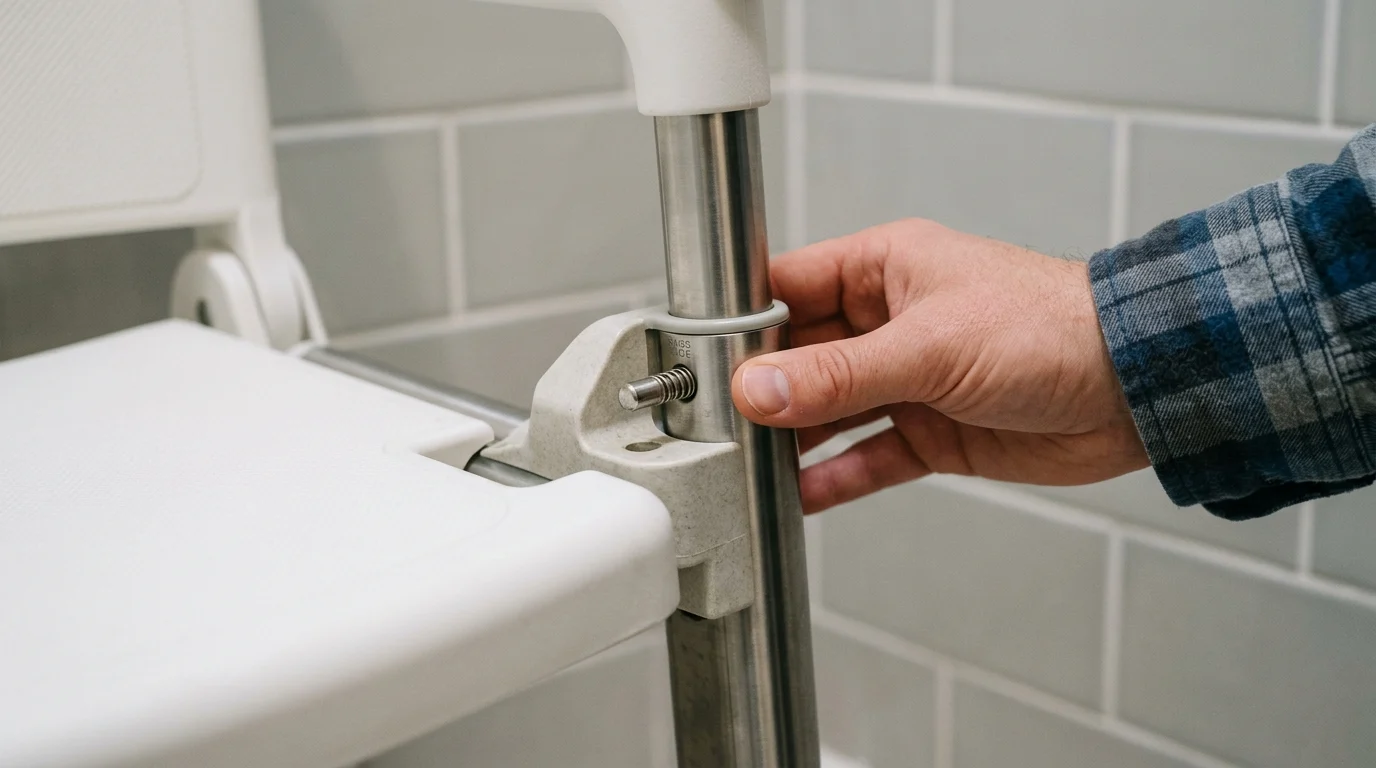
Premium shower seat design is distinguished by its kinetic hardware and meticulous finishing. High-end models utilize concealed torsion springs or gas struts to provide a soft-close and soft-open mechanism, eliminating the abrupt, heavy drops associated with commercial institutional seats.
Aesthetic integration is equally critical. Premium manufacturers offer custom plating options—such as physical vapor deposition (PVD) brushed brass, matte black, or polished nickel—to precisely match the surrounding thermostatic valves and showerheads. The absence of visible fasteners, achieved through hidden mounting brackets and magnetic escutcheon plates, further separates luxury fixtures from their commoditized counterparts.
What Design, Compliance, and Installation Factors Matter Most
The successful integration of a shower seat into a high-end enclosure relies heavily on rigorous planning, strict adherence to compliance codes, and flawless installation execution. In wet environments, structural failures or compromised waterproofing membranes lead to catastrophic moisture damage, often resulting in remediation costs exceeding $10,000 per bathroom. Therefore, technical precision is non-negotiable.
Which planning criteria to assess first
Initial planning criteria must evaluate the spatial relationship between the seating area, water delivery points, and glass enclosures. The seat should be positioned so that the primary user can comfortably reach thermostatic controls without standing. A minimum clearance of 36 inches in front of the seat is recommended to allow for unimpeded standing and maneuvering.
Additionally, the trajectory of water from fixed showerheads and handheld wands must be plotted. The seat should ideally be located in a zone where the user can easily pivot out of the direct water stream, which is particularly important in high-flow, multi-valve shower systems delivering in excess of 5.0 gallons per minute (GPM).
How codes and accessibility requirements affect selection
While residential projects are not strictly bound by the Americans with Disabilities Act (ADA) in the same manner as commercial facilities, ADA guidelines provide the gold standard for ergonomic and safe design. For optimal accessibility, codes dictate that a shower seat should be installed at a height of 17 to 19 inches above the finished shower floor.
Furthermore, accessibility standards influence the shape and dimension of the seat. L-shaped seats are often recommended for transfer ease, requiring a minimum depth of 15 inches and a length of 24 inches. Adhering to these dimensional thresholds ensures that the product not only looks luxurious but functions predictably for users with varying levels of mobility.
What installation practices support safety and durability
Installation practices are the ultimate determinant of a shower seat’s durability. The critical failure point for wall-mounted seats is the anchoring system. Relying on standard drywall anchors or toggle bolts yields an unacceptable defect and failure rate; industry data indicates a 14% failure rate within three years for seats installed without structural blocking.
Best practices mandate the installation of solid wood blocking—typically 2×6 or 2×8 dimensional lumber—recessed between the wall studs during the rough framing phase. Fasteners must be heavy-duty stainless steel lag screws that penetrate the blocking by a minimum of 2.5 inches. Finally, all wall penetrations must be thoroughly sealed with a high-grade polyurethane or silicone waterproofing sealant compatible with the underlying vapor barrier to ensure zero moisture intrusion.
How to Market and Sell Shower Seats Effectively
Marketing shower seats to high-net-worth buyers and the architects who serve them requires a sophisticated approach that transcends traditional product catalog sales. The focus must be on lifestyle enhancement, architectural integration, and long-term value. Showrooms and sales professionals must dismantle preconceived notions about shower seating by presenting these products within the context of high-design hydrotherapy.
Which messages and showroom tactics work best
The most effective messaging strategies position the shower seat as an indispensable luxury feature, analogous to a heated steering wheel in a premium automobile—once experienced, it becomes an expected baseline. Showroom tactics should prioritize experiential displays. ‘Wet’ displays where clients can sit under a functional showerhead or steam system increase conversion rates by up to 35% compared to static, dry displays.
Sales narratives should focus on the concept of the ‘home spa.’ By grouping the shower seat with secondary water delivery systems—such as ambient rain heads, chromatherapy lighting, and steam generators—the seat becomes contextualized as part of a holistic wellness package rather than an isolated accessory.
How to address objections about aesthetics and cost
Addressing objections requires tact and data. The primary objection regarding aesthetics—the fear of an institutional appearance—is easily countered by showcasing premium, minimalist fold-down designs in high-end finishes like PVD brushed gold or matte black. Providing physical material samples, such as a piece of CNC-machined phenolic resin or marine-grade teak, helps buyers feel the quality and density of the product.
Cost objections are common, as premium fold-down units range from $400 to over $1,500, a stark contrast to $50 plastic medical stools. Professionals must contextualize this cost within the overall budget. In a $60,000 bathroom remodel, a $1,200 premium shower seat represents just 2% of the total investment, yet it fundamentally transforms the daily user experience and future-proofs the home for aging in place, thereby protecting the property’s resale value.
Which channels help reach designers, builders, and buyers
Reaching the right audience requires activating specific B2B channels. Architects and interior designers are the primary specifiers for luxury residential projects. Providing Continuing Education Unit (CEU) courses focused on wellness architecture and universal design is a highly effective method for integrating shower seat specifications into standard architectural templates.
Furthermore, high-end builders and plumbing showrooms serve as critical touchpoints. Partnering with these entities to ensure premium shower seats are included in model home build-outs allows end-users to interact with the product organically. Digital channels should focus on high-resolution architectural photography and video demonstrations of the soft-close mechanisms, targeted at design-conscious consumers via platforms like Houzz and Architectural Digest networks.
How to Choose the Right Shower Seat
Selecting the right shower seat is a multidimensional decision that balances structural constraints, user ergonomics, and architectural aesthetics. A systematic approach ensures that specifiers do not overlook critical compatibility issues, leading to seamless installations and high client satisfaction. By applying a structured decision framework, professionals can confidently guide their clients to the optimal product.
What decision framework supports final selection
The decision framework begins with a spatial audit. If the shower enclosure footprint is less than 36 by 36 inches, a built-in bench is structurally prohibitive, and a slim-profile fold-down seat becomes mandatory. The second phase of the framework assesses the primary user profile. If the project involves multi-generational users with varying physical capabilities, dynamic load capacities exceeding 400 pounds and ADA-compliant heights (17 to 19 inches) must be strictly enforced.
The final phase of the framework is aesthetic reconciliation. The selected seat must harmonize with the existing or planned plumbing fixtures. This involves cross-referencing metal finish codes and ensuring that the material of the seat deck (e.g., teak, phenolic, or composite) complements the tile and stone selections within the shower envelope.
How to summarize the key buying criteria
To summarize the key buying criteria, professionals should rely on a standardized matrix that weighs safety, space, and style.
Key Takeaways
- The most important conclusions and rationale for Shower Seat
- Specs, compliance, and risk checks worth validating before you commit
- Practical next steps and caveats readers can apply immediately
Frequently Asked Questions
Why should high-end clients consider seated showering?
It turns the shower into a wellness zone, not just a rinse space. A shower seat supports longer, more relaxing sessions, easier grooming, and a spa-like feel that enhances comfort and perceived bathroom value.
What shower seat type works best in a luxury bathroom?
Wall-mounted fold-down seats often suit luxury projects best. They save floor space, look cleaner, and offer flexibility, while built-in benches fit larger showers where a fully integrated architectural look is the priority.
What specifications matter most when choosing a shower seat?
Focus on load rating, water-resistant materials, and corrosion-resistant hardware. For premium projects, choose seats with about 400–500 lb capacity and Type 304 or 316 stainless steel components for durability.
How can Cassbern shower seats fit a modern, elegant bathroom design?
Cassbern’s design-led bathroom approach helps position shower seats as stylish, practical features. Pairing a sleek wall-mounted seat with modern shower systems and niches keeps the space refined, functional, and visually cohesive.
How do you present a shower seat without making it feel medical?
Lead with comfort, grooming convenience, recovery, and spa-style relaxation. Describe it as a luxury lifestyle upgrade that supports everyday ease, rather than a mobility aid, to better resonate with design-conscious clients.


